Choosing the Best Probiotic for Pregnancy in South Africa
A doctor's guide to finding the best probiotic for pregnancy in South Africa — strain evidence, label-reading tips, and what to discuss with your provider.
Dr. Chomba Chuma, MD & Founder
MD & Founder, PregBiotics

Finding the best probiotic for pregnancy in South Africa can feel overwhelming. Walk into any pharmacy and you'll see dozens of brightly packaged bottles, each claiming to be the one your gut and your baby need. As a medical doctor who has spent years researching maternal microbiome health, I want to give you a framework — not a shortcut — for making this decision with confidence.
This isn't about brand loyalty. It's about understanding what actually matters when a product claims to support your gut during one of the most physiologically demanding periods of your life.
What Does "Best Probiotic for Pregnancy" Actually Mean?
The word "best" gets used loosely in supplement marketing. In a clinical sense, the best probiotic for pregnancy in South Africa isn't the most expensive or the most aggressively advertised — it's the one with evidence behind its specific strains, appropriate dosing, and manufacturing transparency.
Research consistently shows that probiotic benefits are strain-specific, not species-generic. A product listing "Lactobacillus" without a strain designation (like Lactobacillus rhamnosus GG) tells you very little about what it has actually been studied to do.
"The friendly bacteria contained in different probiotic products may have different effects... one strain of probiotic does not necessarily have the same effects as another strain, even if they belong to the same species." — World Health Organization/FAO Joint Working Group on Probiotic Guidelines
This is the single most important filter when comparing products on a South African pharmacy shelf.
Strain-Specific Evidence: Why Not All Probiotics Are Equal
When researchers study probiotics in pregnancy, they are almost always studying named, specific strains — not a generic category. Strains like Lactobacillus rhamnosus HN001 and Bifidobacterium animalis have been investigated in relation to maternal gut comfort and the transfer of beneficial bacteria to the infant microbiome during birth and breastfeeding.
A 2023 review published via the National Institutes of Health's PubMed database noted that probiotic supplementation during pregnancy has been associated with favourable shifts in maternal gut composition, though researchers continue to call for larger, more diverse trial populations — including in African contexts, where gut microbiome research remains under-represented (PubMed).
For more background on how your microbiome shifts throughout pregnancy, our earlier piece on why your gut health changes dramatically during pregnancy covers the physiological context in depth.
What This Means for You
When comparing options, ask:
- Does the label name specific strains, or just genus-level categories?
- Is there published research on those exact strains in pregnant or lactating populations?
- Does the manufacturer disclose the CFU (colony-forming unit) count per strain, not just a total blend figure?
The South African Regulatory Landscape
South Africa's supplement market sits under the oversight of SAHPRA (South African Health Products Regulatory Authority), which classifies most probiotics as complementary medicines. This means manufacturers must meet certain labelling and safety disclosure standards, though the regulatory environment for supplements is generally less stringent than for prescription medicines.
This is precisely why due diligence matters. A compliant label should show:
- A clear list of active ingredients with strain names
- Manufacturing or batch information
- Appropriate storage instructions (many probiotic strains are temperature-sensitive)
- Contact details for the manufacturer or local distributor
We've written previously about the practical side of sourcing safely in our mother's safety checklist for buying probiotics, which pairs well with the evidence-based criteria below.
"Pregnant women should be advised to discuss any dietary supplement use, including probiotics, with their obstetric care provider to ensure appropriateness for their individual clinical circumstances." — American College of Obstetricians and Gynecologists (ACOG), Committee Opinion on Dietary Supplements in Pregnancy
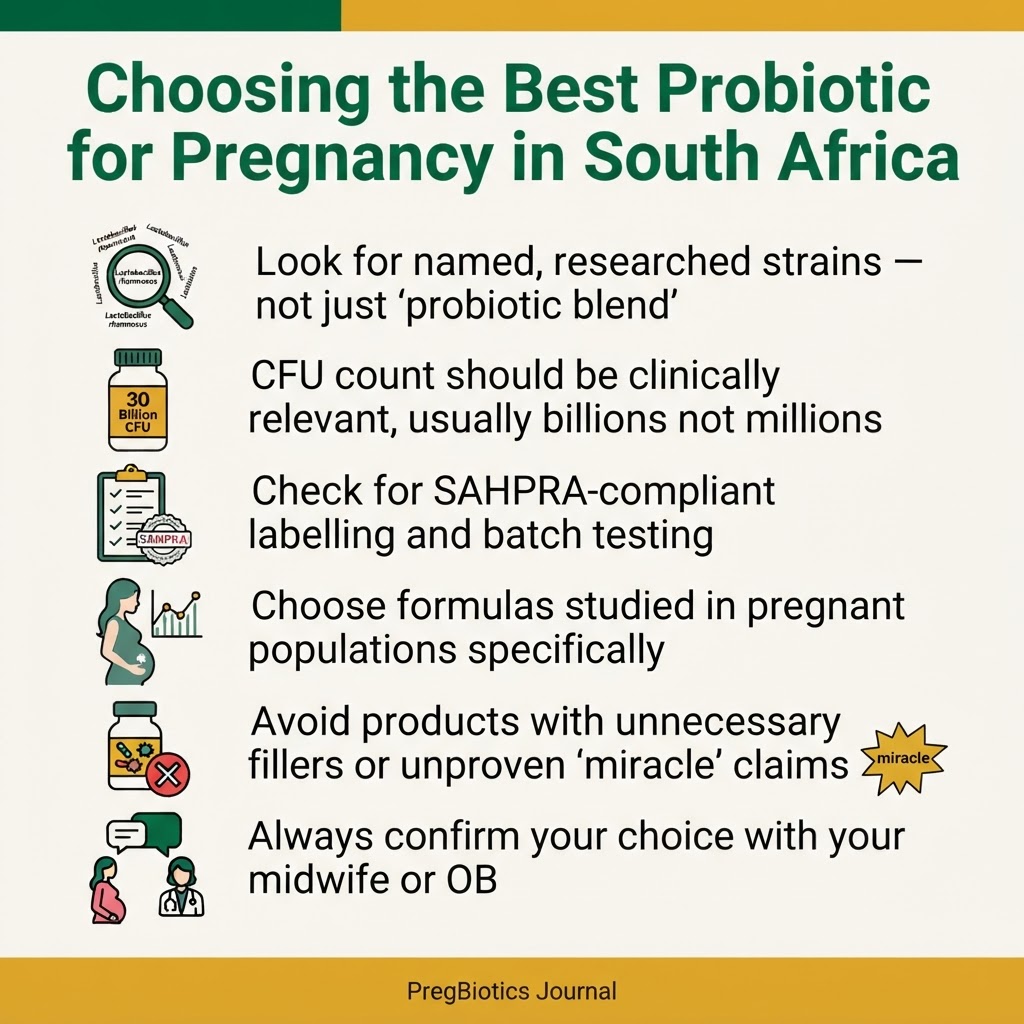
A Label-Reading Checklist for the Best Probiotic for Pregnancy in South Africa
Here's a practical checklist you can use in-store or online, whether you're comparing PregBiotics or any other option on South African shelves:
- Named strains — not vague terms like "proprietary blend"
- CFU count in the billions, measured at expiry, not just at manufacture
- Third-party testing for contaminants and potency
- Pregnancy-specific formulation rather than a generic adult probiotic repackaged
- Absence of unnecessary additives — artificial colourants, excessive fillers
- Transparent sourcing of the strains, ideally traceable to published research
If a product can't answer most of these points clearly on its packaging or website, that's a signal to keep researching before you buy. Our article on the science behind PregBiotics formulas walks through how these criteria translate into an actual product formulation, if you want a worked example.
Trimester-by-Trimester: Matching Your Probiotic to Your Needs
Your gut's needs shift as pregnancy progresses, and the "best" probiotic for you may depend on where you are in that journey.
First Trimester
Early pregnancy often brings digestive sensitivity. Formulas with gentler, well-tolerated strains may be more appropriate here, and many women prefer starting with a lower-dose introduction before increasing as tolerated — always guided by your healthcare provider.
Second and Third Trimester
As the pregnancy progresses, maternal gut composition naturally shifts, and some research has associated specific strains with supporting comfortable digestion and regularity during this period. This is also when many women start thinking ahead to Group B Streptococcus screening — a separate but related gut and vaginal microbiome topic we've explored extensively elsewhere on this journal.
Approaching Labour and Beyond
Some formulas are designed with the transition to breastfeeding in mind, given how maternal gut bacteria may influence the composition of breast milk. If you're planning ahead for this stage, our piece on how your gut microbiome shapes your breast milk offers useful context for what comes after delivery.
Red Flags: What to Avoid When Choosing a Pregnancy Probiotic
As you compare the best probiotic for pregnancy in South Africa, be cautious of:
- Overpromising language — phrases suggesting a product will eliminate a specific condition or deliver guaranteed outcomes
- No strain disclosure — if you can't identify exactly what's in the capsule, it's hard to know what evidence applies
- Unusually low pricing relative to the market, which can sometimes indicate under-dosed or poor-quality raw materials
- Lack of local distributor information, making it difficult to verify authenticity or report concerns
The World Health Organization has repeatedly emphasised that probiotic efficacy claims should be strain- and dose-specific, and consumers are encouraged to seek products backed by peer-reviewed research rather than anecdotal marketing (WHO).
"Claims of health benefits made for probiotic foods must be based on properly conducted intervention and clinical studies... generalised claims lacking strain-specific evidence should be viewed with caution." — FAO/WHO Expert Consultation on Probiotics
Why This Research-First Approach Matters
Choosing a probiotic shouldn't feel like gambling with your health or your baby's. The goal is simple: match your choice to real evidence, verify the manufacturing standards behind it, and loop in the person who knows your medical history best — your midwife, GP, or obstetrician.
If you'd like a deeper foundational understanding of how the gut microbiome actually works before and during pregnancy, our comprehensive guide, The Gut Microbiome 101, is a useful starting point.
Ultimately, "best" is personal. What matters most is that whatever you choose is backed by transparent science, manufactured to a high standard, and discussed with your healthcare provider as part of your overall prenatal care plan.
Your Simplest First Step
If you're ready to move from research to action, start by reviewing a formulation built specifically around pregnancy-appropriate, strain-specific evidence: PregBiotics Essentials. Bring the label to your next antenatal appointment and talk it through with your healthcare provider — that single conversation is the most important step in this whole process.
And if you found this guide useful, consider subscribing to the PregBiotics Journal for more evidence-based, South African-focused guidance on gut health through conception, pregnancy, and beyond.
Get the PregBiotics Journal in your inbox
Gut-smart guidance for conception, pregnancy and breastfeeding — twice a week, plus member-only offers. Unsubscribe anytime.
You deserve to feel beautifully supported.
Join thousands of mothers on the PregBiotics journey. Receive your free Pregnancy Prep Guide and gentle, science-backed wisdom — tailored to where you are right now.