Where to Buy PregBiotics: A Mother's Safety Checklist for Probiotics
Wondering where to buy PregBiotics safely? Dr Chuma explains how to spot quality, evidence-based probiotics for pregnancy, postpartum and breastfeeding.
Dr. Chomba Chuma, MD & Founder
MD & Founder, PregBiotics

When mothers ask me where to buy PregBiotics, they're rarely just asking about a website or a store shelf. They're asking a much bigger question: how do I know this is safe for my baby and me? As a doctor who has spent years studying the maternal microbiome, I understand why this matters so much — the supplement aisle (and the internet) is crowded with products that sound scientific but aren't built for the unique physiology of pregnancy, birth, and breastfeeding.
This guide isn't a sales pitch dressed up as advice. It's the same framework I'd want any expecting or new mother in my own family to use before she puts a probiotic capsule in her body. We'll cover what makes a probiotic genuinely appropriate for this life stage, the red flags that should make you close a browser tab immediately, and finally, where to buy PregBiotics if you decide it's the right fit for you.
Why "Where to Buy PregBiotics" Matters More Than You Think
Probiotics are not a single, interchangeable category. Strain, dose, manufacturing standard, and clinical testing all vary enormously between products — and during pregnancy, those differences are not academic.
Your gut microbiome shifts dramatically across the trimesters, influencing digestion, immune tolerance, and even mood regulation, as we've explored in Why Your Gut Health Changes Dramatically During Pregnancy. A probiotic designed for general digestive wellness in a non-pregnant adult may not have been evaluated in pregnant or breastfeeding populations at all.
That's the real reason the sourcing question matters. It's not brand loyalty — it's about ensuring the product in your hand has been formulated, tested, and manufactured with your specific physiology in mind.
"Probiotic strains are not interchangeable; safety and efficacy data for one strain cannot be extrapolated to another, even within the same species." — World Gastroenterology Organisation, Global Guidelines on Probiotics and Prebiotics, 2023
What Makes a Probiotic Safe for Pregnancy and Breastfeeding
Before you even think about where to purchase, it helps to know what you're looking for. A genuinely pregnancy-appropriate probiotic should meet several criteria.
Strain-specific transparency
The label should name the exact strains used (not just "Lactobacillus" broadly), because research on probiotic safety and benefit is strain-specific, not species-wide. This is a foundational point echoed throughout the Gut Microbiome 101 guide.
Documented CFU count at time of expiry
Colony-forming units (CFUs) should be guaranteed through the shelf life of the product, not just at the point of manufacture. Reputable brands publish this clearly.
Third-party testing
Independent laboratory verification for contaminants, potency, and label accuracy is a meaningful signal of quality control — something regulators in South Africa and abroad increasingly encourage but don't always mandate.
Evidence relevant to your stage
A formula intended for conception has different priorities than one intended for postpartum recovery or lactation support. Look for products that distinguish between these stages rather than offering one generic capsule for every mother.
"Clinicians should counsel patients that dietary supplements, including probiotics, are not subject to the same premarket approval process as medications, and quality can vary substantially between manufacturers." — American College of Obstetricians and Gynecologists (ACOG), Committee Opinion on Dietary Supplements
Red Flags: Where Not to Buy Pregnancy Probiotics
I've had patients bring me bottles purchased from unfamiliar third-party marketplace sellers, with strain names misspelled on the label and no batch number anywhere. These are the warning signs worth taking seriously.
- No named strains — only vague terms like "proprietary probiotic blend"
- No batch or lot number, making recalls or quality tracing impossible
- Prices dramatically below the manufacturer's own listed price, often a sign of counterfeit or expired stock
- Marketplace listings with no verified seller information or inconsistent packaging in photos
- Claims to "cure" morning sickness, "treat" infections, or "guarantee" outcomes — legitimate, compliant brands describe supplements as supportive, not curative
This last point deserves emphasis. A well-regulated probiotic brand will always describe its role in terms of supporting gut balance or may help with certain symptoms — never promising to treat or prevent a medical condition. If a listing makes bold medical claims, that's a signal to walk away, not toward.
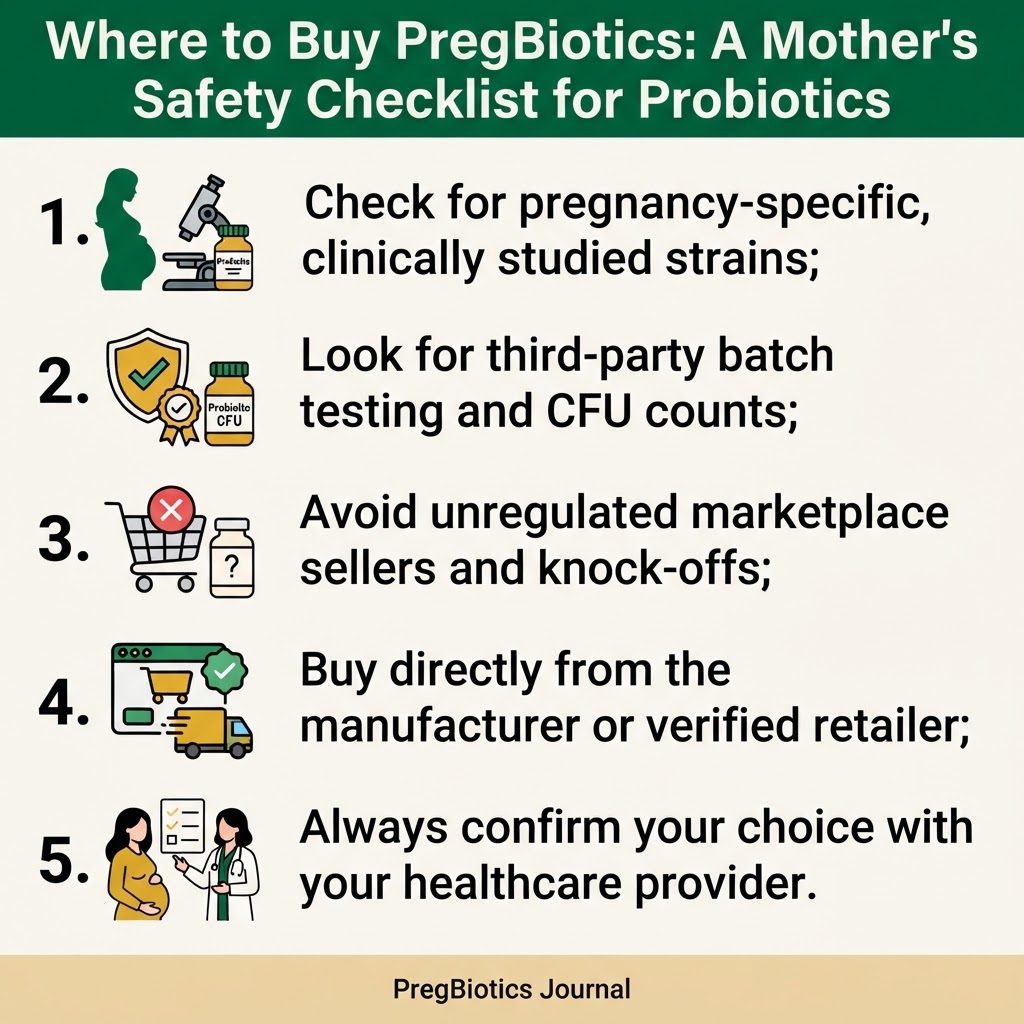
Where to Buy PregBiotics Safely
So, where does that leave you practically? Here is the checklist I recommend to every mother who asks me this question directly.
- Start with the manufacturer's own website. This is the only place you can be certain of batch freshness, correct formulation, and accurate stage-specific labelling.
- Confirm the seller is an authorised retailer if you prefer to shop through a pharmacy or health store — a quick check of the manufacturer's site usually lists verified stockists.
- Check for a South African-relevant supply chain. Products shipped and stored appropriately for local climate conditions reduce the risk of potency loss in transit.
- Look at formulation by life stage — conception, pregnancy, or breastfeeding formulas are not interchangeable, and buying the correct one matters more than buying quickly.
- Keep your proof of purchase and batch number in case you ever need to reference it with your healthcare provider or the manufacturer's support team.
For mothers specifically researching our formulations, the complete, currently available range — including conception, pregnancy, and breastfeeding-specific options — is listed on the official PregBiotics collection page. Buying directly through this channel is the most reliable way to ensure you receive an authentic, correctly stored product with the strain transparency and CFU guarantees described above.
Questions Worth Asking Before You Buy
A few simple questions can protect you from an unsuitable purchase, whether you're buying our formulas or comparing options.
- Does this product name its exact probiotic strains, not just genus and species?
- Is there a clear CFU guarantee through the expiry date, not just at manufacture?
- Has this formula been evaluated with pregnant or breastfeeding populations in mind, even if not through a full clinical trial?
- Is the seller a verified, traceable source — manufacturer website, authorised pharmacy, or listed stockist?
- Does the packaging and labelling match exactly what's shown on the brand's own official channels?
If you can answer yes to each of these, you're in a much stronger position to make an informed decision — one grounded in evidence rather than marketing noise.
How to Talk to Your Healthcare Provider About Probiotics
Even the best-sourced, most rigorously tested probiotic should be discussed with your midwife, GP, or obstetrician before you start it — particularly if you have a complex pregnancy, are managing gestational diabetes, or have a history of preterm labour. This is especially relevant if you've recently learned about Group B Streptococcus screening, as covered in our GBS awareness guide, since gut and vaginal microbiome support are often discussed together during antenatal visits.
Bring the product packaging (or a photo of the label) to your appointment. Ask specifically:
- "Is this strain and dose appropriate given my current pregnancy or breastfeeding stage?"
- "Are there any interactions with medications or conditions I currently have?"
- "Is there anything about my history that would make you recommend a different approach?"
This conversation is not a formality — it's the single most important safeguard you have, more valuable than any label claim.
"Women should be encouraged to discuss all supplement use, including probiotics, with their antenatal care provider as part of routine care." — NICE, Antenatal Care Guideline (NG201)
For a deeper look at the clinical reasoning and formulation philosophy behind our own products, our article on The Science Behind PregBiotics walks through exactly how strain selection and dosing decisions were made — useful reading to bring into that conversation with your provider.
The Bigger Picture: Sourcing as an Act of Self-Advocacy
It's easy to think of "where to buy" as a logistical afterthought — something you sort out after the real decision has been made. But in maternal health, sourcing is part of the clinical decision. A perfectly designed strain, poorly stored or counterfeited, offers none of its intended benefit and may introduce unnecessary risk.
Think of verifying your source the same way you'd think of checking an expiry date on a medication, or confirming a car seat meets safety standards before a long drive. It's not excessive caution — it's the ordinary diligence that comes with caring for two people at once, or, in early postpartum, caring for a newborn whose own microbiome is still being shaped by what you consume, a relationship explored in depth in How Your Gut Microbiome Shapes Your Breast Milk.
Research published via the National Institutes of Health continues to underscore how variable commercial probiotic quality can be across brands, reinforcing why sourcing decisions carry real clinical weight, not just consumer preference. You can review some of this research directly through PubMed and the World Health Organization's guidance on dietary supplements.
Your Simplest Next Step
If you've read this far, you already understand more about sourcing a safe, pregnancy-appropriate probiotic than most product labels will ever tell you. The simplest next step is this: visit the official PregBiotics range, identify the formula that matches your current stage — conception, pregnancy, or breastfeeding — and bring it up with your healthcare provider at your next appointment before starting.
If you'd like more guidance like this delivered straight to you, consider subscribing to the PregBiotics Journal, where we translate the latest maternal microbiome research into practical, doctor-reviewed guidance for every stage of your motherhood journey.
Get the PregBiotics Journal in your inbox
Gut-smart guidance for conception, pregnancy and breastfeeding — twice a week, plus member-only offers. Unsubscribe anytime.
You deserve to feel beautifully supported.
Join thousands of mothers on the PregBiotics journey. Receive your free Pregnancy Prep Guide and gentle, science-backed wisdom — tailored to where you are right now.