The Science Behind PregBiotics: What Makes Our Formulas Different
Imagine this: you're twelve weeks pregnant, navigating morning sickness, food aversions, and a growing stack of supplement bottles on your kitchen counter. A well-meaning friend hands you a generic probiotic from the supermarket shelf and says, You want to believe her. You really do. But something
Dr. Chomba Chuma, MD & Founder
MD & Founder, PregBiotics

The Science Behind PregBiotics: What Makes Our Formulas Different
By Dr. Chomba Chuma, MD & Founder | PregBiotics Journal
Introduction: More Than Just a Probiotic in a Capsule
Imagine this: you're twelve weeks pregnant, navigating morning sickness, food aversions, and a growing stack of supplement bottles on your kitchen counter. A well-meaning friend hands you a generic probiotic from the supermarket shelf and says, "This helped me loads during pregnancy." You want to believe her. You really do. But something inside you asks — is this actually designed for me, for this stage of my life, for what's happening inside my body right now?
That question is exactly why PregBiotics exists.
Here is a statistic that still surprises many of the mothers I speak with: research published in the journal Nutrients suggests that the composition of a mother's gut microbiome during pregnancy directly influences not only her own metabolic and immune health, but also the early microbial colonisation of her newborn — a process now understood to have lifelong consequences for the child's immunity, allergy risk, and even cognitive development.
That is not a small thing. That is foundational.
And yet, the majority of probiotic supplements on the market today were never designed with pregnant or breastfeeding women in mind. They are generic, often under-dosed, and built on limited science specific to the maternal journey.
In this article, I want to walk you through the actual science behind PregBiotics — the research that shapes our formulas, the specific probiotic strains we've selected and why, and what truly separates a science-led maternal supplement from everything else on the shelf. Whether you're newly pregnant, in your third trimester, or navigating the postpartum period, this is the transparency you deserve.
The Gut Microbiome in Pregnancy: A Biological Revolution Most People Miss
Your Gut Is Not Static — Especially During Pregnancy
Most people think of their gut microbiome as a fixed ecosystem — something you either have in good shape or you don't. The reality is far more dynamic, and during pregnancy, it undergoes some of the most dramatic shifts of a woman's entire life.
From the first trimester through to the third, the maternal gut microbiome evolves in ways that are now understood to be intentional and adaptive. A landmark study by Koren et al., published in Cell, demonstrated that the third-trimester microbiome looks almost inflammatory when compared to the first — with increased populations of bacteria associated with metabolic activity and immune priming. In a non-pregnant individual, this profile might signal dysfunction. In a pregnant woman, it appears to support the energy demands of late pregnancy and prime the immune environment for birth and early lactation.
This tells us something profound: the pregnant gut is operating by different biological rules.
The Immune-Gut Connection
Approximately 70–80% of your immune system is housed in and around the gut. During pregnancy, the immune system must perform a remarkable balancing act — tolerating the "foreign" genetic material of your growing baby while still protecting you from genuine threats like infection.
The gut microbiome plays a central role in this modulation. Beneficial bacteria communicate with immune cells through the gut-associated lymphoid tissue (GALT), helping to regulate inflammatory responses, train immune tolerance, and maintain the integrity of the gut lining. When this balance is disrupted — a state known as dysbiosis — the consequences can include increased inflammation, gestational complications, and altered immune programming in the newborn.
Vertical Transmission: You Are Seeding Your Baby's Microbiome
One of the most extraordinary aspects of maternal gut health is vertical transmission — the process by which a mother's microbiome directly seeds her baby's developing microbiome. This begins in utero (through mechanisms we are still researching), continues through vaginal birth, and is significantly extended through breastfeeding and skin-to-skin contact.
The quality and diversity of the mother's microbial environment during pregnancy and lactation has been shown to influence the infant's risk of eczema, asthma, colic, and even mood regulation later in childhood. This is precisely why optimising maternal gut health is not a "nice to have" — it is a clinical priority.
This is the biological foundation upon which every PregBiotics formula is built.
What This Means For You as a Mother
Understanding the science is one thing. But what does it actually look like in your body, your pregnancy, your daily experience? Let me translate the research into something real and tangible.
Signs That Your Gut Microbiome May Need Support During Pregnancy
Many women dismiss gut-related symptoms as "just part of pregnancy." And while some discomfort is normal, persistent symptoms can signal underlying dysbiosis that is worth addressing:
- Constipation or irregular bowel movements — extremely common in pregnancy due to hormonal changes slowing gut motility, but often worsened by microbiome imbalance
- Bloating and excessive gas — while progesterone relaxes smooth muscle (including in the gut), dysbiosis can dramatically amplify these symptoms
- Recurring thrush or bacterial vaginosis — the vaginal microbiome is closely linked to the gut microbiome; imbalance in one often reflects imbalance in the other
- Persistent fatigue beyond expected pregnancy tiredness — gut inflammation can contribute to systemic fatigue through immune and mitochondrial pathways
- Mood changes and heightened anxiety — the gut-brain axis is bidirectional; gut dysbiosis has been linked to elevated cortisol and altered serotonin production, over 90% of which is synthesised in the gut
- Frequent minor infections or slow recovery — indicative of compromised immune modulation through the gut
Why Generic Probiotics Often Fall Short
The probiotic market is crowded, and not all products are equal — especially for pregnant women. Here is what most generic probiotics miss:
- They use non-pregnancy-specific strains that have not been studied in maternal populations
- They are often under-dosed — many products contain insufficient colony-forming units (CFUs) to reach and colonise the gut effectively
- They lack prebiotic co-factors that help beneficial bacteria survive transit and thrive in the gut environment
- They do not account for trimester-specific needs, which change significantly from the first to the third trimester and into the postpartum period
- They rarely consider the safety profile specific to pregnancy — not all probiotic strains have been evaluated for safety in pregnant women
Understanding this gap is what drove me to develop the PregBiotics Range from the ground up.
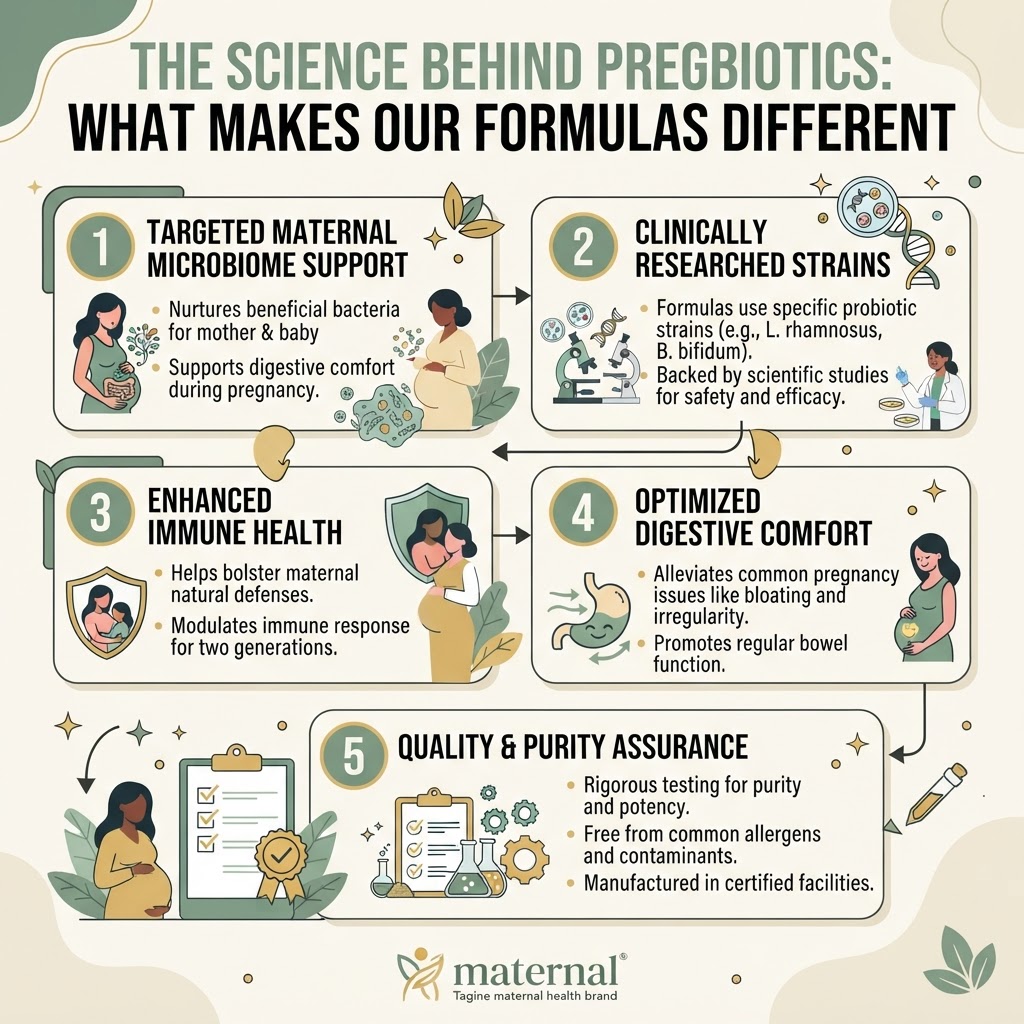
The Role of Clinically Researched Strains and Thoughtful Formulation
PregBiotics Science: Built on Evidence, Not Trends
Every formula in the PregBiotics Range starts with one question: What does the published clinical evidence actually show for pregnant and breastfeeding women?
This means we do not add a strain because it's popular. We include it because it has demonstrated safety and efficacy in maternal or closely related populations, has been characterised in peer-reviewed literature, and contributes meaningfully to the specific health outcomes we are targeting.
The World Health Organization defines probiotics as "live microorganisms that, when administered in adequate amounts, confer a health benefit on the host." The key words here are adequate amounts and health benefit — both of which require specific, evidence-based decision-making.
Key Probiotic Strains in Pregnancy We Prioritise
When selecting probiotic strains for pregnancy, the following are among the most clinically supported:
- Lactobacillus rhamnosus GG (LGG) — one of the most extensively studied probiotic strains globally, with evidence supporting reduced risk of gestational diabetes, eczema prevention in offspring, and immune modulation in mothers
- Lactobacillus reuteri DSM 17938 — shown to reduce colic in breastfed infants and support maternal vaginal microbiome health; also linked to improved infant weight gain in early life
- Lactobacillus acidophilus NCFM — supports lactase activity (important for dairy digestion during pregnancy), immune response, and gut barrier integrity
- Bifidobacterium lactis Bi-07 — critical for immune regulation and particularly important in the third trimester and postpartum period when immune demands are highest
- Lactobacillus crispatus — a key vaginal coloniser that, when supported through the gut-vaginal axis, may reduce risk of preterm birth associated with bacterial vaginosis
Beyond Probiotics: The Full Formulation Philosophy
PregBiotics formulas go beyond isolated probiotic strains. Our approach integrates:
- Prebiotic fibres (FOS and GOS) — to nourish beneficial bacteria and extend their survival and efficacy in the gut
- Postbiotics — beneficial metabolites produced by probiotic bacteria, including short-chain fatty acids (SCFAs) that support gut lining integrity
- Targeted micronutrients — including folate (as methylfolate for superior bioavailability), iodine, vitamin D3, and magnesium glycinate, selected for their synergistic role in maternal and foetal health
- Clean, pregnancy-safe excipients — no artificial colours, no unnecessary fillers, and full transparency on every label
For mothers navigating the postpartum and breastfeeding period specifically, the PregBiotics Breastfeeding formula extends this philosophy with strains and nutrients calibrated to the unique demands of lactation and newborn microbiome seeding.
Expert Tips: How to Get the Most from Your Gut Health Supplements as a Mother
The best supplement is one that you take consistently and that works synergistically with your lifestyle. Here are my evidence-informed recommendations:
-
Start before conception if possible. The preconception window — ideally three to six months before trying to conceive — is one of the most impactful times to optimise your gut microbiome. The changes you make now set the baseline for your entire pregnancy.
-
Take your probiotic at the same time each day. Consistency matters more than timing, but many women find that taking probiotics with their evening meal reduces any initial adjustment symptoms like mild bloating.
-
Pair with a diverse, fibre-rich diet. No supplement replaces food. Aim for 30 different plant foods per week — this diversity feeds the diversity of your microbiome and amplifies the effect of your probiotic supplement.
-
Limit unnecessary antibiotic use — but never avoid antibiotics when medically necessary. If you do require antibiotics during pregnancy, use a probiotic alongside (at a different time of day) and for at least four weeks post-course to support microbiome recovery.
-
Be aware of Group B Streptococcus (GBS). GBS colonisation is screened routinely in late pregnancy and is a significant cause of neonatal infection. Emerging research suggests that a balanced maternal microbiome may influence GBS colonisation rates. Learn more in our dedicated GBS Shield resource.
-
Manage stress actively. The gut-brain axis means that psychological stress directly alters gut microbiome composition. Practices like mindful breathing, gentle prenatal yoga, and adequate sleep are not luxuries — they are microbiome medicine.
-
Stay well hydrated. Prebiotic fibres — and the gut motility changes of pregnancy — require good hydration to function optimally. Aim for at least 2–2.5 litres of water daily.
-
Don't discontinue postpartum. The fourth trimester is a critical window for microbiome recovery, immune recalibration, and — if breastfeeding — ongoing transfer of beneficial bacteria to your baby. Your gut health needs do not end at birth.
-
Read labels carefully. Look for CFU counts at time of expiry (not manufacture), strain-specific names (not just genus), and transparent ingredient lists. If a supplement does not tell you exactly what strains are in it, that is a red flag.
-
Ask your healthcare provider about gut health proactively. Many clinicians are not yet trained in the depth of microbiome science relevant to pregnancy — bring the conversation to them, and bring the evidence.
When to Seek Medical Advice
While optimising your gut health through diet and evidence-based supplementation is appropriate for most pregnant women, there are situations where medical guidance is essential before starting or continuing any supplement programme:
- If you have a history of immunosuppression — including HIV, autoimmune conditions requiring immune-modulating medication, or organ transplant — probiotics require medical clearance, as there are theoretical (though rare) risks in severely immunocompromised individuals
- If you experience severe gastrointestinal symptoms — persistent diarrhoea, blood in stool, severe abdominal pain, or significant unexplained weight loss should always be investigated medically before attributing them to dysbiosis
- If you have a high-risk pregnancy — including preterm labour history, cervical incompetence, or placenta praevia — always discuss supplement use with your obstetrician or midwife
- If you are considering supplementation for your newborn — infant probiotic use should always be guided by a paediatric healthcare professional
The NHS guidance on supplements in pregnancy is a useful reference, and I always encourage my patients to bring this conversation to their midwife, GP, or obstetrician at every antenatal appointment.
PregBiotics supplements are designed to complement — never replace — individualised medical care.
Conclusion: You Deserve Science That Was Built For You
The maternal journey is one of the most biologically extraordinary experiences a human body can undergo. It demands more — more nutrients, more immune precision, more microbial balance — and it deserves more in return from the health and wellness industry.
PregBiotics was not born from a trend or a marketing opportunity. It was born from a clinical frustration: that so many of the mothers I was seeing were taking supplements that simply were not designed for their reality. They deserved formulas rooted in PregBiotics science — in the specific, peer-reviewed, maternal-focused evidence that tells us which probiotic strains pregnancy outcomes depend on, what clinically researched probiotics actually look like in practice, and how gut health supplements for mothers should be formulated differently from the start.
Every ingredient we include has a reason. Every strain has a study. Every formula has been designed with the full arc of the maternal journey in mind — from preconception through pregnancy, birth, and the breastfeeding relationship beyond.
You are not just a consumer purchasing a supplement. You are a mother making a decision that matters — for you and for the small, remarkable person growing within you or feeding from you. That decision deserves transparency, rigour, and genuine care.
I hope this article has given you not just information, but confidence. The kind of confidence that comes from understanding the why behind what you're taking.
For more evidence-based guides, trimester-specific advice, and the latest in maternal gut health research, visit The PregBiotics Journal — where science meets motherhood, every single week.
Dr. Chomba Chuma, MD, is the founder of PregBiotics and a practising physician with a specialist interest in maternal microbiome health, integrative obstetrics, and early-life immunity. All content in the PregBiotics Journal is evidence-informed and reviewed for clinical accuracy.
Get the PregBiotics Journal in your inbox
Gut-smart guidance for conception, pregnancy and breastfeeding — twice a week, plus member-only offers. Unsubscribe anytime.
You deserve to feel beautifully supported.
Join thousands of mothers on the PregBiotics journey. Receive your free Pregnancy Prep Guide and gentle, science-backed wisdom — tailored to where you are right now.