Nausea All Day Pregnancy: What Helps When It Won't Let Up
Struggling with nausea all day, not just mornings? Discover why it happens and what helps—gut-focused, evidence-informed relief for South African mums-to-be.
Dr. Chomba Chuma, MD & Founder
MD & Founder, PregBiotics

If you've been Googling "nausea all day pregnancy what helps" at 2pm, 6pm, and again at midnight, you are not imagining it and you are not alone. For many mothers, so-called "morning sickness" is a misnomer—queasiness can roll in waves from the moment you wake until the moment you (finally) fall asleep. Understanding why this happens, and what genuinely helps, can make the difference between surviving the first trimester and actually functioning through it.
As a doctor who has sat across from countless exhausted, nauseated mothers, I want to walk you through the physiology behind all-day nausea, the strategies with real evidence behind them, and the warning signs that mean it's time to call your healthcare provider.
Why Pregnancy Nausea Isn't Just a Morning Problem
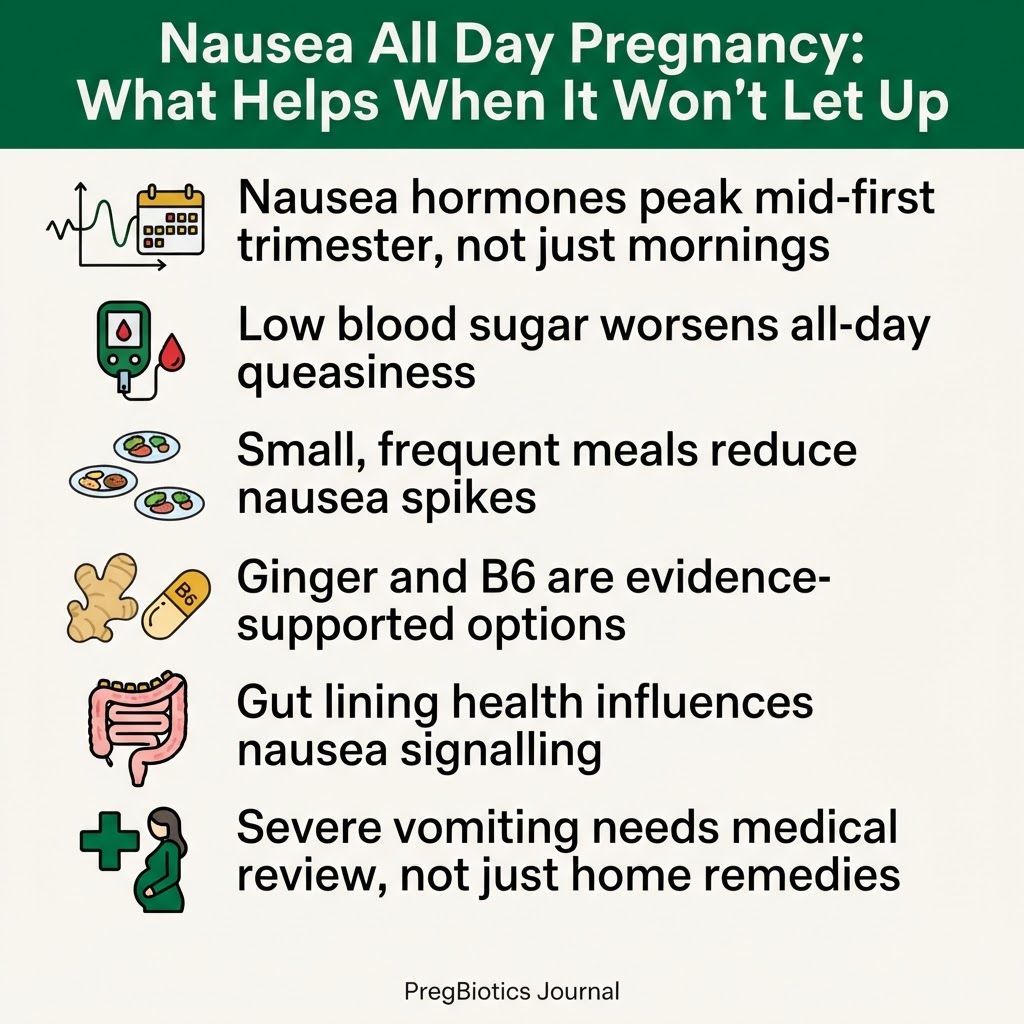
The term "morning sickness" is widely used, but research tells a more nuanced story. Rising human chorionic gonadotropin (hCG) and oestrogen levels affect the part of the brain that controls nausea and vomiting, and these hormones don't switch off after breakfast—they circulate continuously, which is why symptoms can flare at any hour.
Your vagus nerve, which links your gut and brain, is highly sensitive during early pregnancy. Low blood sugar, strong smells, an empty stomach, or even stress can trigger it at 3pm just as easily as 7am. This is also why nausea often worsens on an empty stomach, regardless of the clock.
"Nausea and vomiting of pregnancy affects up to 80% of pregnant women and is not limited to morning hours; symptoms frequently persist throughout the day." — American College of Obstetricians and Gynecologists (ACOG), Practice Bulletin on Nausea and Vomiting of Pregnancy
Understanding that this is a full-day hormonal and neurological process—not a personal failing or an exaggeration—is often the first relief mothers feel.
Nausea All Day Pregnancy: What Helps You Get Through It
There is no single switch to flip, but several small, consistent habits can meaningfully reduce the intensity and frequency of waves throughout the day. Here is what the evidence and clinical experience support:
- Eat before you feel hungry. An empty stomach amplifies nausea. Small amounts every 2–3 hours, even just crackers or a banana, help stabilise things.
- Keep protein nearby. A boiled egg, a handful of nuts, or plain yoghurt between meals may blunt nausea spikes better than carbohydrates alone.
- Sip, don't gulp. Dehydration worsens nausea, but large volumes at once can trigger it. Small sips of water, rooibos tea, or electrolyte solutions work best.
- Try ginger in a form you can tolerate. Ginger tea, ginger biscuits, or ginger capsules have reasonable evidence for mild-to-moderate nausea relief in pregnancy.
- Ask about vitamin B6. Pyridoxine (vitamin B6) is recommended as a first-line option by several international guidelines, often alongside doxylamine when needed.
- Reduce smell triggers. Cooking smells, perfumes, and even toothpaste can set off nausea. Cold or room-temperature foods often have less odour than hot meals.
- Rest when you can. Fatigue and nausea feed each other; even short rest periods can lower symptom intensity.
"Vitamin B6 (pyridoxine), alone or in combination with doxylamine, is recommended as first-line pharmacotherapy for nausea and vomiting of pregnancy where lifestyle measures are insufficient." — National Institute for Health and Care Excellence (NICE), Antenatal Care Guideline
If you've already tried lifestyle changes from our earlier piece on morning sickness relief and symptoms are stubbornly all-day rather than time-limited, the next layer worth exploring is your gut environment itself.
The Gut Connection You Might Not Expect
Most mothers don't realise that the gut lining and its resident microbes play a role in how nausea signals are generated and transmitted. A large proportion of the body's serotonin—a neurotransmitter closely tied to nausea and vomiting—is produced in the gut, not the brain.
When the gut environment is disrupted (which can happen quickly in early pregnancy due to hormonal shifts, slower digestion, and dietary changes), this serotonin signalling can become more erratic, potentially intensifying nausea waves. This doesn't mean your gut "causes" morning sickness, but it may influence how strongly and how often you feel it.
This is one reason we've written at length about how gut health changes dramatically during pregnancy—because the digestive system is far more central to how you feel day-to-day than most mothers are told.
Blood Sugar, Hydration and the All-Day Nausea Cycle
One of the most overlooked contributors to all-day nausea is the blood sugar rollercoaster. Skipping meals, relying on sugary snacks, or going too long between eating can cause blood glucose to dip, which the body interprets as a stress signal—worsening nausea on top of pregnancy hormones.
A simple pattern many mothers find helpful:
- Eat a small protein-containing snack within 30 minutes of waking, even before getting out of bed if needed.
- Avoid more than 3 hours without any food during the day.
- Pair carbohydrates with protein or fat (e.g., crackers with peanut butter) to slow blood sugar spikes and crashes.
- Keep a bottle of water or electrolyte drink within reach at all times, especially if vomiting is occurring.
Dehydration doesn't just worsen nausea—it can also contribute to constipation, headaches, and fatigue, compounding an already difficult trimester. If constipation has crept in alongside your nausea, our dedicated guide on natural constipation relief in pregnancy covers this in more depth.
When All-Day Nausea Signals Something More
Most nausea and vomiting of pregnancy (NVP), even when it lasts all day, is uncomfortable but not dangerous. However, a smaller percentage of mothers experience hyperemesis gravidarum (HG)—a more severe form that requires medical attention.
Contact your healthcare provider promptly if you notice:
- Inability to keep any food or fluids down for more than 24 hours
- Signs of dehydration: dark urine, dizziness, rapid heartbeat
- Losing more than 5% of your pre-pregnancy body weight
- Vomiting blood or very dark material
- Extreme weakness or fainting
This is not a situation to "push through" with home remedies alone. Hyperemesis gravidarum is a recognised medical condition that may require IV fluids, medication, or hospital monitoring, and early treatment generally leads to better outcomes for both mother and baby.
"Hyperemesis gravidarum is estimated to affect 0.3–3% of pregnancies and is associated with dehydration, electrolyte imbalance, and weight loss requiring clinical management." — World Health Organization technical consultation on maternal nutrition
If you're uncertain whether what you're experiencing is "normal" all-day nausea or something more severe, it is always appropriate to speak to your healthcare provider rather than guess. You know your body, and persistent concern is reason enough to be seen.
Supporting Your Gut Through the Hardest Weeks
While no supplement or remedy eliminates nausea entirely, many mothers find that supporting their underlying gut environment—alongside the strategies above—helps them feel steadier as the weeks progress. A settled, well-supported gut may also ease some of the knock-on effects of nausea, such as reduced appetite and disrupted digestion.
This is part of why targeted prenatal probiotic support, alongside food-first strategies, has become a more common conversation between mothers and their healthcare providers during the first trimester. It is not a replacement for medical care when nausea is severe, but rather a complementary layer of support for day-to-day resilience.
For a deeper look at how the gut microbiome shifts in early pregnancy and why it matters beyond nausea alone, our guide on the gut microbiome 101 for mothers is a useful next read.
Additional research on nausea and vomiting of pregnancy and its management can be found through the National Institutes of Health PubMed database and the World Health Organization maternal health resources, both of which are regularly updated with current clinical guidance.
Your Simplest First Step
If today has felt like one long wave of nausea with no clear "morning" or "evening," start small: eat something light before you feel hungry, sip water consistently, and consider whether your gut health routine needs extra support during this demanding trimester.
PregBiotics Essentials was formulated with first-trimester mothers in mind, offering gut-focused support alongside the food-first strategies outlined above. You can explore it here: PregBiotics Essentials.
And if you'd like more evidence-based, compassionate guidance delivered straight to you as your pregnancy progresses, subscribe to the PregBiotics Journal—we're here for every stage, every symptom, and every question you haven't asked yet.
Get the PregBiotics Journal in your inbox
Gut-smart guidance for conception, pregnancy and breastfeeding — twice a week, plus member-only offers. Unsubscribe anytime.
You deserve to feel beautifully supported.
Join thousands of mothers on the PregBiotics journey. Receive your free Pregnancy Prep Guide and gentle, science-backed wisdom — tailored to where you are right now.