Group B Strep in Pregnancy: What It Means for Your Birth Plan
Learn what a Group B Strep result in pregnancy actually means, what happens during labour, and how to feel calm and prepared with your care team.
Dr. Chomba Chuma, MD & Founder
MD & Founder, PregBiotics

When a nurse mentions "Group B Strep" at one of your late pregnancy visits, it's easy to feel a jolt of anxiety before you even understand what she's talking about. Understanding group b strep in pregnancy what it means — for you, your labour, and your baby — is one of the most reassuring things you can do in your final weeks. This isn't about something you did wrong. It's about a very common bacterium that your care team simply wants to plan around.
As a doctor who has sat across from many worried mothers holding a lab form, I want to walk you through this calmly, piece by piece, so the result on that page stops feeling like a verdict and starts feeling like information.
What a GBS Result in Pregnancy Actually Means
Group B Streptococcus (GBS) is a type of bacteria that lives naturally in the vagina or rectum of roughly one in four women, often without causing any symptoms at all. It isn't a sexually transmitted infection, and it isn't a sign of poor hygiene.
Carrying GBS means your body is simply one of many that host this organism as part of its normal microbial landscape. The concern isn't for you — it's about the small chance of exposure to your baby during a vaginal birth.
"Approximately 1 in 4 pregnant women carry group B strep bacteria, usually without any symptoms, and most babies who are exposed do not become unwell." — CDC, Group B Strep Information for Pregnant Women
This single fact changes everything about how to hold this diagnosis. It is a logistics question for your birth team, not a reflection of your health or your pregnancy's success.
Group B Strep in Pregnancy: What It Means at Different Stages
Timing matters a great deal when it comes to GBS, and this is where confusion often creeps in.
- Early pregnancy: GBS isn't routinely tested for, because your microbial status can change as pregnancy progresses.
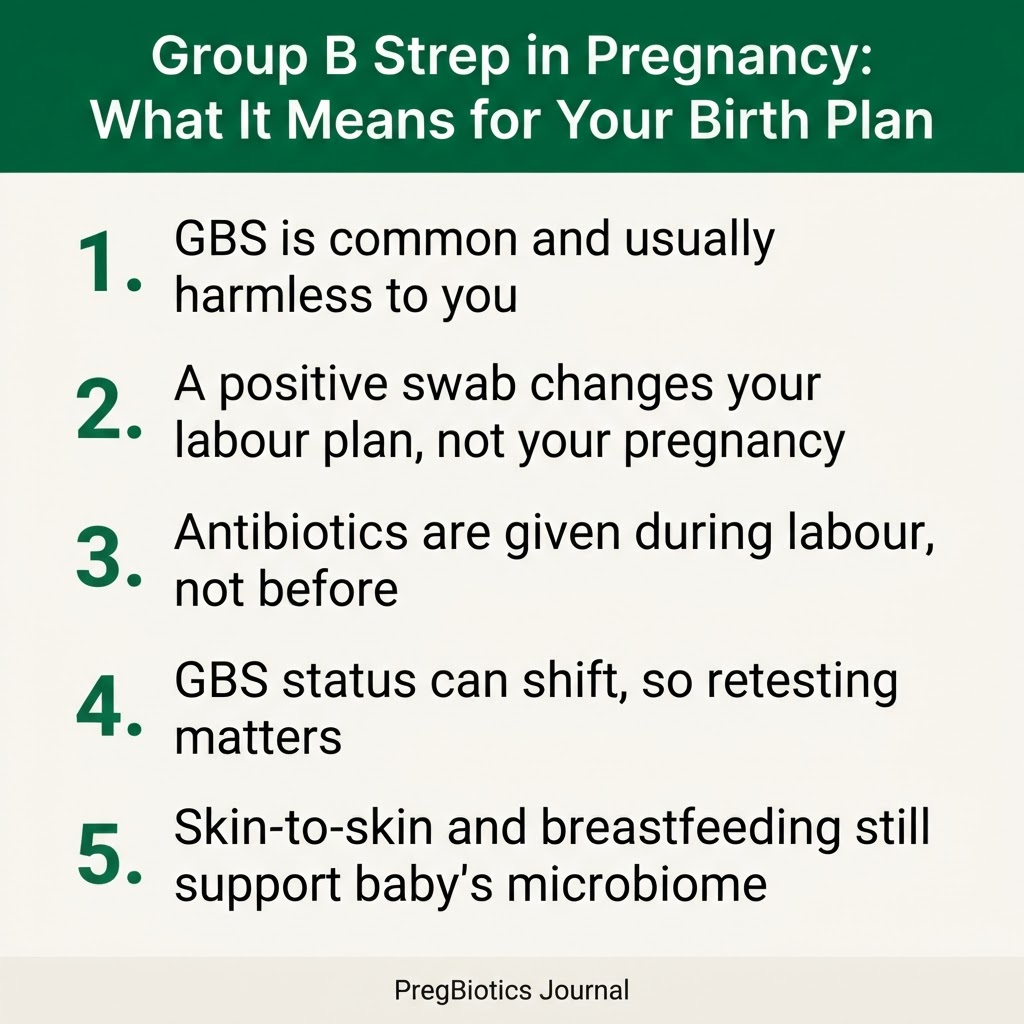
- Around 36–37 weeks: Most guidelines recommend a vaginal-rectal swab close to this window, since this is the period most predictive of your status at labour.
- During labour: If you test positive, intravenous antibiotics are typically offered once labour starts or your waters break — not days or weeks beforehand.
This staged approach exists because GBS colonisation can come and go. A negative result at 28 weeks tells your provider very little about 38 weeks, which is why the later swab is the one that matters most for your birth plan.
If you're curious about the screening process itself step-by-step, our earlier piece on GBS screening, risk, and prevention walks through exactly what the swab involves and when it's offered.
Why a Positive Result Doesn't Mean a Different Pregnancy
A positive GBS swab does not change how your baby grows, how your placenta functions, or how the rest of your pregnancy unfolds. It changes one specific thing: the plan for labour and delivery.
Knowing this distinction early can spare you weeks of unnecessary worry between your swab and your due date.
What Happens During Labour If You're GBS Positive
This is usually the part mothers most want clarity on, so let's be concrete.
- You'll typically receive intravenous penicillin or an alternative antibiotic once labour begins.
- Ideally, this is given at least four hours before delivery to allow it to work.
- Your baby will usually still room in with you, feed, and be monitored as normal afterward.
- If labour moves very quickly, your team has protocols for monitoring your baby closely rather than panicking.
"Intrapartum antibiotic prophylaxis is highly effective at reducing the risk of early-onset group B streptococcal disease in newborns." — American College of Obstetricians and Gynecologists (ACOG)
For context on how intrapartum antibiotics fit into the broader picture of newborn risk, the National Center for Biotechnology Information offers a detailed clinical overview worth bookmarking: GBS Overview, NCBI StatPearls.
If You're Planning a Caesarean
If your birth plan already includes a scheduled caesarean before labour begins and before your waters break, antibiotics for GBS are often not required in the same way, since the exposure pathway is different. This is worth discussing directly with your obstetrician so your specific plan is tailored to you.
Common Myths That Make GBS Feel Scarier Than It Is
Misinformation is often what turns a manageable result into sleepless nights. Let's clear up a few things.
- Myth: A positive result means something is wrong with me. Truth: it reflects normal bacterial flora, not illness.
- Myth: I'll need antibiotics for the rest of my pregnancy. Truth: antibiotics are only given during labour itself.
- Myth: My baby will definitely be affected. Truth: most exposed babies never develop any symptoms, especially with appropriate intrapartum care.
- Myth: I caused this through diet or hygiene. Truth: colonisation isn't linked to lifestyle choices in this way.
Holding accurate information doesn't just ease anxiety — it also helps you ask better questions at your next appointment.
Supporting Your Body Through Labour Preparation
While GBS status itself isn't something you can control through diet alone, the weeks leading into labour are a good time to focus on what you can support: energy, digestion, and overall resilience.
Many mothers find this stretch of pregnancy easier when they're not also battling constipation or bloating on top of appointment anxiety. If sluggish digestion has been part of your third trimester, our guide on natural relief for pregnancy constipation may be a helpful companion read right now.
A daily probiotic formulated for this life stage, such as PregBiotics Essentials, is one simple way some mothers choose to support general gut comfort as they approach labour — always alongside, never instead of, your medical care plan.
After Birth: What Comes Next for You and Baby
Once your baby arrives, GBS status from pregnancy doesn't follow them indefinitely. Paediatric teams typically monitor newborns closely in the first 24–48 hours regardless of exposure, watching for signs like feeding difficulty, unusual breathing patterns, or temperature changes.
Skin-to-skin contact and early breastfeeding remain encouraged and valuable, continuing the natural exchange of maternal microbes that begins at birth. If you're curious about that broader process, we've explored it in depth in how your gut microbiome shapes your breast milk.
"Most infants exposed to GBS during delivery remain well; ongoing newborn observation protocols are designed to catch the rare cases that need extra attention early." — World Health Organization, Maternal and Newborn Health guidance
For a deeper look at the global data behind these newborn observation protocols, the WHO's maternal health resources are a credible starting point: WHO Maternal Health.
When to Contact Your Healthcare Provider
Trust your instincts, but also know the specific signals worth a call.
- Your waters break and you haven't yet discussed your GBS status with your team
- You develop a fever during labour
- Your newborn seems unusually floppy, has trouble feeding, or their breathing seems laboured in the first days
- You simply have questions your midwife or OB hasn't fully answered yet
There is no such thing as an unnecessary question when it comes to your baby's first hours. Speak to your healthcare provider early and often — this is exactly what they're there for.
Your Simplest Next Step
If you're approaching your 36-week mark and haven't yet discussed GBS screening timing with your midwife or doctor, that conversation is the single most useful thing you can do this week. Everything else — the antibiotics protocol, the newborn monitoring, the birth plan adjustments — flows naturally once that swab is scheduled and understood.
While you wait for that appointment, many mothers find comfort in supporting the basics they can influence, like daily gut comfort through pregnancy. You can explore PregBiotics Essentials or browse the full PregBiotics range to find the formula that fits where you are right now.
And if you'd like more clear, judgment-free guidance like this delivered straight to you, subscribe to the PregBiotics Journal — we're here for every stage, one honest article at a time.
Get the PregBiotics Journal in your inbox
Gut-smart guidance for conception, pregnancy and breastfeeding — twice a week, plus member-only offers. Unsubscribe anytime.
You deserve to feel beautifully supported.
Join thousands of mothers on the PregBiotics journey. Receive your free Pregnancy Prep Guide and gentle, science-backed wisdom — tailored to where you are right now.