The Science Behind PregBiotics: What Makes Our Formulas Different
Imagine this: you're twelve weeks pregnant, navigating morning sickness, decoding food labels, and trying to remember which supplements your midwife mentioned at your last appointment. You walk into a pharmacy, scan the shelves, and find yourself staring at dozens of probiotic products — each one cl
Dr. Chomba Chuma, MD & Founder
MD & Founder, PregBiotics

The Science Behind PregBiotics: What Makes Our Formulas Different
By Dr. Chomba Chuma, MD & Founder | PregBiotics Journal
Introduction: When "Just Take a Probiotic" Isn't Enough
Imagine this: you're twelve weeks pregnant, navigating morning sickness, decoding food labels, and trying to remember which supplements your midwife mentioned at your last appointment. You walk into a pharmacy, scan the shelves, and find yourself staring at dozens of probiotic products — each one claiming to be "the best." So you pick the one with the prettiest packaging, hope for the best, and wonder quietly whether it's actually doing anything meaningful for you or your growing baby.
If that sounds familiar, you're not alone. I hear a version of this story from mothers every single week.
Here's a statistic that might surprise you: a 2021 review published in Nutrients found that the majority of commercially available probiotic supplements contain strains that have never been specifically studied in pregnant populations. That means most of what's on the market is essentially a general gut product repackaged for mothers — without any real consideration for the unique, rapidly shifting microbiome of pregnancy.
That gap is precisely why I founded PregBiotics.
In this article, I want to pull back the curtain on the PregBiotics science that underpins every formula we develop. I'll walk you through the biological realities of the maternal gut, explain why probiotic strains in pregnancy are not a one-size-fits-all matter, and show you exactly how our clinically researched approach translates into real support for real mothers — from conception through to breastfeeding. Whether you're newly pregnant, postpartum, or simply exploring gut health supplements for mothers, this is for you.
The Maternal Gut: A System in Constant Transformation
To understand why PregBiotics formulas are different, you first need to understand what pregnancy actually does to a mother's gut — because the changes are nothing short of extraordinary.
The Pregnancy Microbiome Shift
Pregnancy triggers one of the most dramatic and purposeful reconfigurations of the human microbiome ever documented in medical science. Research published in Cell Host & Microbe by Dr. Ruth Ley and colleagues was among the first to characterise this comprehensively, demonstrating that the gut microbiome undergoes significant compositional changes across the three trimesters — changes that are functionally distinct from those seen in non-pregnant individuals.
In the first trimester, microbial diversity is relatively high and reflects the mother's pre-pregnancy baseline. As pregnancy progresses into the second and third trimesters, however, the microbiome shifts in ways that would be considered dysbiotic (imbalanced) outside of pregnancy — but are entirely intentional and metabolically purposeful within it. Bacteria associated with energy storage and insulin modulation increase, helping the body prioritise caloric availability for fetal development.
Implications for Immune Function
Approximately 70–80% of the immune system is housed in the gut. During pregnancy, this relationship becomes even more clinically significant. The maternal immune system must perform a remarkable balancing act — remaining robust enough to fight infection while simultaneously tolerating the presence of a genetically semi-foreign fetus. This immune recalibration is heavily influenced by the gut microbiome.
Beneficial bacteria produce short-chain fatty acids (SCFAs) — including butyrate, propionate, and acetate — which play a direct role in regulating inflammatory pathways and supporting immune tolerance. When the maternal microbiome is depleted or imbalanced, SCFA production falters, and the downstream effects can include increased susceptibility to infection, gestational complications, and altered fetal immune programming.
The Gut-Brain-Baby Axis
There is a growing body of evidence supporting what we might call the gut-brain-baby axis: the bidirectional communication network linking the maternal gut microbiome to maternal mood, fetal neurodevelopment, and even the future child's own microbiome at birth. Vaginal and breastmilk microbiome composition — both of which seed the newborn's gut — are directly influenced by maternal gut health during pregnancy.
This is not incidental. It is foundational. And it is precisely why a probiotic formula designed for pregnant and postpartum mothers must be built on an entirely different scientific framework than a general consumer supplement.
What This Means For You: Translating the Science into Real Life
Understanding the biology is one thing. Knowing what it means for your daily life — and your choices about supplementation — is another. Here's how the maternal gut science translates into practical reality for mothers.
Your gut health during pregnancy affects more than digestion. The ripple effects touch immune function, mood regulation, nutrient absorption, birth canal microbiome composition, and your baby's long-term immune and neurological development. This means that supporting your gut isn't a "nice to have" — it is a core pillar of maternal and infant health.
Not all probiotics are created equal — especially during pregnancy. Consider the following:
-
Strain specificity matters. Different bacterial strains have entirely different mechanisms of action. Lactobacillus rhamnosus GG behaves very differently to Lactobacillus acidophilus NCFM, for example. Using a strain without evidence in pregnant populations is not a neutral act — it's a missed opportunity at best, and potentially counterproductive at worst.
-
Colony-forming units (CFUs) don't tell the whole story. A supplement with 50 billion CFUs of poorly characterised strains delivers less clinical value than one with 10 billion CFUs of research-backed, pregnancy-relevant organisms. More is not always better.
-
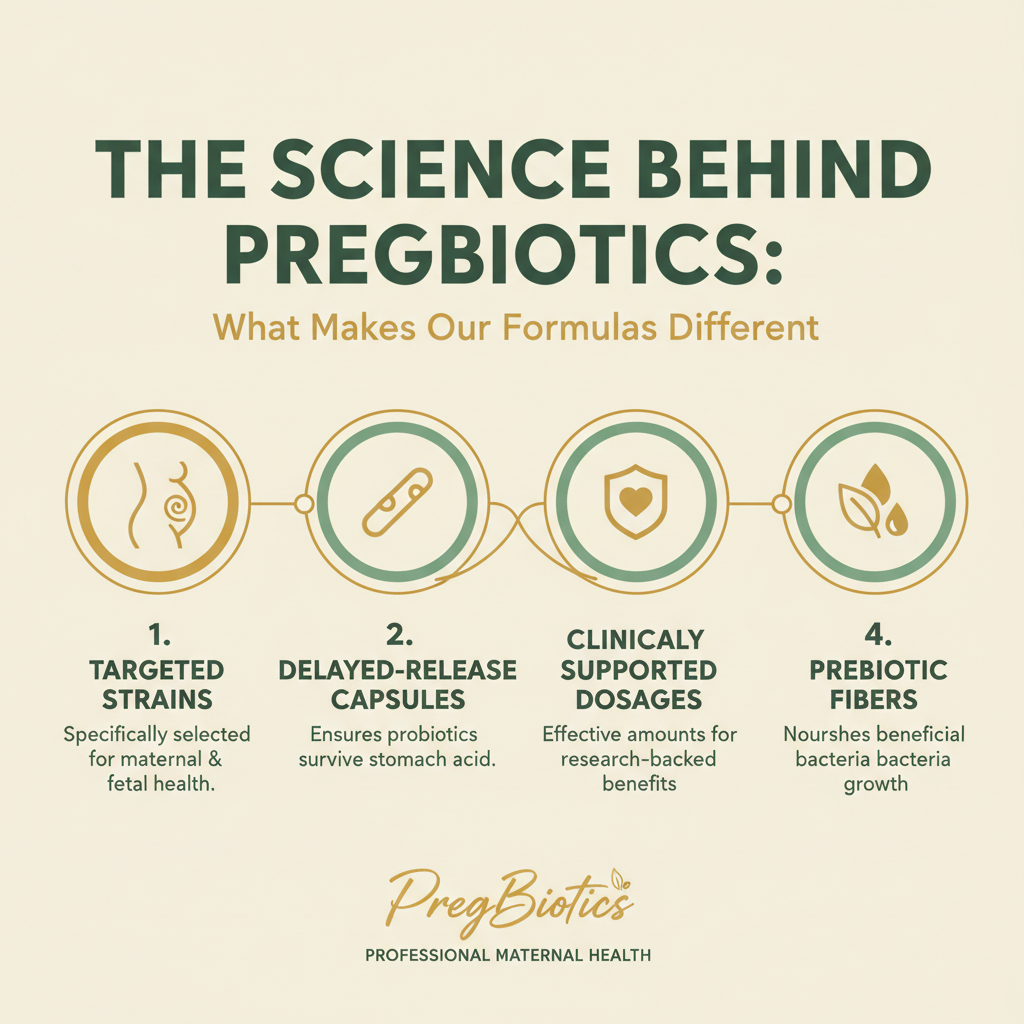
Survivability through the gut is non-negotiable. A probiotic that cannot survive gastric acid and bile salts to reach the intestinal epithelium is functionally useless. Delivery technology and strain hardiness are critical quality indicators that most labels don't communicate clearly.
-
Synbiotics outperform probiotics alone. Combining probiotics (beneficial bacteria) with prebiotics (the fibre substrates they feed on) creates a synbiotic effect — the bacteria arrive alongside their fuel source and are demonstrably more effective at colonising and exerting beneficial effects in the gut.
-
Postpartum and breastfeeding represent a distinct microbiome phase. The gut continues to shift after birth, influenced by hormonal changes, sleep deprivation, and breastfeeding. Maternal gut health during this period directly influences breastmilk microbiome composition and the immune education of the newborn.
For a deeper understanding of how your gut changes across the full arc of pregnancy, I'd encourage you to explore our Pregnancy Gut Guide — it's one of the most comprehensive resources we've developed for mothers at every stage.
The Role of Nutrition, Targeted Supplementation & the PregBiotics Range
This brings me to the heart of what makes PregBiotics different.
When I began developing our formulas, I made one non-negotiable commitment: every ingredient, every strain, every dosage decision would be grounded in clinical evidence — specifically in research conducted on or directly relevant to pregnant and lactating women. No filler strains. No marketing gimmicks. No borrowing research from non-pregnant adult populations and hoping it translates.
The PregBiotics Range was designed around the biological realities of the maternal gut I described above. Here is what that looks like in practice.
Clinically Researched Probiotic Strains
Our formulas feature strains selected from among the most rigorously studied organisms in maternal microbiome research. These include:
- Lactobacillus rhamnosus (specifically studied strains) — with evidence supporting reduction in gestational dysbiosis, prevention of Group B Streptococcus (GBS) colonisation, and lower rates of atopic conditions in offspring
- Lactobacillus reuteri — associated with improved vaginal microbiome health and reduced maternal inflammatory markers
- Bifidobacterium longum — critical for infant gut seeding and immune education via breastmilk; supports maternal mood through the gut-brain axis
- Bifidobacterium lactis — supports immune modulation and SCFA production; well-tolerated across all trimesters
- Lactobacillus acidophilus — foundational for gut barrier integrity and nutrient absorption optimisation
Prebiotic Substrates That Feed the Right Bacteria
Each formula includes evidence-based prebiotic components — including fructooligosaccharides (FOS) and galactooligosaccharides (GOS) — to create a genuine synbiotic effect. These aren't token fibre additions; they are dosed to meaningfully support the colonisation and activity of our probiotic strains.
Key Supportive Micronutrients
In selected products within the PregBiotics Range, we've integrated targeted micronutrients that work synergistically with gut health:
- Folate (methylated form) — superior bioavailability compared to folic acid, especially for women with MTHFR variants
- Vitamin D3 — immune-modulatory, supports calcium metabolism, and influences gut barrier function
- Magnesium bisglycinate — supports relaxation of smooth muscle, reduces constipation (a major pregnancy complaint), and supports sleep quality
- Zinc — essential for immune function and fetal cell development
The WHO recommends comprehensive nutritional support during pregnancy, and our formulas are built to complement — not replace — a balanced dietary approach.
Expert Tips: Making the Most of Your Gut Health During Pregnancy & Beyond
As a physician who has worked with hundreds of pregnant and postpartum mothers, here are my most actionable evidence-based recommendations for supporting your gut health across the maternal journey:
-
Start before conception if possible. The gut microbiome you bring into pregnancy significantly influences the trajectory of the maternal microbiome shift. Ideally, begin a targeted synbiotic supplement 3–6 months before trying to conceive to establish a stronger microbial baseline.
-
Take your probiotic consistently. Microbiome modulation requires persistence. A single dose won't move the needle; daily supplementation over weeks and months creates cumulative benefit. Set a phone reminder and tie it to an existing habit — your morning glass of water, for instance.
-
Feed your gut bacteria daily through food. Probiotics work best alongside a fibre-rich, plant-diverse diet. Aim for 30 different plant foods per week (this includes herbs and spices), and include naturally fermented foods like plain yoghurt, kefir, and sauerkraut where tolerated.
-
Protect your gut microbiome if antibiotics are necessary. Antibiotics during pregnancy — including intrapartum GBS prophylaxis — can significantly disrupt the gut and vaginal microbiome. If you are prescribed antibiotics, discuss probiotic support with your healthcare provider. Take probiotics 2 hours apart from antibiotic doses.
-
Don't neglect your postpartum gut health. The fourth trimester is a period of profound hormonal and microbial flux. Many mothers focus entirely on the baby's needs and let their own supplementation lapse — but this is when your gut health most directly influences your breastmilk composition, your mood stability, and your recovery. Our PregBiotics Breastfeeding formula is specifically formulated for this phase.
-
Hydration is a microbiome essential. Adequate fluid intake supports mucosal gut lining integrity and helps prevent the constipation that disrupts microbial balance. Aim for at least 2–2.5 litres of water daily during pregnancy.
-
Manage stress intentionally. Chronic psychological stress has a measurable negative impact on the gut microbiome through the gut-brain axis. Mindfulness practices, gentle exercise, adequate sleep, and social connection all serve as genuine microbiome interventions — not soft wellness suggestions.
-
Be informed about Group B Streptococcus. GBS colonisation affects approximately 10–30% of pregnant women globally and is directly linked to vaginal and gut microbiome composition. If you'd like to understand this in more depth, our GBS Shield resource is an excellent starting point.
When to Seek Medical Advice
While gut health supplements for mothers are generally very well-tolerated, I want to be clear: supplementation should complement, not replace, proper antenatal and postnatal medical care.
Please consult your obstetrician, midwife, or GP before starting any new supplement during pregnancy — including probiotics — if any of the following apply to you:
- You are immunocompromised or have a condition affecting your immune system
- You have a history of preterm labour or cervical incompetence
- You are experiencing significant gastrointestinal symptoms such as persistent diarrhoea, blood in stools, or severe abdominal pain
- You are currently hospitalised or receiving intravenous nutrition
- You have been diagnosed with small intestinal bacterial overgrowth (SIBO)
Additionally, if you notice any unexpected changes in digestion, bloating, or general health after starting a new supplement, pause and seek advice from your healthcare provider.
The NHS guidance on supplements in pregnancy is a valuable reference point for understanding the general safety landscape of supplementation during this critical period.
PregBiotics formulas are developed with maternal safety as the absolute priority — but your individual clinical picture always comes first. Your healthcare provider is your partner in this journey, and I encourage you to bring your supplement choices to your appointments for informed, personalised guidance.
Conclusion: Science That Puts Mothers First
The science of the maternal microbiome is one of the most exciting and rapidly evolving areas of medical research. Every year, new studies deepen our understanding of just how profoundly the gut influences maternal health, fetal development, and infant outcomes — and every year, I become more convinced that this is where meaningful change for mothers can and should happen.
The PregBiotics science isn't about selling supplements. It's about closing the gap between what research tells us mothers need and what is actually available to them on the shelves — whether you're in Johannesburg, Cape Town, or any city where pregnancy supplements in South Africa have historically been limited to generic formulations built without maternal specificity in mind.
What makes our formulas different is not a marketing claim. It's a clinical commitment: to probiotic strains with genuine pregnancy relevance, to synbiotic formulations that deliver measurable benefit, to micronutrients dosed with bioavailability in mind, and to total transparency about what is in each capsule and why.
You deserve more than a product designed for the general population with a pink label added. You deserve a formula that was built for you — for the remarkable, complex, science-worthy biology of becoming and being a mother.
To continue exploring the research and practical guidance behind maternal gut health, visit The PregBiotics Journal — our growing library of evidence-based articles written for mothers, by clinicians who care deeply about getting this right.
Warm regards and good health, Dr. Chomba Chuma, MD Founder, PregBiotics
Disclaimer: This article is intended for informational and educational purposes only. It does not constitute personalised medical advice. Always consult a qualified healthcare provider before making changes to your supplement or medication regimen during pregnancy or breastfeeding.
Get the PregBiotics Journal in your inbox
Gut-smart guidance for conception, pregnancy and breastfeeding — twice a week, plus member-only offers. Unsubscribe anytime.
You deserve to feel beautifully supported.
Join thousands of mothers on the PregBiotics journey. Receive your free Pregnancy Prep Guide and gentle, science-backed wisdom — tailored to where you are right now.