The Essential Nutrients Every Woman Should Optimise Before Trying to Conceive
Imagine this: you've made the exciting decision to start trying for a baby. You feel ready emotionally, your relationship is solid, and you've started tracking your cycle. But here's something that surprises many of my patients — by the time a pregnancy test turns positive, your baby has already bee
Dr. Chomba Chuma, MD & Founder
MD & Founder, PregBiotics

The Essential Nutrients Every Woman Should Optimise Before Trying to Conceive
By Dr. Chomba Chuma, MD & Founder | PregBiotics Journal
Introduction
Imagine this: you've made the exciting decision to start trying for a baby. You feel ready emotionally, your relationship is solid, and you've started tracking your cycle. But here's something that surprises many of my patients — by the time a pregnancy test turns positive, your baby has already been developing for approximately four weeks. The neural tube, which forms the brain and spinal cord, begins closing just 28 days after conception. In many cases, women don't even know they're pregnant yet.
This is why preconception nutrition isn't just a "nice to have" — it is one of the most powerful investments you can make in the health of your future child, and in your own wellbeing throughout pregnancy and beyond.
According to the World Health Organization, micronutrient deficiencies affect over 2 billion people globally, and women of reproductive age are among the most vulnerable. Yet the conversation around fertility and pregnancy preparation still tends to focus heavily on timing and tracking, while nutrition quietly takes a back seat.
In this article, I want to change that. We'll explore the essential nutrients your body needs before conception, the fascinating science behind how they support fertility and early development, how your gut health plays a more central role than you might expect, and how targeted supplementation — including our specially formulated PregBiotics Conception — can help you fill the gaps with confidence.
Whether you're planning to conceive in the next few months or simply want to start building a healthier foundation, this guide is for you.
The Biology of Preconception Nutrition: Why What You Eat Now Shapes What Comes Next
Most people think of pregnancy nutrition as something that begins once you see two lines on a test. But the science tells a very different story. The preconception window — ideally the three to six months before you begin trying — is a critical developmental period that influences egg quality, hormonal balance, uterine receptivity, and even the long-term health outcomes of your child.
Egg Quality and the Nutrient Connection
A mature egg (oocyte) takes approximately 90 days to develop before it is released during ovulation. This means that what you're eating right now is actively influencing the quality of the eggs that will be available to you in three months' time. Nutrients such as CoQ10, folate, zinc, and antioxidants play a direct role in mitochondrial function within oocytes — and healthier mitochondria mean better energy production for fertilisation and early cell division.
Hormonal Health and Micronutrients
Your reproductive hormones — oestrogen, progesterone, FSH, and LH — are exquisitely sensitive to nutritional status. For example, research published in the American Journal of Clinical Nutrition has linked low vitamin D levels with irregular menstrual cycles and reduced IVF success rates. Iron deficiency, even without full anaemia, can disrupt ovulation. Iodine is essential for thyroid function, which in turn regulates the hormonal cascade needed for conception.
Epigenetics: You're Feeding More Than One Future
One of the most remarkable areas of modern reproductive science is epigenetics — the study of how environmental factors, including nutrition, switch genes on or off. The nutrients you consume before and during pregnancy can influence gene expression in your baby that persists well into their adult life. This includes risk factors for metabolic disease, immune function, and even neurological development. This is not meant to be alarming — it is profoundly empowering. You have more influence over your baby's biological blueprint than previously understood.
The Gut-Brain Axis and Fertility
Perhaps less well-known is the role of the gut-brain axis fertility connection. The gut microbiome communicates bidirectionally with the brain and endocrine system via the vagus nerve, immune signalling, and short-chain fatty acid production. A disrupted gut microbiome can elevate systemic inflammation, impair nutrient absorption, and dysregulate the hormonal environment needed for conception. Studies have even identified a distinct uterine microbiome, suggesting that gut health may have a direct bearing on uterine receptivity and implantation. I explore this in more depth in our Pregnancy Gut Guide.
What This Means For You: Translating the Science Into Real Life
Understanding the biology is one thing — knowing what to actually do with that information is another. Here's what the evidence means in practical terms for women preparing to conceive.
Your Nutritional Status Matters Before You're Even Pregnant
Many of the nutrients critical to early fetal development cannot be "caught up on" once pregnancy begins. The neural tube closes before most women have their first antenatal appointment. This is why building nutritional reserves in advance is so important.
Key practical implications:
- Start supplementing at least 3 months before trying to conceive — ideally six months in advance if you have known deficiencies or digestive concerns
- Get baseline blood tests done — ask your GP to check ferritin (iron stores), vitamin D, B12, folate, and thyroid function before you start trying
- Audit your diet honestly — even healthy eaters can have significant gaps, particularly in iron, iodine, omega-3s, and zinc
- Address gut health first — if you experience bloating, irregular bowel habits, food sensitivities, or have taken antibiotics recently, your gut microbiome may be affecting your ability to absorb key nutrients effectively
Lifestyle Factors That Amplify or Undermine Your Nutritional Status
Nutrients don't exist in isolation. Several common lifestyle factors can deplete your stores or impair absorption:
- Stress depletes magnesium and B vitamins rapidly
- Hormonal contraception (especially the pill) is associated with lowered levels of folate, B6, B12, zinc, and magnesium — allow 3–6 months after stopping before trying to conceive if possible
- Alcohol interferes with folate metabolism and liver detoxification pathways
- Ultra-processed diets are high in inflammatory compounds that disrupt the gut microbiome and hormonal signalling
- Intense exercise without adequate fuelling can suppress ovulation through hypothalamic disruption
None of this is about achieving perfection. It's about making informed, compassionate adjustments that create the most fertile ground — in every sense — for new life.
The Role of Nutrition and Supplementation: Building Your Preconception Stack
Even with the most nutrient-dense, whole-food diet, research consistently shows that most women of reproductive age fall short in several key micronutrients. Supplementation isn't a shortcut — it is a sensible, evidence-based strategy to ensure your body has everything it needs during one of the most nutritionally demanding transitions of your life.
This is exactly why I developed PregBiotics Conception — a comprehensive, science-formulated supplement designed specifically for the preconception window, combining targeted micronutrients with a clinically studied probiotic blend to support both nutrient status and gut health simultaneously.
Key Nutrients to Prioritise
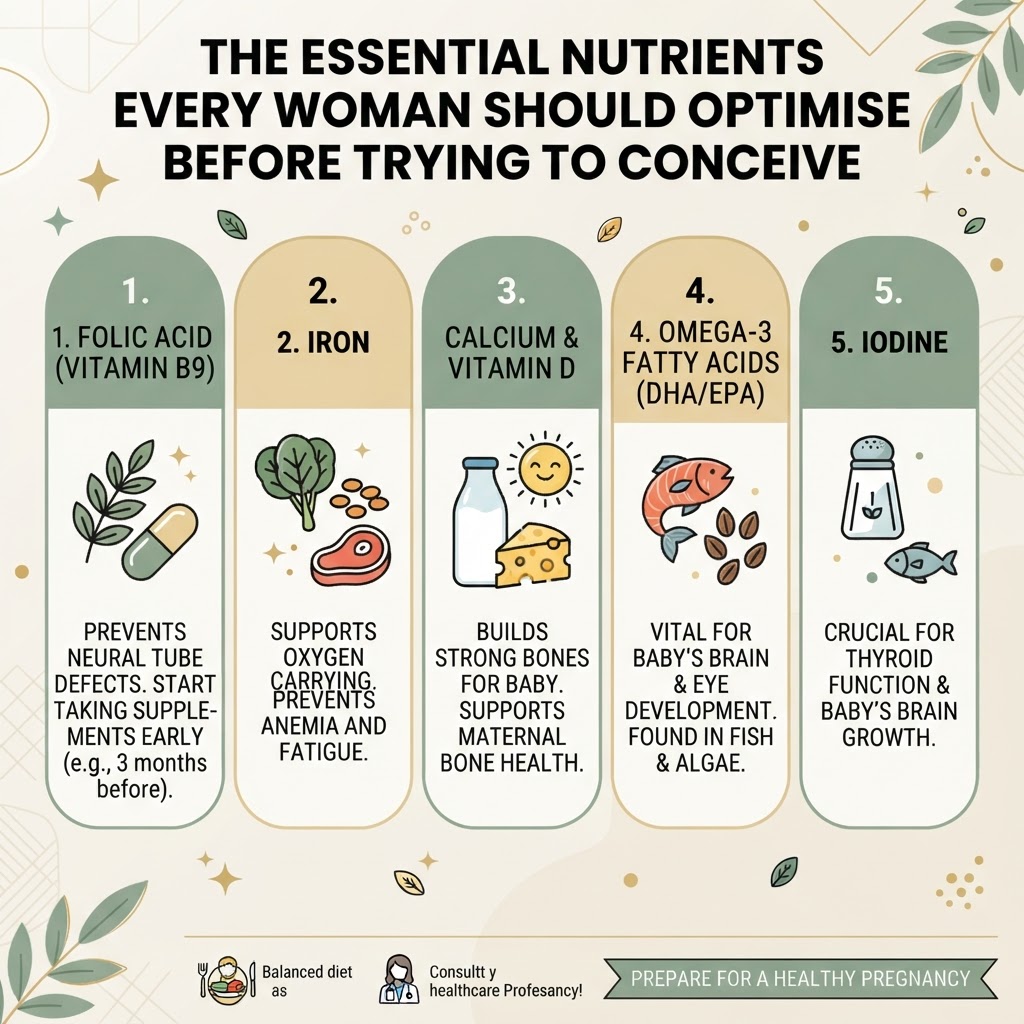
- Methylfolate (active folic acid) — Folic acid fertility is perhaps the most well-established relationship in reproductive medicine. NHS guidance recommends 400mcg daily before and during early pregnancy to reduce neural tube defects by up to 70%. PregBiotics Conception uses the methylated form (5-MTHF), which is better absorbed, particularly by women with the MTHFR gene variant
- Iron — Iron supplements conception support are critical for women with heavy periods or plant-based diets. Low ferritin impairs ovulation and increases miscarriage risk. We use a gentle, non-constipating form of iron in our formula
- Vitamin D3 + K2 — Supports hormonal regulation, immune function, and calcium metabolism. Deficiency is widespread in the UK
- Iodine — Essential for thyroid hormone synthesis; chronically under-consumed in women who avoid dairy and fish
- Zinc — Supports egg maturation, progesterone production, and immune function
- Choline — Often overlooked in preconception discussions but vital for neural tube closure and brain development
- Omega-3 (DHA/EPA) — Reduces systemic inflammation, supports oocyte quality, and prepares the uterine lining
- CoQ10 (Ubiquinol) — Powers mitochondrial function in oocytes; particularly important for women over 35
- B6 & B12 — Support hormonal regulation, methylation, and homocysteine metabolism
- Probiotics (Lactobacillus rhamnosus, Lactobacillus reuteri) — Clinically studied strains that support gut integrity, reduce inflammation, and optimise nutrient absorption
Vitamins before pregnancy should never be generic. The combination, form, and dose of each nutrient matter enormously — which is what sets a targeted preconception formula apart from a standard multivitamin.
Expert Tips and Actionable Advice
Here are my top evidence-based recommendations for women in the preconception phase:
-
Book a preconception health check. Before you start trying, speak with your GP or a women's health specialist. Request blood tests for ferritin, vitamin D, B12, folate, thyroid function (TSH, T3, T4), and HbA1c if you have metabolic concerns.
-
Start your preconception supplement 3–6 months early. Begin PregBiotics Conception at least 90 days before you plan to start trying. This aligns with the egg maturation cycle and ensures your stores are genuinely replete — not just topped up.
-
Eat a Mediterranean-style diet as your foundation. Consistent evidence supports this dietary pattern for fertility. Prioritise oily fish, leafy greens, legumes, colourful vegetables, olive oil, and whole grains. Reduce ultra-processed foods, refined sugars, and trans fats.
-
Optimise your gut microbiome actively. Include prebiotic-rich foods daily (garlic, onions, leeks, asparagus, oats) alongside fermented foods (live yoghurt, kefir, sauerkraut). A diverse gut microbiome supports better nutrient absorption and lower inflammation — two pillars of fertility.
-
Address the MTHFR question. If you have a family history of neural tube defects, recurrent miscarriage, or have been told you carry the MTHFR gene variant, speak to your doctor about using methylated folate (5-MTHF) rather than synthetic folic acid — as I've formulated in PregBiotics Conception.
-
Manage stress as a nutritional strategy. Chronic stress depletes B vitamins and magnesium while raising cortisol, which directly suppresses reproductive hormones. Prioritise sleep, gentle movement, and mindfulness practices alongside dietary changes.
-
Minimise alcohol and caffeine. Current evidence recommends zero alcohol in the preconception period. Caffeine should be limited to under 200mg per day — roughly one to two cups of coffee.
-
Review your medications and supplements with a professional. Some common medications (metformin, antacids, certain antidepressants) can affect nutrient absorption. Always disclose all supplements to your healthcare provider.
When to Seek Medical Advice
While this article is designed to empower and inform, it is not a substitute for personalised medical advice. I always encourage women to work alongside a qualified healthcare provider throughout the preconception journey.
Please speak to your GP or a specialist if:
- You have been trying to conceive for more than 12 months without success (or 6 months if you are over 35)
- You have irregular or absent periods, or a history of polycystic ovary syndrome (PCOS), endometriosis, or thyroid conditions
- You have experienced one or more miscarriages
- You have a known genetic condition or family history of chromosomal disorders
- You are taking prescription medications that may interact with supplements
- You have significant digestive symptoms such as chronic bloating, diarrhoea, or suspected malabsorption
Supplementation is a powerful tool, but it works best as part of a comprehensive, personalised approach to your reproductive health. Blood results and clinical history allow us to tailor recommendations in a way that generic advice simply cannot.
Conclusion
The decision to try for a baby is one of the most profound a woman can make. And while so much of conception can feel uncertain or outside of our control, preconception nutrition is one area where your choices genuinely and measurably matter.
By prioritising the right nutrients — folic acid for neural tube protection, iron for ovulation and implantation, vitamin D for hormonal balance, probiotics for gut integrity and nutrient absorption — you are not just preparing your body for pregnancy. You are laying the biological foundations for your child's lifelong health.
The science is clear: the preconception window is one of the highest-impact periods for nutritional intervention. It doesn't require perfection. It requires intention, consistency, and the right support.
PregBiotics Conception was designed with exactly this in mind — combining the most bioavailable forms of essential preconception nutrients with clinically studied probiotic strains to support the whole system: gut, hormones, egg quality, and beyond.
You deserve to enter this journey feeling prepared, nourished, and confident. That's not wishful thinking — it's science.
For more evidence-based guidance on maternal gut health and nutrition at every stage of pregnancy, visit The PregBiotics Journal.
With warmth and science, Dr. Chomba Chuma, MD Founder, PregBiotics
This article is for informational purposes only and does not constitute medical advice. Always consult a qualified healthcare professional before starting any new supplement.
Get the PregBiotics Journal in your inbox
Gut-smart guidance for conception, pregnancy and breastfeeding — twice a week, plus member-only offers. Unsubscribe anytime.
You deserve to feel beautifully supported.
Join thousands of mothers on the PregBiotics journey. Receive your free Pregnancy Prep Guide and gentle, science-backed wisdom — tailored to where you are right now.