The Essential Nutrients Every Woman Should Optimise Before Trying to Conceive
Imagine this: you've made the exciting, life-changing decision to start trying for a baby. You're feeling hopeful, perhaps a little nervous, and ready to do everything right. But here's a statistic that might surprise you — research suggests that nearly *after* a positive test. By that point, the mo
Dr. Chomba Chuma, MD & Founder
MD & Founder, PregBiotics

The Essential Nutrients Every Woman Should Optimise Before Trying to Conceive
By Dr. Chomba Chuma, MD & Founder | PregBiotics Journal
Introduction
Imagine this: you've made the exciting, life-changing decision to start trying for a baby. You're feeling hopeful, perhaps a little nervous, and ready to do everything right. But here's a statistic that might surprise you — research suggests that nearly 50% of pregnancies are unplanned, and even among women who are actively trying to conceive, many don't begin optimising their nutrition until after a positive test. By that point, the most critical window of early foetal development — often before a woman even knows she's pregnant — has already begun.
This matters enormously. The first four weeks of pregnancy, when the neural tube is forming and cell division is happening at a breathtaking pace, are profoundly influenced by the nutritional environment you've been building for months. Preconception nutrition isn't simply a wellness trend — it's a biological imperative backed by decades of research.
In this article, I want to walk you through the essential nutrients every woman should consider optimising before trying to conceive: why they matter, what the science says, and how to practically incorporate them into your daily life. We'll cover everything from folic acid and iron to the often-overlooked role of your gut microbiome in supporting fertility. My goal, as always, is to empower you with knowledge so that when the time comes, your body is ready to give both you and your future baby the very best possible start.
The Biology of Preconception: Why What You Eat Today Shapes Tomorrow's Pregnancy
The Nutritional Window That Most People Miss
There is a concept in reproductive medicine called the "periconceptional period" — broadly defined as the three to six months before conception and the first trimester of pregnancy. During this time, your nutritional status has a direct and measurable impact on egg quality, hormonal balance, the successful implantation of a fertilised egg, and the early development of your baby's brain, spine, and organs.
Unlike many areas of health where you can course-correct relatively quickly, building optimal nutrient reserves takes time. Fat-soluble vitamins like D and E accumulate gradually in tissue. Your gut microbiome — the trillions of bacteria that influence everything from nutrient absorption to immune function — takes weeks to meaningfully shift in composition. Even your red blood cells, which carry oxygen and iron throughout your body, have a lifespan of approximately 120 days, meaning iron status today is a reflection of months of dietary habits.
Egg Quality and Nutritional Status
Oocyte (egg) development, known as folliculogenesis, begins months before ovulation. During this process, the developing egg is exquisitely sensitive to its surrounding environment, including the levels of antioxidants, micronutrients, and inflammatory mediators present in the follicular fluid. Studies published in Reproductive Biology and Endocrinology have demonstrated that adequate intake of nutrients like folate, CoQ10, and omega-3 fatty acids is associated with improved egg quality and fertilisation rates.
The Gut-Microbiome-Fertility Connection
Here is where it gets particularly fascinating, and perhaps a little surprising: your gut health plays a powerful role in preconception readiness. The gut-brain axis fertility connection is an emerging and exciting area of research. Your gut microbiome influences oestrogen metabolism through a collection of bacteria known as the estrobolome, which regulate how oestrogen is processed and recycled in the body. Imbalances here can contribute to hormonal disruption, irregular cycles, and difficulties conceiving.
Beyond hormones, a healthy gut microbiome is essential for the efficient absorption of key prenatal nutrients — including iron, folate, zinc, and magnesium. If your gut lining is compromised or your microbiome is out of balance, you may be consuming all the right foods and supplements, but absorbing far less than you think.
Epigenetics: You're Not Just Feeding Yourself
One of the most profound revelations of modern nutritional science is epigenetics — the study of how environmental factors, including nutrition, switch genes on and off. The nutrients you consume before and during early pregnancy don't just nourish your body; they actively influence which genes your baby's cells will express. Folate and choline, in particular, are critical methyl donors — molecules that participate in the epigenetic programming of your future child's health.
What This Means For You: Turning Science Into Self-Care
Understanding the biology is one thing. But what does this actually look like in your day-to-day life? Here's the honest truth: preconception nutrition doesn't have to be overwhelming or perfectionistic. It's about building a consistent foundation — one that supports your hormones, your gut, your energy, and your reproductive system working in harmony.
Here are some key things this science tells us you should prioritise:
-
Start early, not just when you see a positive test. Ideally, begin optimising your nutrition at least three to six months before you plan to start trying. This gives your body time to build reserves, rebalance your microbiome, and support egg quality during folliculogenesis.
-
Your gut health is part of your fertility health. Bloating, irregular bowels, food sensitivities, or a history of antibiotic use can all signal a gut microbiome that needs attention. Prioritising gut health before pregnancy also sets the stage for reduced pregnancy-related digestive discomfort, better nutrient absorption, and even influences your baby's immune development after birth. I'd encourage you to explore our Pregnancy Gut Guide for a deeper dive into this connection.
-
Nutritional deficiencies are common, even in well-nourished women. Iron deficiency is the most prevalent nutritional deficiency globally, affecting approximately 30% of women of reproductive age according to the WHO. Vitamin D insufficiency is similarly widespread. You can be eating a balanced diet and still have subclinical deficiencies that affect your reproductive health.
-
Stress and sleep matter too. The gut-brain axis is bidirectional — chronic stress elevates cortisol, disrupts gut microbiome diversity, impairs nutrient absorption, and suppresses reproductive hormones. Optimising nutrition is most effective when paired with adequate sleep and stress management.
-
One-size-fits-all doesn't apply. Women with conditions like PCOS, endometriosis, thyroid disorders, or a history of gut issues may have specific nutritional needs that differ from the general recommendations. This is why working with a healthcare provider is so valuable.
The Role of Nutrition and Supplementation in Preconception Readiness
The Key Nutrients — and Why Each One Matters
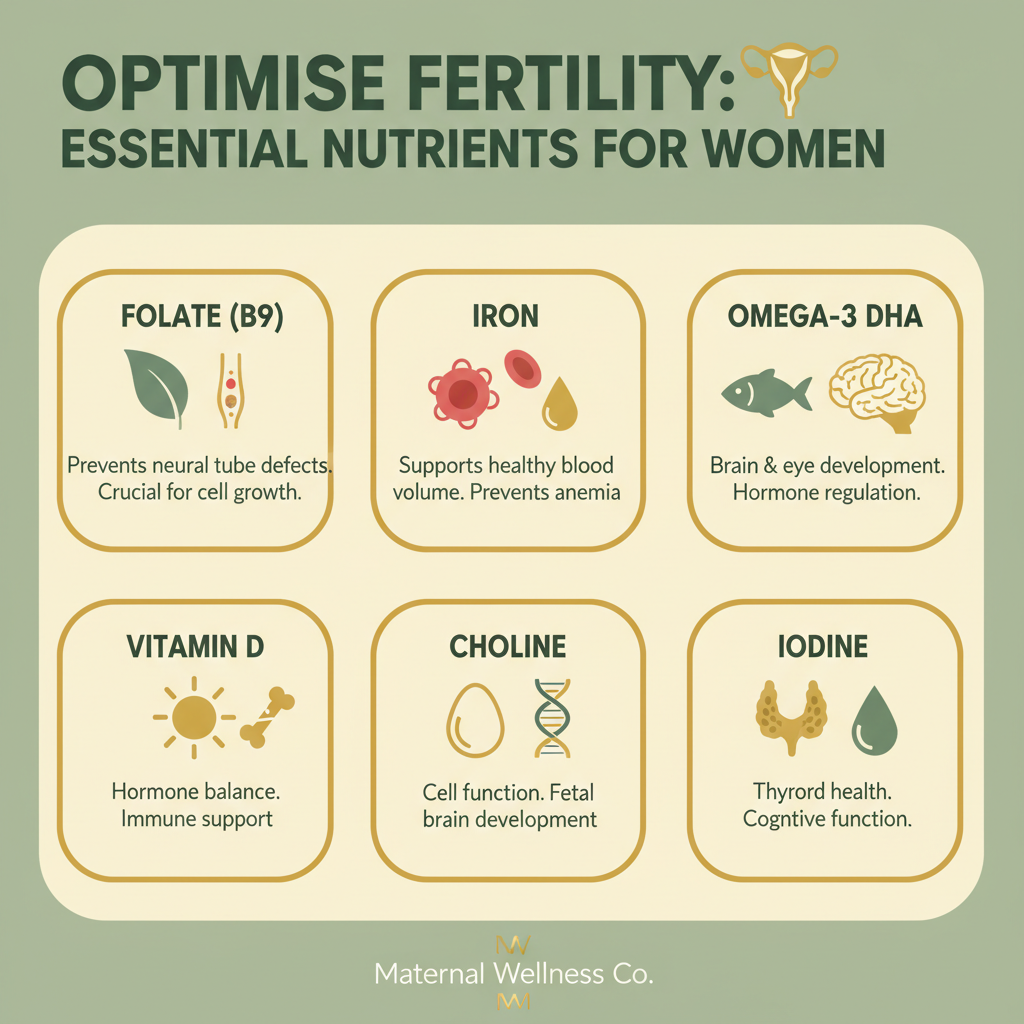
Let's get specific. These are the nutrients that the evidence most consistently supports optimising before conception:
-
Folate (and Folic Acid Fertility): Perhaps the most well-known preconception nutrient, and for good reason. Adequate folate in the periconceptional period reduces the risk of neural tube defects — such as spina bifida — by up to 70%, according to the NHS. The recommended dose is 400mcg of folic acid daily, starting at least one month before conception. Women with certain MTHFR gene variants may benefit from the active form, methylfolate. Folic acid fertility is not just about preventing defects — folate also plays a crucial role in DNA synthesis, cell division, and early embryonic development.
-
Iron: Iron deficiency before conception increases the risk of anaemia during pregnancy, which is associated with preterm birth, low birth weight, and maternal fatigue. Iron supplements conception planning should include a check of your ferritin levels — it's the most sensitive marker of iron stores. Food sources include red meat, lentils, spinach, and fortified cereals, but supplemental iron is often necessary to correct deficiency.
-
Vitamin D: Acts more like a hormone than a vitamin, influencing immune regulation, mood, and reproductive function. Low vitamin D is associated with irregular ovulation and implantation failure. Most women in the UK and many other countries are insufficient, especially in winter months.
-
Omega-3 Fatty Acids (DHA/EPA): Critical for early brain and eye development, and also anti-inflammatory — important for women with conditions like endometriosis or PCOS.
-
Choline: Often underappreciated, choline is essential for neural tube development and works synergistically with folate. Many prenatal supplements don't include adequate amounts.
-
Iodine: Essential for thyroid function and foetal brain development. Often insufficient in plant-based diets.
-
Zinc: Supports ovulation, fertilisation, and early cell division. Deficiency impairs egg maturation.
-
Probiotics (specific strains for gut-brain axis fertility): Lactobacillus and Bifidobacterium strains support the gut microbiome, enhance nutrient absorption, regulate oestrogen metabolism via the estrobolome, and reduce systemic inflammation — all critical for preconception readiness.
How PregBiotics Conception Supports This
This is precisely why I developed PregBiotics Conception. I saw so many women in clinical practice who were doing everything right in their minds — eating well, taking a standard folic acid tablet — but who weren't addressing the full picture of preconception readiness, particularly gut health.
PregBiotics Conception is a science-formulated supplement that combines the key micronutrients needed before pregnancy — including active methylfolate, iron, vitamin D3, iodine, zinc, and choline — with targeted probiotic strains specifically chosen to support the gut-brain axis, oestrogen metabolism, and nutrient absorption. It's designed to work as a complete preconception system, not just a standalone folic acid supplement.
When you combine robust vitamins before pregnancy with a thriving gut microbiome, you create the optimal internal environment for conception and early pregnancy.
Expert Tips and Actionable Advice
Here are my top practical recommendations for women in the preconception phase:
-
Start at least three months before you plan to try. This is the minimum I recommend. Six months is even better, particularly if you have a history of gut issues, hormonal imbalances, or have been on the contraceptive pill for an extended period (which can deplete B vitamins, zinc, and magnesium).
-
Get baseline blood tests done. Ask your GP or a private clinician to check: ferritin (iron stores), vitamin D, B12, folate, thyroid function (TSH and free T4), and a full blood count. Knowledge is power — you can't optimise what you haven't measured.
-
Prioritise food first, supplement second. A nutrient-dense diet forms the foundation. Focus on: dark leafy greens (folate, iron, magnesium), oily fish like salmon or sardines (DHA, iodine), eggs (choline, vitamin D, B12), legumes (folate, iron, zinc), colourful vegetables and berries (antioxidants), and full-fat dairy or fortified alternatives (calcium, iodine).
-
Reduce gut disruptors. Ultra-processed foods, excess alcohol, and unnecessary antibiotic use all negatively affect the gut microbiome. In the months before conception, it's worth reducing these where possible and increasing fibre from diverse plant sources to feed beneficial gut bacteria.
-
Take a targeted preconception supplement daily — consistently. The benefits of supplementation are cumulative and dose-dependent. Missing days frequently undermines the purpose. Take your supplement at the same time each day (many women find with breakfast easiest) to build the habit.
-
Don't neglect your partner's nutrition. Male factor infertility contributes to around 40–50% of cases. Zinc, selenium, vitamin C, and CoQ10 are particularly important for sperm health and motility. Preconception nutrition is a couple's endeavour.
-
Manage stress actively. Chronic stress measurably disrupts the HPA axis, suppresses LH and FSH (the hormones that govern ovulation), and negatively impacts gut microbiome diversity. Yoga, mindfulness, regular walking, and adequate sleep (7–9 hours) are not luxuries — they are part of your preconception protocol.
-
Track your cycle. Understanding your menstrual cycle — its length, regularity, and any symptoms — gives you and your healthcare provider valuable insight into your hormonal health. Apps like Natural Cycles or Clue can help you identify patterns.
When to Seek Medical Advice
While optimising preconception nutrition is something every woman can begin independently, there are important situations where professional medical guidance is essential.
Please consult your GP, obstetrician, or a fertility specialist if:
- You have been trying to conceive for 12 months without success (or 6 months if you are over 35)
- You have a known condition such as PCOS, endometriosis, thyroid disorder, coeliac disease, or inflammatory bowel disease, as your nutritional needs and supplementation requirements may differ significantly
- You have a personal or family history of neural tube defects — your doctor may recommend a higher dose of folic acid (5mg rather than 400mcg)
- You are taking prescription medications that may interact with supplements
- You have a history of recurrent miscarriage
- You have symptoms of nutritional deficiency such as persistent fatigue, hair loss, brittle nails, or irregular periods
Supplements, including PregBiotics Conception, are designed to complement medical care — not replace it. Always share what you're taking with your healthcare team, and use blood test results to guide your supplementation decisions where possible.
Conclusion: Your Body Is Ready to Be Nurtured
Preconception is one of the most powerful and underutilised windows of opportunity in a woman's health journey. The months before you conceive are not a waiting room — they are an active, vibrant phase of preparation that can profoundly shape your experience of pregnancy and your baby's lifelong health.
By focusing on preconception nutrition, ensuring adequate folic acid fertility support, addressing iron supplements conception needs, building a resilient gut microbiome through the gut-brain axis fertility connection, and taking targeted vitamins before pregnancy, you are giving yourself the strongest possible foundation.
You deserve to enter pregnancy feeling nourished, informed, and empowered — not depleted or overwhelmed. Small, consistent steps taken now will echo forward into your pregnancy and beyond.
PregBiotics Conception was created with exactly this vision: a complete, science-led solution that supports your gut and your reproductive readiness together, because the two are inseparable.
For more evidence-based guidance on gut health through every stage of your pregnancy journey, visit The PregBiotics Journal — your go-to resource for maternal microbiome science, written with warmth and clinical rigour.
You've got this. And I'm here every step of the way.
Dr. Chomba Chuma, MD, is a medical doctor, maternal gut health researcher, and Founder of PregBiotics. Her work focuses on the intersection of the microbiome, nutrition, and reproductive health. This article is intended for informational purposes and does not constitute personalised medical advice. Always consult a qualified healthcare provider before beginning any new supplement regimen.
Get the PregBiotics Journal in your inbox
Gut-smart guidance for conception, pregnancy and breastfeeding — twice a week, plus member-only offers. Unsubscribe anytime.
You deserve to feel beautifully supported.
Join thousands of mothers on the PregBiotics journey. Receive your free Pregnancy Prep Guide and gentle, science-backed wisdom — tailored to where you are right now.