The Essential Nutrients Every Woman Should Optimise Before Trying to Conceive
Imagine two women, both in their early thirties, both healthy by every conventional measure, both trying to conceive. One falls pregnant within a few months and enjoys a smooth first trimester. The other struggles for over a year, experiences an early miscarriage, and is left with more questions tha
Dr. Chomba Chuma, MD & Founder
MD & Founder, PregBiotics

The Essential Nutrients Every Woman Should Optimise Before Trying to Conceive
By Dr. Chomba Chuma, MD & Founder | PregBiotics Journal
Introduction
Imagine two women, both in their early thirties, both healthy by every conventional measure, both trying to conceive. One falls pregnant within a few months and enjoys a smooth first trimester. The other struggles for over a year, experiences an early miscarriage, and is left with more questions than answers. On the surface, their lives look remarkably similar — same age, same BMI, same diet. But when we look deeper, at the cellular level, at the gut microbiome, at micronutrient stores and inflammatory markers — the picture becomes far more complex, and far more actionable.
Here is a statistic that stops many of my patients in their tracks: according to the World Health Organization, micronutrient deficiencies affect over 2 billion people globally — and many of these deficiencies are entirely silent, producing no obvious symptoms until the body is placed under the extraordinary physiological demand of conception and early pregnancy.
The truth is, preconception nutrition is one of the most powerful — and most underutilised — tools available to women who want to conceive. What you eat, absorb, and supplement in the months before pregnancy doesn't just affect your own health; it lays down the very biological blueprint for your future baby's brain, immune system, and gut microbiome.
In this article, I want to take you through the essential nutrients that the science consistently identifies as critical before conception, explain why gut health sits at the heart of nutritional readiness, and show you how to translate this knowledge into a practical, empowering preconception plan. Whether you are just beginning to think about trying for a baby or have been on this journey for a while, this is information every woman deserves to have.
The Biology of Preconception Readiness: What's Actually Happening in Your Body
Before we talk supplements and food, it helps to understand what your body is quietly doing in the months before conception — because it is doing quite a lot.
Egg Quality and the Three-Month Window
Each egg that is released at ovulation has been maturing for approximately 90 days beforehand. During this follicular development phase, the egg is extraordinarily sensitive to its nutritional environment. Oxidative stress, inflammation, and micronutrient deficiency during this window can impair mitochondrial function within the egg — and mitochondria are the energy powerhouses that fuel the early cell divisions of a fertilised embryo. This is precisely why nutritional preparation ideally begins at least three months before you start trying to conceive.
Hormonal Balance and Nutrient Dependency
Reproductive hormones — oestrogen, progesterone, follicle-stimulating hormone (FSH), and luteinising hormone (LH) — do not operate in isolation. Their synthesis, metabolism, and receptor sensitivity are deeply influenced by micronutrients. Zinc, for example, is required for the production of FSH and plays a key role in progesterone synthesis. Vitamin D functions more like a steroid hormone than a vitamin, with receptors found in ovarian tissue, and deficiency has been associated with reduced ovarian reserve and poorer IVF outcomes.
The Gut-Brain Axis and Fertility
One of the most exciting areas of emerging research is the relationship between the gut microbiome and reproductive health — what scientists are increasingly calling the gut-brain axis fertility connection. The gut microbiome influences the hypothalamic-pituitary-ovarian (HPO) axis, which governs the hormonal cascade of the menstrual cycle. A disrupted microbiome can contribute to systemic inflammation, impaired oestrogen metabolism, and altered signalling along this hormonal axis.
The gut also hosts a specific community of bacteria known as the estrobolome — microbes responsible for metabolising and recycling oestrogen via the enterohepatic circulation. When the estrobolome is compromised through dysbiosis (microbial imbalance), oestrogen metabolism becomes dysregulated, potentially contributing to conditions like PCOS, endometriosis, and luteal phase defects — all of which can impair fertility.
Nutrient Absorption: The Gateway to Effectiveness
Here is something that often surprises women: taking a supplement does not automatically mean your body is absorbing and utilising it. Gut integrity — the health of the intestinal lining and the balance of your microbiome — directly determines how efficiently you absorb key nutrients like folate, iron, magnesium, and B12. A compromised gut environment can render even a high-quality supplement significantly less effective. This is why at PregBiotics, we believe that gut health is not separate from preconception nutrition — it is preconception nutrition.
What This Means For You: Connecting the Science to Your Everyday Life
Understanding the biology is empowering, but I know what most women really want to know is: what does this mean for me, right now, in my daily life?
Here is what the science translates to in practical terms:
-
Your nutritional status today is building tomorrow's pregnancy. Because eggs mature over 90 days and the uterine environment is continuously shaped by what you eat and absorb, there is no such thing as "I'll start eating well once I'm pregnant." The preparation needs to begin now.
-
Deficiencies can be invisible. You can feel perfectly well and still have suboptimal levels of folate, iron, vitamin D, or iodine — all of which are critical in early pregnancy. Standard blood tests don't always check these routinely. It is worth asking your GP or healthcare provider for a preconception blood panel.
-
Gut health determines nutrient availability. If you have a history of IBS, bloating, antibiotic use, or a highly processed diet, your gut microbiome may be compromised — meaning even a nutrient-rich diet may not be fully delivering its benefits at the cellular level. Addressing gut health alongside nutrition is not optional; it is foundational.
-
Inflammation is a fertility disruptor. Chronic low-grade inflammation — often driven by gut dysbiosis, poor diet, and micronutrient deficiency — is increasingly recognised as a contributing factor to implantation failure and early pregnancy loss. Anti-inflammatory nutrients like omega-3 fatty acids, vitamin E, and antioxidants like CoQ10 are therefore directly relevant to fertility.
-
The impact extends to your baby. Epigenetics — the science of how environmental factors influence gene expression — tells us that the nutritional environment around conception can alter how your baby's genes are expressed for years, potentially decades, to come. This is not meant to add pressure; it is meant to add perspective on why this preparation is genuinely meaningful.
-
You are not starting from scratch. Whatever your current diet or lifestyle looks like, targeted, evidence-based nutritional support can make a significant difference in a relatively short period of time. The body is remarkably responsive when given the right building blocks.
The Role of Nutrition and Supplementation: Building Your Preconception Foundation
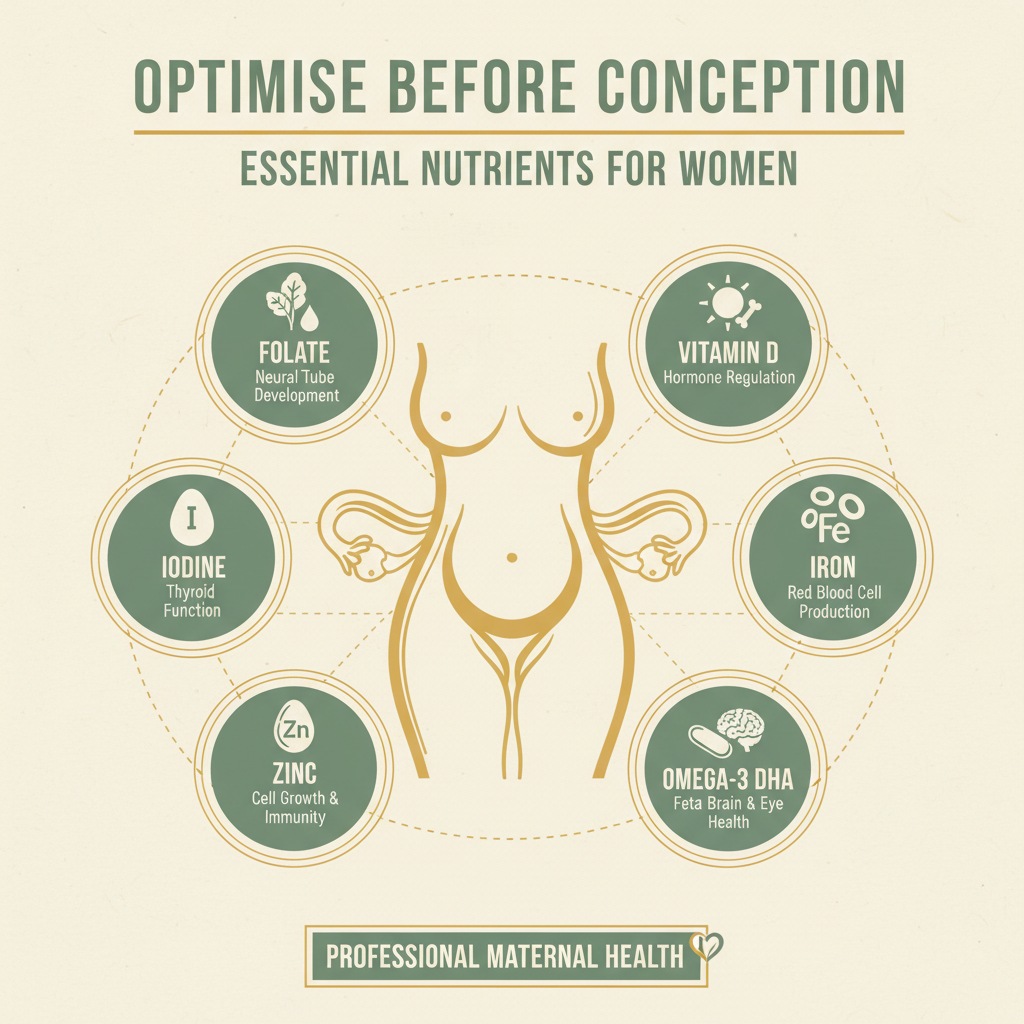
Let us now get specific. The following nutrients are those most consistently supported by evidence as critical in the preconception window — and where dietary intake alone is often insufficient.
Folic Acid and Folate
When women ask me about vitamins before pregnancy, folic acid fertility is always the first conversation. Folate (the natural form) and folic acid (the synthetic supplement form) are both forms of vitamin B9, essential for DNA synthesis and cell division. Critically, adequate folate in the weeks around conception and early pregnancy reduces the risk of neural tube defects by up to 70%. The neural tube closes by week 6 of pregnancy — often before many women even know they are pregnant. This is why supplementation must begin before conception.
For women with the MTHFR gene variant — which affects folate metabolism and is more common than many realise — methylated folate (5-MTHF) may be better utilised than standard folic acid.
Iron
Iron supplements for conception are another area frequently overlooked until it's too late. Iron is required for ovulation, implantation, and the enormous increase in blood volume that begins almost immediately after conception. Pre-existing iron deficiency is one of the most common nutritional issues I see in women of reproductive age, particularly those with heavy periods. Notably, gut health directly affects iron absorption — and a disrupted microbiome can impair the uptake of dietary and supplemental iron.
Key Nutrients in PregBiotics Conception
PregBiotics Conception was formulated specifically to address the full spectrum of preconception nutritional needs, with a particular focus on gut-mediated nutrient delivery. The formula includes:
- Methylated Folate (5-MTHF) — the bioavailable form that bypasses MTHFR gene variants
- Iron Bisglycinate — a gentle, highly absorbable form that avoids the digestive discomfort associated with standard iron supplements
- Vitamin D3 — essential for ovarian function, immune regulation, and embryo implantation
- Iodine — critical for thyroid function and fetal brain development; widely deficient in UK diets
- CoQ10 (Ubiquinol) — supports mitochondrial function in maturing eggs
- Omega-3 DHA — anti-inflammatory, supports embryo development and placental function
- Zinc — key for FSH production, progesterone synthesis, and egg maturation
- Vitamin B12 (Methylcobalamin) — supports DNA synthesis and neurological development
- Choline — increasingly recognised alongside folate for neural tube protection
- Lactobacillus rhamnosus & Lactobacillus reuteri — evidence-backed probiotic strains that support gut integrity, enhance nutrient absorption, and modulate the reproductive microbiome
This combination reflects a whole-system approach — not just replacing individual nutrients, but creating the gut environment in which those nutrients can be properly absorbed and utilised. You can also explore our Pregnancy Gut Guide for a deeper understanding of how gut health supports every stage of the journey from conception through to postpartum.
Expert Tips and Actionable Advice: Your Preconception Nutrition Plan
Here is how I recommend women approach this preparation in a way that is both science-aligned and genuinely sustainable:
-
Start at least three months before you plan to try. This aligns with the egg maturation window and gives time for nutrient stores to build. If you are not sure when you will start trying, starting now is always the right answer.
-
Get a preconception blood panel. Ask your GP to check ferritin (iron stores), vitamin D, B12, thyroid function (TSH and T4), and — if available — a full blood count. Knowing your baseline means you can target your supplementation more precisely.
-
Prioritise a whole-food, diverse diet. Supplementation works best as a complement to a nutrient-rich diet, not a replacement for one. Aim for a rainbow of vegetables, quality proteins (including plant-based sources), oily fish twice weekly, legumes, nuts, and seeds. Diversity of plant foods is one of the strongest predictors of a healthy gut microbiome.
-
Reduce ultra-processed foods. These contribute to gut dysbiosis, inflammation, and micronutrient displacement. You don't need to be perfect — but a meaningful reduction in highly processed foods will support both gut health and hormonal balance.
-
Address gut health proactively. If you have a history of digestive issues, regular antibiotic use, or a diet that has been low in fibre, consider supporting your microbiome with a targeted probiotic alongside prebiotic foods (garlic, onions, leeks, asparagus, oats, and green bananas).
-
Limit alcohol. Even moderate alcohol consumption can deplete folate, disrupt oestrogen metabolism, and impair gut integrity. Preconception is an ideal time to reduce or eliminate alcohol altogether.
-
Manage stress. Chronic psychological stress activates the HPA axis and can disrupt the HPO axis — meaning it directly affects ovulation and cycle regularity. Practices like yoga, mindfulness, adequate sleep, and time in nature are not luxuries; they are part of your fertility plan.
-
Don't forget your partner. Male fertility — sperm quality, motility, and DNA integrity — is equally influenced by nutrition. Zinc, selenium, CoQ10, and antioxidants are particularly important for sperm health.
-
Be consistent, not perfect. Nutritional preparation is cumulative. A consistently good routine over three months will outperform an intense two-week overhaul every time.
-
Track your cycle. Understanding your menstrual cycle — including ovulation timing — is invaluable information. Apps and ovulation predictor kits can be helpful tools, and cycle irregularities are often early signals worth discussing with your doctor.
When to Seek Medical Advice
While preconception nutrition is something every woman can and should take ownership of, there are important circumstances where professional medical input is essential — and where self-directed supplementation alone is not sufficient.
Please consult your GP, gynaecologist, or a registered healthcare provider if:
- You have been trying to conceive for 12 months without success (or 6 months if you are over 35)
- You have a known or suspected reproductive condition such as PCOS, endometriosis, or uterine fibroids
- You have a history of recurrent miscarriage (two or more pregnancy losses)
- You have a known MTHFR gene variant or a family history of neural tube defects — in which case higher-dose or methylated folate may be specifically recommended
- You have a thyroid condition, autoimmune disease, or any chronic health condition that may affect fertility or nutrient absorption
- You are taking prescription medications, as some interact with supplements
- You have had bariatric surgery, which significantly affects nutrient absorption
The information in this article is evidence-based and educational, but it does not replace a personalised clinical assessment. A knowledgeable healthcare provider can help you interpret your blood results, identify any underlying conditions, and tailor your supplementation plan to your specific needs. The most empowering step you can take is combining informed self-advocacy with expert medical support.
Conclusion
Preconception nutrition is not about being perfect. It is not about following a rigid protocol or feeling anxious about every meal. It is about giving your body — and the life you hope to create — the very best biological foundation possible.
The science is clear: the nutrients you build up in the months before conception influence egg quality, hormonal balance, gut microbiome composition, and the earliest stages of embryo development. Folate and folic acid for fertility, bioavailable iron for conception readiness, vitamin D for ovarian function, probiotics for gut-brain axis fertility support — these are not abstract concepts. They are tangible, actionable, and within your reach.
What I hope you take from this article is a sense not of overwhelm, but of genuine empowerment. You are not simply waiting to get pregnant. You are actively, meaningfully preparing — at the cellular level — for one of the most profound experiences a human body can undergo.
PregBiotics Conception was created to support exactly this preparation — a science-led, gut-centred formula that delivers the nutrients your body needs in the forms it can actually use. Because what you absorb matters just as much as what you take.
If you found this article helpful, explore more evidence-based guides, expert Q&As, and trimester-by-trimester resources at The PregBiotics Journal. You deserve to feel informed, supported, and confident on this journey — and we are here to help you every step of the way.
Dr. Chomba Chuma, MD, is the founder of PregBiotics and a specialist in maternal gut health. All content is intended for educational purposes and does not constitute medical advice. Always consult a qualified healthcare professional before beginning any new supplement regimen.
Get the PregBiotics Journal in your inbox
Gut-smart guidance for conception, pregnancy and breastfeeding — twice a week, plus member-only offers. Unsubscribe anytime.
You deserve to feel beautifully supported.
Join thousands of mothers on the PregBiotics journey. Receive your free Pregnancy Prep Guide and gentle, science-backed wisdom — tailored to where you are right now.