Managing Pregnancy Nausea, Constipation and Bloating Naturally With Gut Support
You wake up at 6am, and before your feet even touch the floor, it hits — that wave of nausea that has defined every morning for the past five weeks. You drag yourself to the kitchen, nibble on a plain cracker, and hope today might be different. Then, two hours later, comes the bloating — that uncomf
Dr. Chomba Chuma, MD & Founder
MD & Founder, PregBiotics

Managing Pregnancy Nausea, Constipation and Bloating Naturally With Gut Support
By Dr. Chomba Chuma, MD & Founder | PregBiotics Journal
Introduction: When Your Gut Feels Like the Enemy
You wake up at 6am, and before your feet even touch the floor, it hits — that wave of nausea that has defined every morning for the past five weeks. You drag yourself to the kitchen, nibble on a plain cracker, and hope today might be different. Then, two hours later, comes the bloating — that uncomfortable, distended feeling that makes even your loosest trousers feel tight. And when you finally want to use the bathroom? Nothing. Days of nothing.
If this sounds familiar, you are far from alone. Studies suggest that up to 80% of pregnant women experience nausea and vomiting during the first trimester, while constipation affects between 11 and 38% of pregnancies at some point across all three trimesters. Bloating and gas are so common that many women simply accept them as unavoidable rites of passage.
But here is something that may surprise you: all three of these symptoms — nausea, constipation, and bloating — share a common thread. They are deeply connected to the health and function of your gut microbiome.
In this article, I want to walk you through the science of why your digestion changes so dramatically during pregnancy, what those changes mean for how you feel day to day, and — most importantly — what you can do about it naturally. We will explore the powerful role of gut-supportive nutrition, evidence-based supplementation, and simple lifestyle habits that can genuinely make a difference, not just mask symptoms.
This is not about suffering through pregnancy. It is about understanding your body and giving it what it needs to thrive.
The Biology Behind the Discomfort: What Is Really Happening in Your Gut
Your Gut Microbiome Is Changing — by Design
Pregnancy is one of the most biologically transformative periods of a woman's life, and your gut microbiome is not exempt from that transformation. Research published in Cell (Koren et al., 2012) demonstrated that the gut microbiome undergoes significant compositional shifts across the three trimesters, with a notable increase in bacterial diversity and changes to the relative abundance of specific bacterial families. These changes are not random — they serve metabolic purposes, including increased energy extraction from food to support fetal growth.
However, these same microbial shifts can contribute to the very symptoms that make pregnancy so uncomfortable. Here is why:
The Hormonal Disruption of Digestion
The pregnancy hormone progesterone is remarkable in what it does. It relaxes smooth muscle tissue throughout the body — a critical function for allowing the uterus to expand. But your intestines are also made of smooth muscle. As progesterone levels rise through the first trimester and beyond, intestinal motility — the rhythmic contractions that move food through your digestive tract — slows significantly. The result? Food and waste sit in the bowel for longer, water is reabsorbed, and constipation becomes almost inevitable for many women.
Meanwhile, human chorionic gonadotropin (hCG) — the hormone that causes a positive pregnancy test — peaks sharply in the first trimester and is widely understood to be a primary driver of pregnancy nausea and the broader morning sickness gut health connection. Recent research suggests that the gut microbiome may interact with hCG signalling pathways, and women with altered microbial diversity may experience more severe nausea responses.
The Gut-Brain Axis in Pregnancy
The gut-brain axis — the bidirectional communication network between your digestive system and your central nervous system — is profoundly active during pregnancy. Your gut produces approximately 90% of the body's serotonin, a neurotransmitter that regulates mood, nausea, and gastrointestinal motility. Disruptions to microbial balance can impair serotonin production and signalling, potentially worsening both nausea and gut motility issues simultaneously.
Mechanical Pressure and Digestive Displacement
As the uterus expands, it physically displaces the stomach and intestines, reducing gastric capacity and slowing the rate at which the stomach empties. This contributes to the bloating and fullness that are so characteristic of mid-to-late pregnancy, and it also worsens acid reflux in many women.
A Connected Picture
What emerges from this science is a genuinely connected picture: the pregnancy nausea gut relationship, the constipation, and the bloating are not isolated problems. They are overlapping consequences of hormonal, microbial, mechanical, and neurological changes that occur simultaneously. Understanding this helps us target solutions more intelligently.
What This Means For You: Translating Science Into Lived Experience
Understanding the biology is one thing — but what does it mean practically for the woman staring down another morning of nausea or three days of uncomfortable bloating?
Here is what the science tells us matters most for your daily experience:
-
Your microbiome composition influences symptom severity. Women with a more balanced and diverse gut microbiome appear to have a degree of buffering capacity against the worst digestive disruptions of pregnancy. This is not about blame — it is about opportunity. Supporting your microbiome actively is one of the most empowering things you can do.
-
Constipation compounds everything. When stool sits in the large intestine for extended periods, fermentation by gut bacteria increases, producing more gas and contributing to that relentless bloating. Addressing constipation in pregnancy probiotics research suggests is one of the most impactful single steps for reducing bloating concurrently.
-
Morning sickness is not purely psychological. The gut health morning sickness connection is real and measurable. Women who experience severe nausea and vomiting of pregnancy (NVP) have been shown to have distinct microbial profiles compared to those with mild or no symptoms. This validates your experience — and points toward gut-level solutions.
-
Dehydration creates a vicious cycle. Nausea makes it hard to drink enough fluids. Inadequate hydration worsens constipation. Worsening constipation increases bloating and discomfort. That discomfort feeds nausea. Breaking this cycle is possible, but it requires deliberate, consistent effort.
-
Small, frequent meals are not just folklore. Reducing the volume of each meal limits the mechanical stretch on your already-compressed stomach and reduces the fermentation load reaching your large intestine at any one time. The science genuinely supports this traditional wisdom.
-
Stress makes it worse. The gut-brain axis means that anxiety and emotional stress directly alter gut motility, gut permeability, and microbial balance. Many pregnant women underestimate this connection. Nervous system regulation — through rest, gentle movement, breathwork, or support — is a legitimate digestive strategy.
-
Not all fibre is equal. Rapidly fermentable fibres (found in large amounts of raw onion, garlic, and beans) can dramatically worsen bloating in an already-compromised gut. Gentler soluble fibres — like those in oats, ground flaxseed, and psyllium — support bowel regularity without the gas explosion.
If you would like a deeper dive into how your gut health changes across each trimester, our Pregnancy Gut Guide walks you through exactly what to expect and how to prepare at each stage.
The Role of Nutrition and Supplementation: Building Your Inner Foundation
Managing digestive issues in pregnancy is not just about avoiding the wrong things — it is about actively nourishing your gut with what it needs to function well. This is where targeted nutrition and thoughtful supplementation become genuinely transformative.
Nutrition Strategies That Support Gut Health in Pregnancy
Prioritise prebiotic-rich foods. Prebiotics are the dietary fibres that feed your beneficial gut bacteria. Foods like bananas (particularly less-ripe ones), oats, asparagus, leeks, and chicory root are gentle prebiotic sources that support microbial diversity without causing excessive gas.
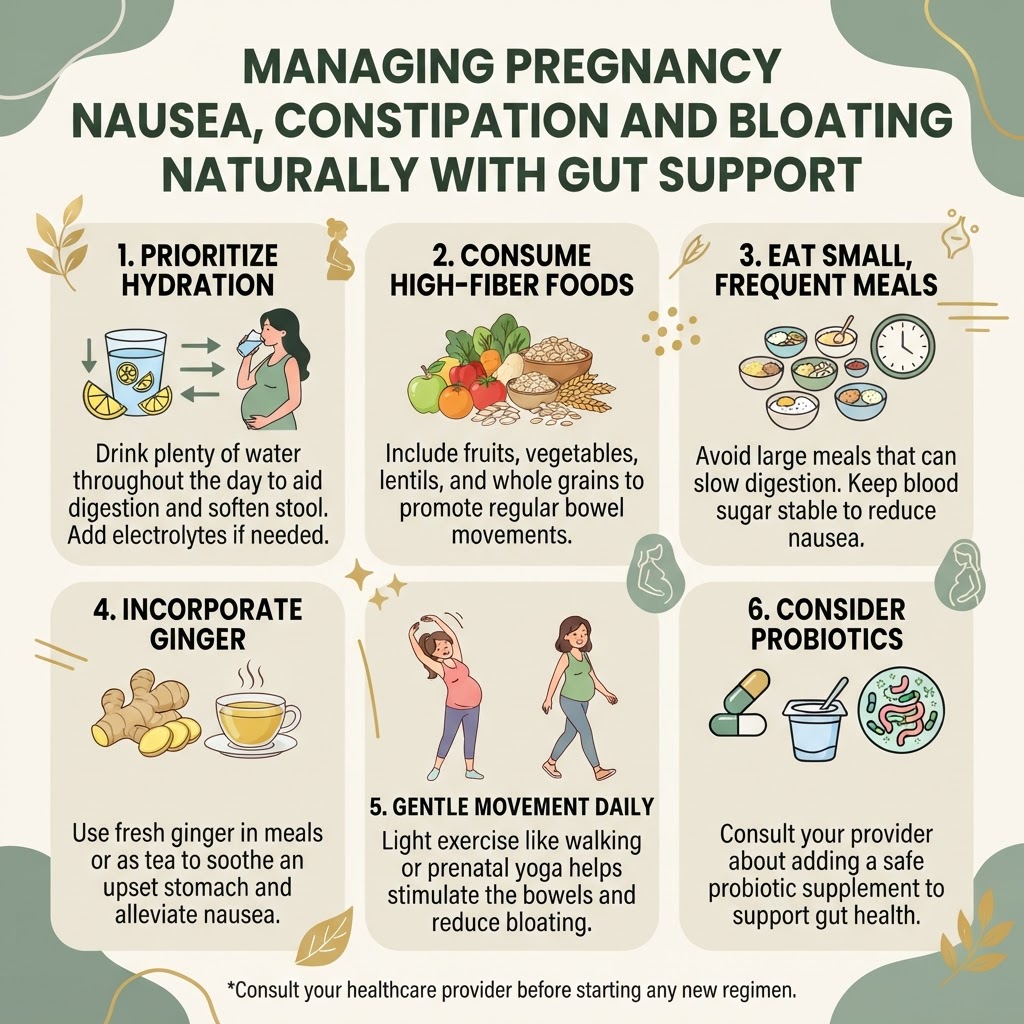
Stay adequately hydrated. Aim for 8–10 glasses of water or non-caffeinated fluid daily, and consider small sips of ginger tea — ginger has well-documented anti-nausea properties supported by multiple systematic reviews, including one published in the British Journal of Anaesthesia, demonstrating its efficacy in reducing nausea and vomiting during pregnancy.
Eat magnesium-rich foods. Magnesium plays a key role in smooth muscle relaxation and bowel motility. Dark leafy greens, pumpkin seeds, and whole grains are excellent sources, and many pregnant women are deficient without realising it.
Consider fermented foods where tolerated. Natural yoghurt with live cultures, kefir, and sauerkraut can contribute beneficial bacteria to the gut — though some women find fermented foods worsen nausea in the first trimester. Listen to your body and introduce these gently.
The Case for Targeted Supplementation: Why Food Alone May Not Be Enough
Even with the best dietary intentions, pregnancy increases your nutritional demands significantly, while nausea often reduces your ability to eat consistently. This is where a carefully formulated supplement becomes not a luxury but a genuine clinical support tool.
PregBiotics Essentials was developed specifically to address this gap. Unlike generic probiotics or standard prenatal vitamins, it is formulated around the specific microbiome and nutritional needs of the pregnant body — and it targets all three of the symptoms we have been discussing.
Key nutrients and strains in PregBiotics Essentials include:
- Lactobacillus rhamnosus GG — one of the most extensively studied probiotic strains in pregnancy, shown to support gut barrier integrity and reduce the incidence and severity of gastrointestinal symptoms
- Lactobacillus acidophilus — supports vaginal microbiome health while contributing to gut microbial balance and aiding constipation relief; directly relevant to the bloating pregnancy remedies discussion
- Bifidobacterium longum — supports bowel regularity, reduces intestinal transit time, and has been associated with improved serotonin-related gut-brain signalling
- Prebiotic FOS (fructooligosaccharides) — a gentle, non-gaseous prebiotic fibre that feeds and sustains the beneficial bacterial strains
- Vitamin B6 (Pyridoxine) — clinically supported for reducing pregnancy nausea and vomiting; the NHS and ACOG both recognise B6 as a first-line recommendation for morning sickness gut health management
- Magnesium bisglycenate — a highly bioavailable form of magnesium to support gut motility and reduce the constipation pregnancy probiotics approach requires
- Ginger root extract — standardised for gingerols, the active compounds responsible for its anti-emetic properties
The formulation philosophy behind PregBiotics Essentials is based on a simple but important principle: your gut is the foundation of your pregnancy health, and when you support it comprehensively, the downstream benefits — fewer nausea episodes, more regular bowel movements, less bloating, better mood, better nutrient absorption — follow naturally.
Suggested Infographic: "The Pregnancy Gut Symptom Cycle" — Visual showing how hormonal changes → microbiome shifts → slowed motility → constipation/bloating/nausea → vicious cycle. Overlay with intervention points: probiotics, hydration, fibre, B6, ginger.
Expert Tips and Actionable Advice: What I Tell My Patients
Over years of clinical practice and through founding PregBiotics, I have had thousands of conversations with pregnant women about their digestive symptoms. Here are the strategies I return to again and again because the evidence — and my patients' experiences — consistently back them up:
-
Take your probiotic supplement consistently, not just when you feel bad. Microbiome support is cumulative. The beneficial bacteria in a quality probiotic need time to colonise and establish themselves. Think of it like tending a garden — you cannot water it once and expect a harvest.
-
Eat within 30 minutes of waking. Blood sugar dips overnight often trigger or worsen morning nausea. A small, protein-rich snack or a few plain crackers before you even get out of bed can take the edge off significantly.
-
Move gently, every day. Even a 20-minute walk after meals can meaningfully improve gut motility and reduce bloating. You do not need a structured workout — gentle, consistent movement is what counts.
-
Elevate your upper body slightly after eating. Lying flat immediately after a meal slows gastric emptying and worsens reflux and bloating. Try to remain upright for at least 45–60 minutes post-meal.
-
Reduce FODMAP foods during flares. During periods of significant bloating, temporarily reducing high-FODMAP foods (such as large quantities of apples, onions, wheat, and legumes) can provide meaningful relief. This is not a permanent dietary change — just a short-term tool.
-
Chew your food thoroughly. Digestion begins in the mouth. Proper chewing reduces the particle size of food entering the stomach, eases the digestive burden, and reduces gas formation lower in the tract. It sounds simple, because it is — but it genuinely works.
-
Address stress as a gut health intervention. A five-minute breathing practice, prenatal yoga, journalling, or simply stepping outside for fresh air can measurably alter your gut-brain axis activity. These are not soft suggestions — they are physiological interventions.
-
Track your symptoms alongside your diet and bowel habits. Patterns emerge quickly. Many women discover that certain foods consistently precede their worst days. Knowledge is power — and a simple symptom diary takes only a few minutes a day.
-
Do not self-prescribe laxatives without guidance. Some over-the-counter laxatives are not safe in pregnancy. Osmotic laxatives like lactulose are generally considered safer, but always check with your midwife or doctor first. Probiotic and dietary approaches should always be your first line.
-
Pair your PregBiotics Essentials with a consistent routine. Taking your supplement at the same time each day — such as with breakfast — improves adherence and allows your body to establish a rhythm. Consistency, in gut health as in so much of pregnancy, is everything.
When to Seek Medical Advice: Knowing the Limits of Self-Management
While most digestive discomfort in pregnancy is normal and manageable with the approaches outlined in this article, there are circumstances where symptoms require prompt medical evaluation.
Seek medical attention if you experience:
- Severe, persistent vomiting that prevents you from keeping any food or fluid down (this may indicate hyperemesis gravidarum, a serious condition affecting up to 3% of pregnancies, as documented by the World Health Organization)
- Signs of dehydration — dark urine, dizziness, reduced urination, or extreme fatigue
- Constipation lasting longer than one week without any bowel movement, or accompanied by abdominal pain or blood in the stool
- Sudden, severe abdominal pain or cramping at any stage of pregnancy
- Bloating accompanied by fever, vomiting, or any change in your baby's movements
It is also important to remember that not all supplements are appropriate for all pregnancies. While probiotics have an excellent safety profile in pregnancy — supported by a large body of evidence including a Cochrane review on probiotic safety in pregnant and breastfeeding women — you should always inform your midwife, obstetrician, or GP about any supplements you are taking or considering.
Your care team is your partner in this journey. Empowering yourself with knowledge is not a replacement for professional guidance — it is a complement to it.
Conclusion: Your Gut Deserves Attention — And You Deserve to Feel Well
Pregnancy is one of the most profound experiences of a woman's life, and you deserve to experience it with as much comfort, vitality, and joy as possible. Nausea, constipation, and bloating are common — but common does not mean inevitable, and it certainly does not mean untreatable.
What I hope this article has given you is not just a list of tips, but a genuine understanding of why your gut behaves the way it does during pregnancy. When you understand the hormonal drivers, the microbiome changes, and the gut-brain connections at play, you stop feeling like your body is failing you — and you start to see the clear, logical pathways toward feeling better.
Supporting your gut microbiome through quality targeted supplementation like PregBiotics Essentials, nourishing nutrition, consistent hydration, gentle movement, and stress management is not a passive approach to pregnancy symptoms. It is an active, evidence-based investment in your own wellbeing and your baby's foundational health.
The research is clear: a healthy maternal gut microbiome during pregnancy lays a crucial groundwork for infant immune development, birth outcomes, and even long-term metabolic health in your child. When you support your gut, you are doing something deeply meaningful — for both of you.
You are not just managing symptoms. You are building a foundation.
For more science-backed guidance on gut health throughout your pregnancy journey, visit The PregBiotics Journal — where we continue to translate the latest maternal microbiome research into practical, empowering support for mothers at every stage.
Dr. Chomba Chuma, MD, is a physician and the Founder of PregBiotics. She specialises in maternal gut health and the microbiome-pregnancy interface. The content in this article is intended for educational purposes and does not constitute individual medical advice. Always consult your healthcare provider regarding your personal pregnancy care.
Get the PregBiotics Journal in your inbox
Gut-smart guidance for conception, pregnancy and breastfeeding — twice a week, plus member-only offers. Unsubscribe anytime.
You deserve to feel beautifully supported.
Join thousands of mothers on the PregBiotics journey. Receive your free Pregnancy Prep Guide and gentle, science-backed wisdom — tailored to where you are right now.