Managing Pregnancy Nausea, Constipation and Bloating Naturally With Gut Support
Imagine this: it's 7am, you're eight weeks pregnant, and the smell of your morning coffee — the one you've loved for years — sends you sprinting to the bathroom. By mid-morning, you're bloated and uncomfortable. By afternoon, you haven't had a proper bowel movement in four days. You're exhausted, ov
Dr. Chomba Chuma, MD & Founder
MD & Founder, PregBiotics

Managing Pregnancy Nausea, Constipation and Bloating Naturally With Gut Support
By Dr. Chomba Chuma, MD & Founder | PregBiotics Journal
Introduction
Imagine this: it's 7am, you're eight weeks pregnant, and the smell of your morning coffee — the one you've loved for years — sends you sprinting to the bathroom. By mid-morning, you're bloated and uncomfortable. By afternoon, you haven't had a proper bowel movement in four days. You're exhausted, overwhelmed, and wondering whether any of this is normal.
I want to start by telling you: it is. And you are not alone.
Studies suggest that up to 85% of pregnant women experience nausea and vomiting during pregnancy, while constipation affects between 11–38% of women at some point across all three trimesters. Bloating and gas? Almost universally reported. These are among the most common — and most distressing — physical complaints of pregnancy, and yet they are frequently dismissed as "just part of pregnancy."
But here's what I find fascinating as both a physician and a gut health researcher: all three of these symptoms — nausea, constipation, and bloating — are deeply connected to your gut. More specifically, to the community of trillions of microorganisms living in your digestive tract, known as the gut microbiome.
In this article, I'm going to walk you through the science of why pregnancy disrupts your digestive system, what that means for your day-to-day experience, and — most importantly — how targeted nutrition and gut support can help you feel more like yourself again. Because managing these symptoms isn't just about comfort. It's about supporting your health and your baby's development from the inside out.
The Biology Behind Pregnancy's Digestive Disruption
To understand why your gut feels so different during pregnancy, we need to look at what's actually happening inside your body — because the changes are significant, swift, and interconnected.
Hormonal Shifts and Their Gut Consequences
From the moment of implantation, your body begins a hormonal revolution. Progesterone — the hormone essential for maintaining pregnancy — rises dramatically and stays elevated throughout gestation. While this is vital for your baby's safety, progesterone is also a smooth muscle relaxant. That means the muscles lining your entire digestive tract slow down.
The technical term for this is reduced gastrointestinal motility, and its effects are far-reaching. Food moves more slowly through your stomach and intestines. The lower oesophageal sphincter relaxes, contributing to acid reflux. The colon reabsorbs more water from stool as it lingers, leading to harder, drier stools — and the constipation so many women know all too well.
At the same time, human chorionic gonadotropin (hCG) — the hormone detected in pregnancy tests — surges in the first trimester and is strongly implicated in pregnancy nausea gut responses. Research published in Reproductive Sciences suggests that the gut itself may be a key mediator of hCG-driven nausea, through its effect on serotonin signalling in the gut-brain axis.
The Gut-Brain Axis: Your Body's Hidden Communication Network
Here's where things get especially interesting. Your gut and brain are in constant, bidirectional communication via what scientists call the gut-brain axis — a complex network of neural, hormonal, and immunological signals. Approximately 95% of your body's serotonin (the "feel good" neurotransmitter) is actually produced in the gut, not the brain.
During pregnancy, shifts in your gut microbiome — which are well documented and begin as early as the first trimester — can disrupt serotonin production and regulation. This may contribute directly to morning sickness gut health issues, as altered gut signalling affects the nausea centres in the brain.
A Microbiome in Transition
Research published in Cell Host & Microbe by Koren et al. demonstrated that the composition of the gut microbiome changes substantially across the three trimesters of pregnancy — and that these changes, while partly adaptive, can also increase susceptibility to digestive discomfort, inflammation, and metabolic disruption if the beneficial bacteria are not adequately supported.
Physical Pressure and Its Role
As your uterus grows — particularly from the second trimester onward — it physically compresses the stomach and intestines, further slowing transit time and contributing to feelings of fullness, bloating, and gas. Combined with the hormonal and microbial changes already underway, the result is a perfect storm of digestive discomfort.
Understanding this biology is the first step toward addressing it. Because when you know why your gut is struggling, you can take meaningful, targeted action.
What This Means For You: Translating Science Into Daily Life
The biology is fascinating, but what does it actually mean for how you feel on a Tuesday morning at nine weeks pregnant? Let me make this real and practical.
Nausea Is a Gut Story
When we talk about morning sickness gut health, we're really talking about a gut-brain communication problem. Your altered microbiome and slowed digestive motility create a cascade of signals that your brain interprets as nausea. This is why nausea often improves when gut function improves — and why strategies that support the microbiome can reduce the severity of symptoms for many women.
What you might experience:
- Nausea that is worse on an empty stomach (because slower gastric emptying means acids linger longer)
- Nausea triggered by certain smells or foods linked to inflammatory gut responses
- Nausea that is worse in the morning after a night of fasting and accumulated stomach acid
- Nausea that improves slightly after eating small, easily digestible foods
Constipation Is Not Inevitable
Constipation during pregnancy is so common that many women accept it as unavoidable. It isn't. When we understand that constipation pregnancy probiotics research shows measurable improvements in transit time and stool consistency with the right bacterial strains, we realise there is real, evidence-based action to take.
Signs your constipation needs attention:
- Fewer than three bowel movements per week
- Hard, dry, or pellet-like stools
- Straining that causes pain or haemorrhoids
- A persistent feeling of incomplete emptying
Bloating Is a Microbiome Signal
Bloating pregnancy remedies often focus on surface-level solutions — peppermint tea, avoiding carbonated drinks — without addressing the root cause. Bloating is largely a product of gas produced by bacteria fermenting undigested food in the colon. When your microbiome is out of balance (a state called dysbiosis), certain gas-producing bacteria can overgrow, making bloating worse.
Common bloating triggers during pregnancy:
- Iron supplementation (a known cause of constipation and bloating)
- High-fibre foods introduced too quickly without adequate water intake
- Lactose sensitivity, which can worsen during pregnancy for some women
- Slowed gastric emptying causing food to ferment in the stomach
Recognising these patterns in your own body is empowering. It means you can make targeted changes — not just cope.
The Role of Nutrition, Gut Support, and Supplementation
This is where science meets practical maternal care, and where I want to share what we've built at PregBiotics around these very needs.
Dietary Foundations
Before we talk about supplementation, nutrition matters enormously. A diet rich in diverse plant foods — fruits, vegetables, legumes, whole grains — provides the prebiotic fibre that feeds beneficial gut bacteria. Fermented foods like live-culture yogurt, kefir, and sauerkraut introduce beneficial organisms naturally. Adequate hydration (aim for 8–10 glasses of water daily) softens stool and supports motility.
However, during pregnancy — particularly in the first trimester when nausea is often severe — eating a diverse, balanced diet can feel practically impossible. This is where targeted supplementation becomes not just helpful, but clinically important.
Why Probiotics Matter in Pregnancy
The evidence for probiotics in pregnancy is growing rapidly. A systematic review published in the British Journal of Nutrition found that probiotic supplementation during pregnancy was associated with reduced constipation, improved stool frequency, and a lower incidence of gestational complications. Crucially, probiotics were found to be safe for use throughout pregnancy.
Specific strains matter. Not all probiotics are equal, and the research on constipation pregnancy probiotics points to particular strains with well-documented effects on gut motility and microbiome composition.
Introducing PregBiotics Essentials
PregBiotics Essentials was formulated specifically for this — for the mother who is navigating the complex terrain of pregnancy digestive issues and wants science-led support that she can trust.
Key strains and nutrients in PregBiotics Essentials and why they matter:
- Lactobacillus rhamnosus GG — One of the most extensively researched probiotic strains; supports gut barrier integrity, reduces intestinal inflammation, and has demonstrated benefits for nausea reduction in clinical settings
- Bifidobacterium longum — A dominant species in a healthy gut microbiome; improves bowel regularity and reduces bloating by outcompeting gas-producing bacteria
- Lactobacillus acidophilus — Supports vaginal microbiome health and digestive balance; reduces the overgrowth of harmful organisms that can worsen gut dysbiosis
- Prebiotic inulin (FOS) — Feeds the beneficial bacteria, ensuring they thrive and colonise effectively; also softens stool naturally
- Ginger root extract — Clinically validated for reducing nausea and vomiting in pregnancy; works through both gut motility improvement and anti-inflammatory pathways
- Magnesium citrate — Gently supports bowel regularity by drawing water into the colon; a safer, gentler alternative to stimulant laxatives
- Vitamin B6 (Pyridoxine) — Recommended by ACOG (American College of Obstetricians and Gynecologists) as a first-line intervention for pregnancy nausea
Together, these components work synergistically — addressing the gut-brain axis, supporting microbiome diversity, and tackling both the motility and fermentation issues that drive digestive discomfort in pregnancy.
For a deeper understanding of how your gut functions during each trimester, explore our Pregnancy Gut Guide, where I walk you through what your microbiome needs at every stage.
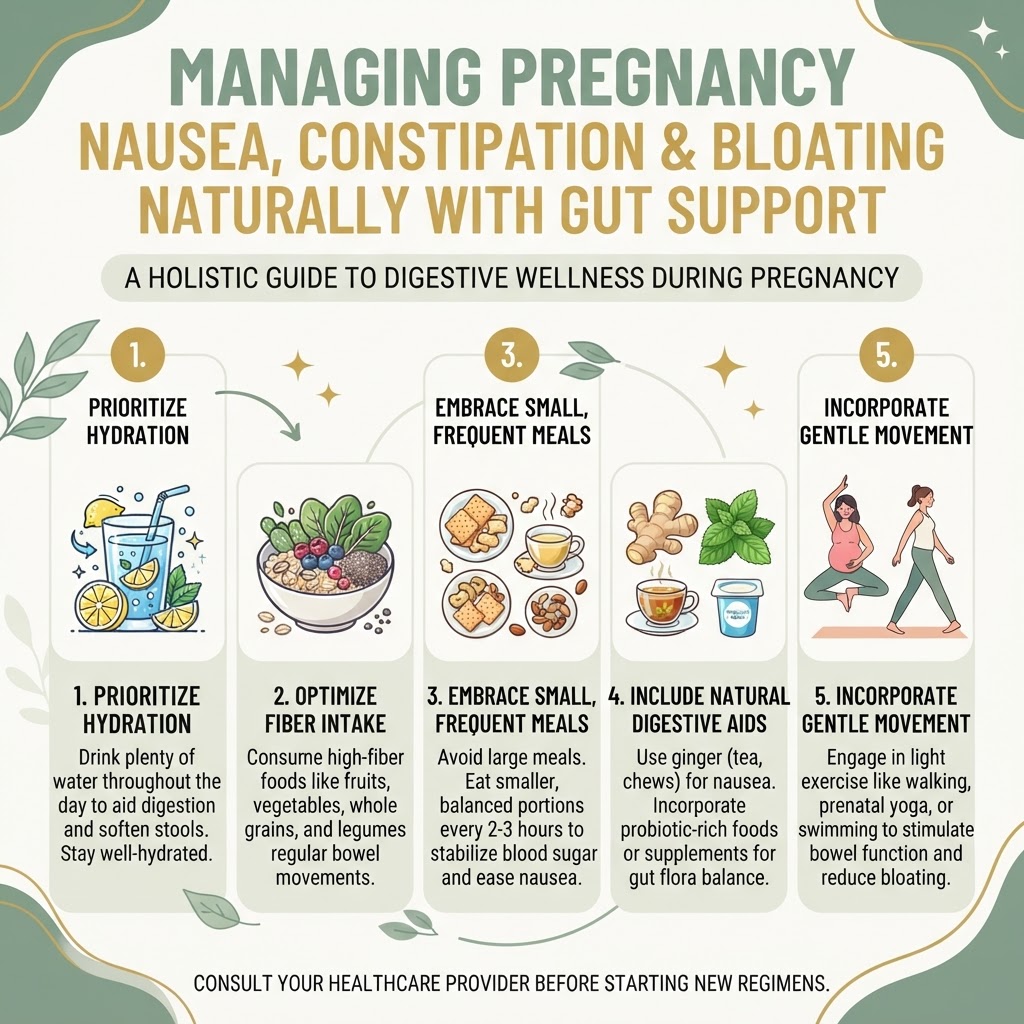
Suggested Infographic: "How PregBiotics Essentials Targets the 3 Core Digestive Complaints of Pregnancy" — visual showing nausea (gut-brain axis), constipation (motility + probiotics), bloating (microbiome balance + prebiotics)
Expert Tips and Actionable Advice
As a physician, I always want to leave my patients with something concrete they can do today. Here are my evidence-informed recommendations for managing nausea, constipation, and bloating during pregnancy:
For Nausea:
-
Never let your stomach be completely empty. Keep plain crackers, oat cakes, or dry toast by your bedside and eat a small amount before getting up in the morning. Rising slowly with something in your stomach can dramatically reduce early morning nausea.
-
Eat small, frequent meals every 2–3 hours. Large meals overwhelm a sluggish digestive system. Smaller portions are processed more comfortably and leave the stomach more quickly.
-
Try cold or room-temperature foods. Hot foods release more aroma, which can trigger nausea. Cold foods are often better tolerated in early pregnancy.
-
Consider ginger in multiple forms. Ginger tea, ginger chews, ginger capsules — the research supports 1g of ginger daily as an effective, safe intervention for pregnancy nausea gut symptoms.
-
Start your probiotic support early. Beginning gut support before nausea peaks — ideally from the moment you find out you're pregnant — can help maintain microbiome stability and reduce the severity of symptoms.
For Constipation:
-
Increase fibre gradually, not suddenly. A sudden fibre increase can actually worsen bloating and discomfort. Add one new plant food every few days and allow your microbiome to adjust.
-
Hydration is non-negotiable. Fibre without water is like adding dry concrete to your intestines. Aim for at least 8 glasses of water daily, more if you're in warm weather or vomiting frequently.
-
Move your body gently every day. Even a 20-minute walk stimulates gut motility. Prenatal yoga poses, particularly those involving gentle twists and hip openers, can support bowel movement.
-
Consider the timing of your iron supplement. Iron is a well-known cause of constipation. Ask your midwife or OB whether an alternate-day dosing schedule or a gentler form of iron (like ferrous bisglycinate) might suit you better.
For Bloating:
-
Eat mindfully and slowly. Swallowing air while eating quickly significantly increases gas production. Take your time, chew thoroughly, and try to eat in a relaxed environment.
-
Identify your personal trigger foods. Common culprits include cruciferous vegetables (broccoli, cabbage), legumes, and dairy. You don't need to eliminate them — just introduce them gradually and in smaller amounts.
-
Try abdominal massage. Gentle clockwise massage of the abdomen (following the direction of the colon) can encourage gas movement and relieve bloating naturally.
When to Seek Medical Advice
While nausea, constipation, and bloating are common during pregnancy, there are circumstances where these symptoms warrant prompt medical attention. I always encourage my patients to trust their instincts — if something feels wrong, please reach out to your healthcare provider.
Seek medical care if you experience:
- Hyperemesis gravidarum — severe, unrelenting nausea and vomiting that prevents you from keeping food or fluids down, causes significant weight loss, or leads to dehydration. This is a medical condition that requires treatment, not just management.
- No bowel movement for more than a week, particularly if accompanied by abdominal pain or bloating that is severe and worsening
- Blood in your stool — while haemorrhoids are common in pregnancy, rectal bleeding should always be evaluated
- Severe abdominal pain that is sudden, sharp, or accompanied by fever
- Signs of dehydration — dark urine, dizziness, rapid heartbeat, or significantly reduced urination
The NHS recommends that all pregnant women maintain regular contact with their midwife or obstetrician throughout pregnancy, including open communication about digestive symptoms that are affecting quality of life. You deserve relief, and there is always more that can be done. Please don't suffer in silence.
Conclusion
Pregnancy is one of the most extraordinary journeys a human body can undertake — and your gut is right at the centre of it. The nausea that catches you off guard, the constipation that makes mornings miserable, the bloating that leaves you reaching for your loosest clothes — these aren't just discomforts to endure. They are signals from your gut microbiome and digestive system, telling you that they need support.
The good news is that with the right knowledge and the right tools, these symptoms are manageable. A combination of mindful eating, adequate hydration, gentle movement, and targeted gut support — including the strains and nutrients in PregBiotics Essentials — can make a meaningful difference to how you feel through your pregnancy.
What I want you to take away from this is simple: you have agency. Your gut health is not something that happens to you during pregnancy — it's something you can actively nurture, for yourself and for the tiny person growing inside you. The microbiome you cultivate now will be one of the most profound biological gifts you give your child.
If you found this article helpful, I invite you to explore more evidence-based guidance across all areas of pregnancy gut health at The PregBiotics Journal. We publish regular, science-led content written for mothers who want more than just generic advice — mothers who want to understand their bodies and feel empowered to care for them.
You've got this. And I'm here to help.
Dr. Chomba Chuma, MD Founder, PregBiotics Board-certified physician | Specialising in maternal microbiome health and gut-focused prenatal care
This article is for educational and informational purposes only and does not constitute medical advice. Always consult your healthcare provider before beginning any new supplement during pregnancy.
Get the PregBiotics Journal in your inbox
Gut-smart guidance for conception, pregnancy and breastfeeding — twice a week, plus member-only offers. Unsubscribe anytime.
You deserve to feel beautifully supported.
Join thousands of mothers on the PregBiotics journey. Receive your free Pregnancy Prep Guide and gentle, science-backed wisdom — tailored to where you are right now.