Managing Pregnancy Nausea, Constipation and Bloating Naturally With Gut Support
Picture this: it's 7am, you're eight weeks pregnant, and before your feet have even touched the floor, a wave of nausea rolls over you. You drag yourself to the kitchen for dry crackers, only to realise you haven't had a proper bowel movement in four days. By midday, your belly feels so bloated and
Dr. Chomba Chuma, MD & Founder
MD & Founder, PregBiotics

Managing Pregnancy Nausea, Constipation and Bloating Naturally With Gut Support
By Dr. Chomba Chuma, MD & Founder | PregBiotics Journal
Introduction
Picture this: it's 7am, you're eight weeks pregnant, and before your feet have even touched the floor, a wave of nausea rolls over you. You drag yourself to the kitchen for dry crackers, only to realise you haven't had a proper bowel movement in four days. By midday, your belly feels so bloated and uncomfortable that your loosest pair of trousers feel like a vice. Sound familiar?
If it does, you are not alone — not by a long stretch. Studies suggest that up to 80% of pregnant women experience nausea or vomiting, particularly during the first trimester, while constipation affects an estimated 40% of pregnancies at some point, and bloating is one of the most universally reported digestive complaints from conception through to the third trimester. These are not minor inconveniences. For many mothers, they are daily battles that affect nutrition, sleep, work, and quality of life.
What rarely gets talked about — and what I've built my entire clinical practice and the PregBiotics brand around — is the profound connection between these symptoms and the health of your gut microbiome. The good news? Understanding this connection puts real, meaningful tools in your hands.
In this article, I'll walk you through the science behind pregnancy nausea gut changes, why constipation and bloating are so common in pregnancy, and how targeted gut support — through nutrition, lifestyle, and the right supplementation — can offer genuine, lasting relief. Let's start at the root.
The Biology Behind Pregnancy Digestive Symptoms
To understand why your gut feels so different in pregnancy, we need to talk about what is actually happening inside your body — because the changes are profound, far-reaching, and begin almost immediately after conception.
Hormones Are Running the Show
The dramatic rise in progesterone during early pregnancy is one of the primary drivers of digestive disruption. Progesterone is a smooth muscle relaxant — which is essential for relaxing the uterus to accommodate your growing baby, but it has the same relaxing effect on the smooth muscle of the entire gastrointestinal tract. The result? Slowed gut motility. Food moves more slowly through your intestines, water is reabsorbed more aggressively, and stool becomes harder and more difficult to pass. This is the direct biological mechanism behind constipation in pregnancy.
Meanwhile, rising levels of human chorionic gonadotropin (hCG) — the hormone that surges in the first trimester — are strongly associated with pregnancy nausea and morning sickness. Research published in Reproductive Sciences has suggested a meaningful correlation between peak hCG levels and the severity of nausea, which explains why symptoms are often worst between weeks 8–10 and typically ease as hCG levels plateau.
Your Microbiome Is Actively Reshaping Itself
Here is what truly fascinates me as a clinician and researcher: pregnancy doesn't just affect gut motility and hormones — it fundamentally reshapes your gut microbiome. A landmark study published in Cell by Koren et al. demonstrated that the gut microbiome undergoes dramatic compositional shifts across the trimesters of pregnancy, with changes that, in non-pregnant individuals, would actually resemble a state of metabolic dysfunction.
These microbiome shifts — including reductions in microbial diversity and alterations in the balance of key bacterial families — have downstream effects on:
- Gut transit time, influencing constipation
- Gas production, contributing directly to bloating and discomfort
- The gut-brain axis, which plays a meaningful role in nausea signalling
- Immune tolerance, essential for a healthy pregnancy but also affecting gut inflammation
The Gut-Brain Axis and Morning Sickness
The gut-brain axis — the bidirectional communication network between your enteric nervous system (sometimes called the "second brain") and your central nervous system — is increasingly understood to influence nausea responses. Serotonin, approximately 90% of which is produced in the gut, plays a key role in both gut motility and nausea signalling. When the gut microbiome is disrupted, serotonin production and signalling can be affected, potentially amplifying feelings of nausea and digestive discomfort in the context of pregnancy nausea gut changes.
This is why addressing gut health isn't a peripheral strategy when it comes to morning sickness gut health — it's central to it.
What This Means For You: Understanding Your Symptoms Through a Gut Lens
Understanding the biology is empowering, but what does it actually mean for your day-to-day experience? Here is how I translate the science into something you can act on.
Nausea Isn't Just About Your Stomach
When you feel nauseated, it's tempting to think of it purely as a stomach issue — but as we've established, the gut-brain axis means nausea is a whole-system response. A disrupted microbiome can amplify nausea signals, increase gut hypersensitivity, and slow gastric emptying, all of which worsen the sensation. Addressing pregnancy nausea gut health directly — not just masking the symptom — is a more sustainable approach.
Constipation Has Layers
Pregnancy constipation isn't simply about "not drinking enough water" (though hydration matters enormously). The factors stacking against you include:
- Progesterone-driven motility reduction — slowing transit throughout the gut
- Iron supplementation — many prenatal vitamins contain ferrous sulphate, which is notoriously constipating
- Dietary changes — nausea often means women eat less fibre-rich food in the first trimester
- Reduced physical activity — fatigue in early pregnancy is real, and movement stimulates gut motility
- Microbiome imbalance — reduced populations of key short-chain fatty acid (SCFA) producing bacteria diminish the natural signals that promote healthy bowel movements
When it comes to constipation pregnancy probiotics, the evidence is building. A 2020 systematic review in Nutrients found that probiotic supplementation showed positive effects on stool frequency and consistency in constipated adults, with a particularly promising safety profile for use in pregnancy.
Bloating Is About Bacterial Gas Production
Bloating in pregnancy is largely driven by increased gas production in the gut. As motility slows and microbiome composition shifts, certain bacteria produce more fermentation gases — hydrogen, methane, and carbon dioxide — leading to distension, discomfort, and that uncomfortable "full but empty" feeling. Addressing the bacterial balance in the gut is one of the most effective bloating pregnancy remedies available, and it's one that works from the inside out.
Key practical takeaways from the science:
- Your gut is a dynamic, living ecosystem — it responds to what you feed it and how you support it
- Symptoms like nausea, constipation, and bloating are interconnected through the microbiome
- Supporting gut health is not a luxury add-on in pregnancy — it is foundational care
- Probiotic and prebiotic support is increasingly recognised as safe and beneficial in pregnancy
For a broader overview of how to support your gut throughout pregnancy, our Pregnancy Gut Guide is a fantastic place to start.
The Role of Nutrition and Supplementation in Gut-Led Relief
Food is medicine — but in pregnancy, when nausea makes the sight of a salad unbearable and your cravings run more toward dry toast and ginger biscuits, optimising nutrition takes real strategy. Here is how I approach it with my patients, and how targeted supplementation bridges the gaps.
Dietary Foundations
Even small, consistent dietary choices can meaningfully support your gut microbiome and reduce digestive issues pregnancy brings:
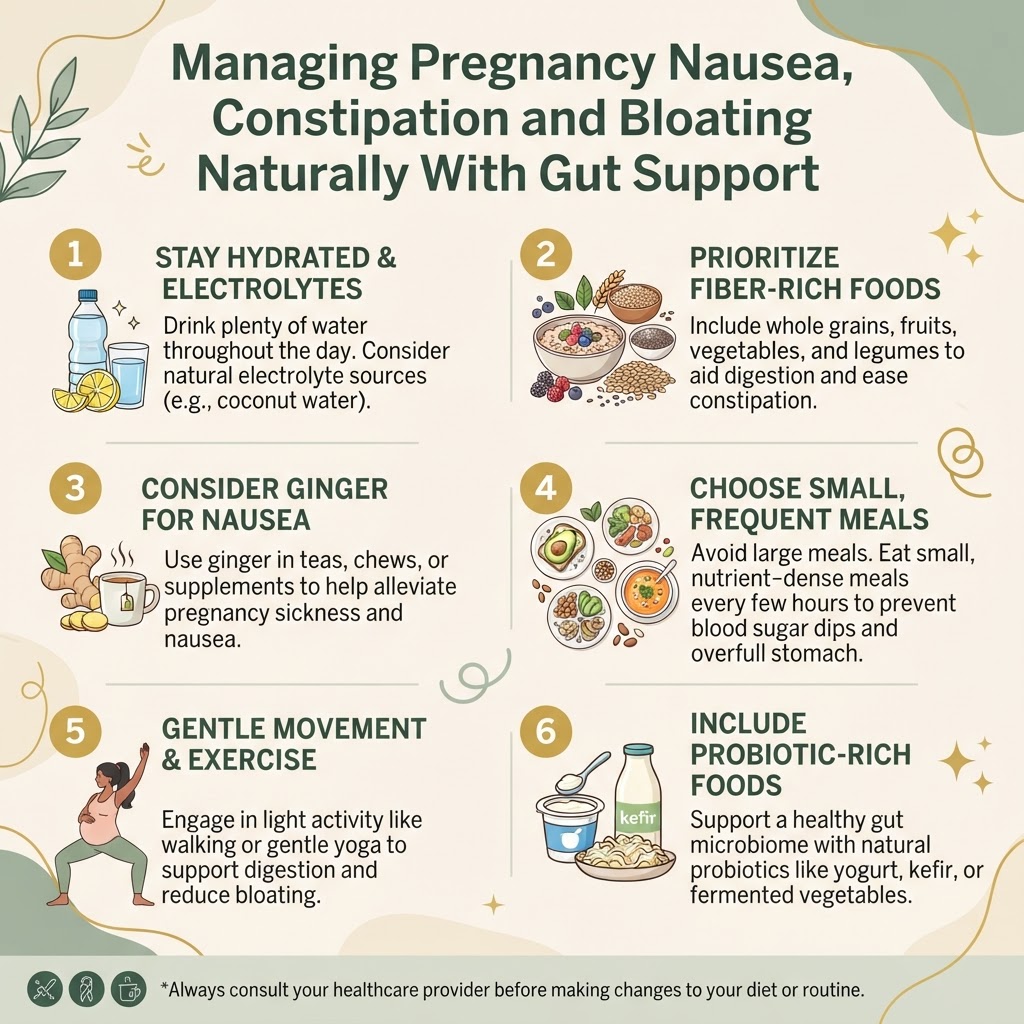
- Prebiotic-rich foods: Oats, bananas (especially slightly underripe ones), garlic, leeks, and asparagus feed beneficial gut bacteria. Even half a banana a day makes a difference.
- Fermented foods: Natural yoghurt, kefir, sauerkraut, and miso introduce live cultures to the gut — though in early pregnancy nausea, these can be harder to tolerate. Start small.
- Fibre diversity: Aim for a variety of fibre types — soluble (oats, apples, flaxseed) and insoluble (wholegrains, vegetables) — to support both stool bulk and feeding a diverse microbiome.
- Hydration: Every additional glass of water you drink supports gut motility, softens stool, and helps manage bloating. Aim for 8–10 glasses daily.
- Ginger: Backed by clinical evidence, ginger in tea, capsule, or biscuit form has demonstrated efficacy in reducing nausea in pregnancy — and it has mild carminative (gas-relieving) properties too.
Where Supplementation Becomes Essential
Diet alone has limits — particularly in the first trimester when food aversions, nausea, and fatigue are at their peak. This is where a well-formulated, pregnancy-specific probiotic and prebiotic supplement becomes not just helpful, but genuinely important.
This is exactly why I developed PregBiotics Essentials. It is a carefully formulated maternal gut health supplement designed specifically for the demands of pregnancy, with each ingredient chosen based on clinical evidence.
Key strains and nutrients in PregBiotics Essentials include:
- Lactobacillus rhamnosus GG — one of the most extensively studied probiotic strains in pregnancy, supporting gut barrier integrity and immune modulation
- Lactobacillus acidophilus — supports healthy microbiome balance and has been linked to reductions in gut inflammation
- Bifidobacterium longum — promotes healthy bowel function, addressing constipation pregnancy probiotics needs directly
- Lactobacillus reuteri — associated with reduced intestinal transit time and has been studied in the context of nausea reduction
- Prebiotic FOS (Fructooligosaccharides) — feeds and sustains beneficial bacteria in the gut, amplifying the effect of the probiotic strains
- Ginger root extract — clinically dosed for nausea support and digestive comfort
- Vitamin B6 (Pyridoxine) — well-evidenced for reducing morning sickness gut health related nausea, and often recommended by NICE guidelines for this purpose
Every ingredient is dosed at clinically relevant levels, free from artificial additives, and formulated with the safety of both mother and baby as the absolute priority.
Expert Tips and Actionable Advice for Managing Symptoms Naturally
Here are the evidence-informed strategies I recommend to my patients, and that I share publicly because every pregnant woman deserves access to this knowledge:
-
Start your probiotic early. Ideally, gut support should begin in the pre-conception period or as soon as you find out you are pregnant. The earlier you begin cultivating a healthy microbiome, the better positioned you are to manage first-trimester symptoms.
-
Eat little and often. An empty stomach worsens nausea — the stomach acid has nothing to work on and irritates the gut lining. Small, frequent meals every 2–3 hours keep blood sugar stable and stomach acid occupied.
-
Prioritise morning hydration. Drink a glass of warm water with a squeeze of lemon before anything else in the morning. This gently stimulates the migrating motor complex — the "housekeeping wave" of gut contractions — and helps get things moving naturally.
-
Move your body gently, every day. A 15–20 minute walk after meals significantly improves gut motility. You don't need intense exercise — gentle movement is enough to stimulate the bowel and reduce bloating.
-
Position matters for constipation. Use a small footstool to elevate your feet when sitting on the toilet — this adopts the squatting position that the human colon is anatomically designed for, making elimination significantly easier.
-
Don't suppress the urge. When your body signals it's time to go, respond promptly. Delaying the urge to open your bowels repeatedly leads to harder, drier stool and worsens constipation over time.
-
Reconsider your iron supplement. If your prenatal contains ferrous sulphate and constipation is a serious problem, speak to your midwife or GP about switching to a gentler form of iron, such as ferrous bisglycinate, which has a much better gastrointestinal tolerability profile.
-
Warm ginger tea before bed. A cup of fresh ginger tea — made by steeping a few slices of fresh root in boiling water for 10 minutes — can ease both evening nausea and bloating, while the warmth supports gut motility overnight.
-
Take your probiotic consistently. The gut microbiome responds to consistency. Missing doses occasionally won't derail progress, but daily use builds and sustains the bacterial populations that drive meaningful symptom improvement.
-
Manage stress actively. The gut-brain axis means that stress and anxiety directly worsen gut symptoms. Mindfulness, breathwork, prenatal yoga, and adequate sleep are not indulgences — they are part of your gut health strategy.
When to Seek Medical Advice
While nausea, constipation, and bloating are common and usually manageable with the strategies outlined in this article, there are circumstances where symptoms warrant urgent medical attention. Please do not hesitate to contact your GP, midwife, or maternity unit if you experience:
- Severe, persistent vomiting that prevents you from keeping any food or fluids down — this may indicate Hyperemesis Gravidarum, a serious condition requiring medical treatment
- No bowel movement for more than a week, particularly if accompanied by pain, cramping, or fever
- Blood in your stool or on toilet paper
- Severe abdominal pain that is sudden, sharp, or worsening
- Signs of dehydration — dark urine, dizziness, extreme thirst, or significantly reduced urination
- Bloating accompanied by rapid weight gain, swelling of the face or hands, or headaches (which may signal other pregnancy complications)
Natural and supplement-based support works beautifully for the vast majority of pregnant women — but the foundation of your care must always be a trusted healthcare provider who knows your full clinical picture. Everything I recommend through PregBiotics is designed to complement, never replace, your medical care team.
Conclusion
Pregnancy is one of the most remarkable journeys the human body undertakes — and your gut is one of its most important co-pilots. The nausea, constipation, and bloating that so many mothers experience aren't random misfortunes. They are the result of real, identifiable biological changes — hormonal shifts, microbiome remodelling, altered gut motility — that respond beautifully to targeted, evidence-based gut support.
By understanding the connection between your pregnancy nausea gut health, your microbiome, and your daily symptoms, you move from feeling like a passive sufferer to an informed, empowered participant in your own wellbeing. That shift matters enormously — not just for your comfort, but for the long-term health of both you and your baby.
The practical tools are clear: eat little and often, prioritise diverse fibre and hydration, move your body gently, manage stress, and support your gut with a clinically formulated probiotic designed specifically for pregnancy. PregBiotics Essentials was created precisely for this purpose — to give your gut the daily, targeted support it needs throughout every stage of pregnancy.
You deserve to feel as well as possible during this extraordinary time. Your gut health is not a side note — it's the foundation.
For more evidence-based guidance on maternal gut health, explore The PregBiotics Journal, where I share research, clinical insights, and practical wisdom for every stage of your journey.
With warmth and in your corner,
Dr. Chomba Chuma, MD Founder, PregBiotics
This article is intended for informational purposes only and does not constitute medical advice. Always consult your GP, midwife, or obstetric care provider before starting any new supplement during pregnancy.
Get the PregBiotics Journal in your inbox
Gut-smart guidance for conception, pregnancy and breastfeeding — twice a week, plus member-only offers. Unsubscribe anytime.
You deserve to feel beautifully supported.
Join thousands of mothers on the PregBiotics journey. Receive your free Pregnancy Prep Guide and gentle, science-backed wisdom — tailored to where you are right now.