Managing Pregnancy Nausea, Constipation and Bloating Naturally With Gut Support
Picture this: it's 7am, you're eight weeks pregnant, and the smell of your partner's morning coffee — something you used to love — sends you rushing to the bathroom. You make it back to the kitchen, determined to eat something, anything, but your stomach feels like a knotted balloon that hasn't move
Dr. Chomba Chuma, MD & Founder
MD & Founder, PregBiotics

Managing Pregnancy Nausea, Constipation and Bloating Naturally With Gut Support
By Dr. Chomba Chuma, MD & Founder | PregBiotics Journal
Introduction
Picture this: it's 7am, you're eight weeks pregnant, and the smell of your partner's morning coffee — something you used to love — sends you rushing to the bathroom. You make it back to the kitchen, determined to eat something, anything, but your stomach feels like a knotted balloon that hasn't moved in three days. Sound familiar?
If you're nodding along, you are in very good company. Studies suggest that up to 80% of pregnant women experience nausea or vomiting during pregnancy, while constipation affects an estimated 11–38% of expectant mothers — and bloating? It's so common it's practically considered a rite of passage. Yet despite how widespread these symptoms are, so many mothers are told simply to "push through it" or handed a list of generic lifestyle tips that barely scratch the surface of what's actually happening inside their bodies.
Here's what most conversations about pregnancy discomfort miss: your gut is at the centre of all of it.
In this article, I want to take you beyond the surface-level advice and into the real science of why your digestive system is under such profound pressure during pregnancy — and, more importantly, what you can do about it. We'll explore the connection between morning sickness gut health, the role your microbiome plays in digestive symptoms, and how targeted nutritional support can genuinely transform how you feel day to day. Whether you're in your first trimester riding waves of nausea or in your third trimester fighting bloating and constipation, this guide is for you.
The Gut-Pregnancy Connection: What's Really Happening in Your Body
To understand why digestive issues in pregnancy are so pervasive, we need to talk about what pregnancy actually does to your gut — and the answer is: quite a lot.
Hormones Reshape Your Digestive Landscape
From the moment of implantation, your body begins a dramatic hormonal shift. Progesterone, often called the "pregnancy hormone," rises sharply and remains elevated throughout gestation. While progesterone is essential for maintaining the uterine lining and preventing premature contractions, it also has a powerful relaxing effect on smooth muscle tissue — including the muscles of your gastrointestinal tract.
The result? The rhythmic muscular contractions that normally move food through your digestive system (a process called peristalsis) slow down considerably. Food and waste spend longer in the intestines, water is reabsorbed more aggressively, and the outcome is the constipation, gas build-up, and bloating that so many mothers experience. This is not a minor inconvenience — it is a physiological reality driven by the very hormones keeping your pregnancy intact.
As your pregnancy progresses into the second and third trimesters, the physical growth of your uterus adds mechanical pressure on the stomach and intestines, compressing digestive organs and further disrupting normal gut motility.
The Microbiome Shift During Pregnancy
What's even more fascinating — and less discussed — is what happens to your gut microbiome during pregnancy. Research published in Cell Host & Microbe demonstrated that the gut microbiome undergoes substantial compositional changes across the three trimesters of pregnancy. These shifts are partly adaptive — they help optimise energy extraction from food to support foetal growth — but they can also contribute to increased inflammation, reduced microbial diversity, and heightened digestive sensitivity.
Declining populations of beneficial bacteria like Lactobacillus and Bifidobacterium species are commonly observed in pregnant women, particularly those experiencing significant gastrointestinal symptoms. This matters because these strains play key roles in:
- Gut motility regulation — helping keep things moving
- Intestinal barrier integrity — preventing "leaky gut" and systemic inflammation
- Immune modulation — critical during a time when your immune system is deliberately recalibrated to tolerate the foetus
- Serotonin production — up to 95% of your body's serotonin is produced in the gut, influencing nausea signals and mood
Why Nausea Is a Gut Issue
The pregnancy nausea gut connection is more direct than many realise. Nausea during pregnancy is mediated largely through the vagus nerve — a major communication highway between the gut and the brain. A disrupted microbiome produces inflammatory signals and abnormal levels of short-chain fatty acids (SCFAs) that can sensitise this nerve pathway, amplifying nausea responses. Elevated human chorionic gonadotropin (hCG) in the first trimester also slows gastric emptying, meaning food sits in the stomach longer, intensifying feelings of sickness and fullness.
What This Means For You: Translating the Science Into Real Life
Understanding the biology is empowering, but what does it actually mean for your day-to-day experience? Let me connect the science to the symptoms you're living with.
Your Nausea Has a Physical Root — and It Can Be Addressed
Morning sickness is not "in your head," and it is not simply a sign that you're a sensitive person. It is a cascade of hormonal, neurological, and microbiome-driven events. Approaches that support the gut-brain axis — including dietary adjustments, specific probiotic strains, and stress reduction — have been shown to reduce the frequency and severity of nausea in clinical settings. This is encouraging news.
Constipation Is Not Just About Fibre
One of the most common pieces of advice given to pregnant women with constipation is simply "eat more fibre and drink more water." While these are genuinely helpful, they tell only half the story. Fibre requires a healthy microbiome to be fermented into the short-chain fatty acids that stimulate bowel movement. Without adequate populations of fibre-fermenting bacteria, increasing fibre intake can actually worsen bloating and gas.
This is why constipation pregnancy probiotics are increasingly being recognised as a critical complementary strategy — not a replacement for fibre and hydration, but a necessary partner to them.
Bloating Is Often a Sign of Microbial Imbalance
Bloating pregnancy remedies abound online — peppermint tea, walking after meals, avoiding carbonated drinks — and while these can offer temporary relief, persistent bloating is often a sign that your gut bacteria are out of balance. When pathogenic or gas-producing bacteria overgrow relative to beneficial strains, fermentation becomes dysregulated and excessive gas is produced. Supporting microbial diversity is the most sustainable, root-cause approach.
Key takeaways for your daily life:
- Your digestive symptoms are physiologically driven, not signs of weakness — be compassionate with yourself
- Gut support works best as a holistic strategy: diet, movement, hydration, and targeted supplementation working together
- The earlier in pregnancy you begin supporting your microbiome, the more stable your gut environment will be as your body changes
- Stress directly impacts gut motility and microbiome composition — gentle stress management is genuinely a digestive health tool
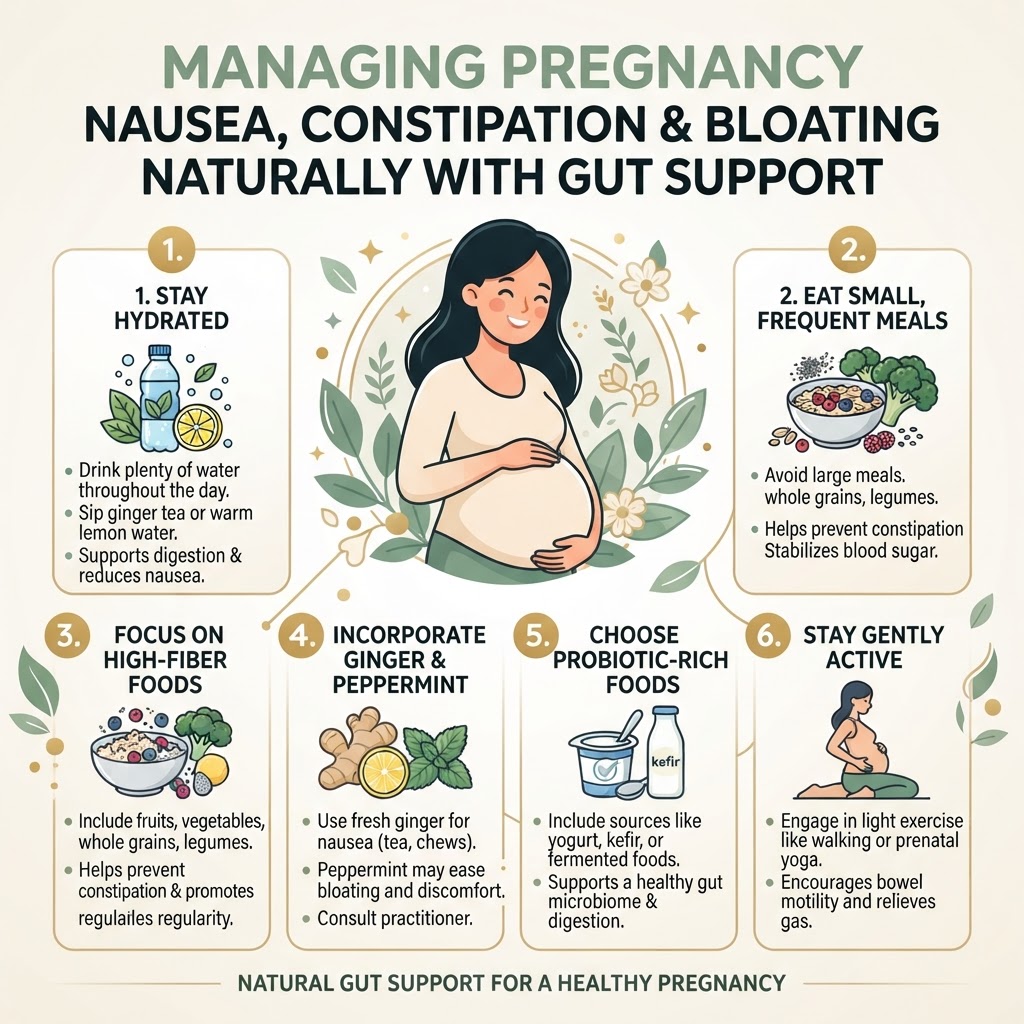
- Small, frequent meals reduce gastric pressure and can significantly ease both nausea and bloating
- Positioning matters — remaining upright for at least 30 minutes after eating reduces reflux and bloating symptoms
For a deeper understanding of how your gut health impacts your pregnancy journey holistically, I'd encourage you to explore our Pregnancy Gut Guide, which walks through trimester-specific gut support strategies in detail.
The Role of Nutrition and Targeted Supplementation
Diet is foundational — no supplement will outperform a poor nutritional base — but during pregnancy, even the most health-conscious mothers face real barriers: food aversions, nausea that makes eating anything feel impossible, and nutrient demands that far exceed what diet alone can reliably deliver. This is where evidence-based supplementation becomes not a luxury but a genuine clinical tool.
Nutritional Strategies That Support Gut Health in Pregnancy
Prebiotic-rich foods feed your beneficial bacteria and support motility:
- Oats, bananas, garlic, leeks, asparagus, and chicory root
- Aim for a variety of plant foods to support microbial diversity
Fermented foods provide natural probiotic support (where tolerated):
- Live yoghurt, kefir, miso, sauerkraut
- Note: many women find fermented food smells trigger nausea in the first trimester — supplemental probiotics offer an odourless alternative
Magnesium-rich foods support bowel muscle relaxation and motility:
- Dark leafy greens, pumpkin seeds, almonds, dark chocolate (in moderation)
Ginger, extensively studied for its anti-nausea properties, works partly through its effect on gastric motility and serotonin receptors — it is one of the most evidence-backed natural interventions for pregnancy nausea, as supported by research published in the British Journal of Anaesthesia
Where PregBiotics Essentials Fits In
This is precisely where PregBiotics Essentials was designed to step in. Formulated specifically for the physiological demands of pregnancy, PregBiotics Essentials is not a generic probiotic repackaged with a pink label. Every strain and nutrient has been selected based on its evidence base in maternal and perinatal health.
Key strains and nutrients in PregBiotics Essentials, and what they do:
- Lactobacillus rhamnosus GG — the most extensively studied probiotic strain in pregnancy; supports gut barrier integrity, reduces GI inflammation, and has shown benefit in reducing pregnancy-related constipation
- Bifidobacterium longum — supports healthy bowel transit time and reduces bloating through balanced fermentation; important for immune regulation during pregnancy
- Lactobacillus acidophilus — supports vaginal microbiome health alongside gut health, and contributes to serotonin production
- Fructooligosaccharides (FOS) — prebiotic — feeds and amplifies the beneficial bacteria, making the probiotic strains more effective
- Ginger root extract — included at a clinically relevant dose for nausea support, complementing the microbiome work of the probiotic strains
- Vitamin B6 (Pyridoxine) — NHS guidance acknowledges B6 as a supported intervention for pregnancy nausea; included at a pregnancy-safe dose
- Magnesium — supports bowel motility and reduces the muscle tension that contributes to constipation
Expert Tips and Actionable Advice
After years of working with pregnant mothers and researching maternal gut health, here are the practical strategies I recommend most consistently. These are simple, evidence-informed, and genuinely effective when applied consistently:
-
Start gut support early. Ideally, begin probiotic support before you conceive or as soon as you discover you're pregnant. The microbiome changes of the first trimester are significant, and early intervention gives you the best foundation.
-
Eat small amounts every 90–120 minutes. An empty stomach can worsen nausea (acid on an empty stomach irritates the gastric lining), while large meals overwhelm sluggish digestion. Small, frequent meals and snacks keep blood sugar stable and reduce gastric pressure.
-
Hydrate between meals, not during. Drinking large amounts of water with meals dilutes digestive enzymes and can worsen bloating. Sip water consistently throughout the day, but reduce intake during meals themselves.
-
Move gently after eating. A 10–15 minute walk after meals significantly improves gastric motility. It doesn't need to be vigorous — gentle movement is enough to stimulate the gut.
-
Try the "cold food" approach for nausea. Many women find that cold or room-temperature foods produce fewer strong smells that trigger nausea. Cold porridge, chilled fruit, and room-temperature crackers with nut butter can be more tolerable than hot cooked meals during peak nausea periods.
-
Prioritise sleep and stress management. Cortisol — your primary stress hormone — directly suppresses gut motility and disrupts the microbiome. Adequate sleep and even 5–10 minutes of daily breathwork or meditation has measurable effects on gut function.
-
Take your probiotic consistently at the same time each day. The benefits of probiotics are cumulative and dose-dependent. Taking PregBiotics Essentials at the same time daily — ideally with or just before a meal — optimises colonisation and efficacy.
-
Keep a simple symptom diary. Tracking your symptoms alongside what you eat and how you sleep helps you identify personal triggers and patterns that generic advice can't account for.
-
Don't rely on laxatives. Stimulant laxatives are not recommended during pregnancy and can create dependency. Osmotic laxatives should only be used under medical supervision. Focus on dietary fibre, hydration, movement, and probiotic support as your primary strategy.
-
Be patient with your body. Gut rebalancing takes time — typically 4–8 weeks of consistent support before the full benefits of probiotic therapy are felt. Trust the process.
When to Seek Medical Advice
While the digestive symptoms discussed in this article are extremely common during pregnancy, there are situations where they may signal something that requires prompt medical attention. Please do not delay contacting your midwife, obstetrician, or GP if you experience any of the following:
- Hyperemesis gravidarum — severe, persistent vomiting that prevents you from keeping any food or fluids down, or results in weight loss of more than 5% of your pre-pregnancy body weight. This condition requires medical management and, in some cases, hospitalisation for intravenous fluids and medication.
- Blood in your stool or rectal bleeding beyond minor spotting from haemorrhoids (though haemorrhoids themselves should also be discussed with your provider)
- Severe abdominal pain that is persistent, worsening, or accompanied by fever
- Constipation lasting more than two weeks that does not respond to dietary measures
- Sudden onset of severe bloating accompanied by pain, which could indicate bowel obstruction in rare cases
- Dark, tarry stools, which may indicate upper gastrointestinal bleeding
This article is intended to inform and empower — it is not a substitute for personalised medical advice. Always discuss any new supplement, including probiotics, with your healthcare provider before beginning, particularly if you have any underlying health conditions or are being closely monitored during your pregnancy. Your WHO-recommended antenatal care team is your most important partner in this journey.
Conclusion
Pregnancy is one of the most remarkable things the human body can do — and it deserves to be supported with the same depth of science and care that we apply to every other area of maternal health. The nausea, constipation, and bloating you may be experiencing are not simply inconveniences to be endured. They are signals from a gut that is under real physiological pressure, and they deserve a real, evidence-based response.
The good news — the news I want you to leave this article with — is that your gut is remarkably responsive to support. When you nourish it with the right probiotic strains, prebiotic foods, key micronutrients, and consistent healthy habits, it has a remarkable capacity to rebalance, and your symptoms can improve meaningfully. You do not have to simply "get through" pregnancy. You can genuinely thrive.
PregBiotics Essentials was created because I believe that every pregnant mother deserves access to gut health support that is specifically designed for her — not adapted from generic products, but built from the ground up with her physiology, her symptoms, and her baby's development in mind.
Take care of your gut, mama. It is taking care of you — and your little one — every single day.
For more science-backed articles on maternal gut health, visit The PregBiotics Journal, where we publish regular research updates, trimester guides, and expert-led advice to support you throughout your pregnancy journey.
Dr. Chomba Chuma, MD, is a medical doctor and the Founder of PregBiotics. Her work focuses on the intersection of gut microbiome science and maternal health, with the mission of empowering mothers with evidence-based tools to support their wellbeing from preconception through the postpartum period.
Get the PregBiotics Journal in your inbox
Gut-smart guidance for conception, pregnancy and breastfeeding — twice a week, plus member-only offers. Unsubscribe anytime.
You deserve to feel beautifully supported.
Join thousands of mothers on the PregBiotics journey. Receive your free Pregnancy Prep Guide and gentle, science-backed wisdom — tailored to where you are right now.