Managing Pregnancy Nausea, Constipation and Bloating Naturally With Gut Support
Picture this: it's 7am, you haven't even made it to breakfast yet, and the smell of coffee — once your morning comfort — sends you rushing to the bathroom. By mid-morning, you're uncomfortably bloated, and you realise you haven't had a proper bowel movement in four days. You're exhausted, frustrated
Dr. Chomba Chuma, MD & Founder
MD & Founder, PregBiotics

Managing Pregnancy Nausea, Constipation and Bloating Naturally With Gut Support
By Dr. Chomba Chuma, MD & Founder | PregBiotics Journal
Introduction
Picture this: it's 7am, you haven't even made it to breakfast yet, and the smell of coffee — once your morning comfort — sends you rushing to the bathroom. By mid-morning, you're uncomfortably bloated, and you realise you haven't had a proper bowel movement in four days. You're exhausted, frustrated, and wondering whether this is just the price of pregnancy.
You are not alone. Up to 80% of pregnant women experience nausea and vomiting, particularly in the first trimester, while constipation affects approximately 40% of pregnancies, and bloating is one of the most universally reported yet under-discussed complaints of the gestational journey. These aren't minor inconveniences — they can significantly affect your quality of life, your relationship with food, and your emotional wellbeing at a time when you need nourishment most.
Here's what many women — and even some healthcare providers — don't yet fully appreciate: your gut is not just passively processing food during pregnancy. It is an active, intelligent system that is being profoundly reshaped by your hormones, your immune system, and the incredible biological demands of growing a human being. When we understand the gut as the central player in pregnancy wellness, we open up a genuinely evidence-based path to relief.
In this article, I'm going to walk you through the science of why digestive issues are so common in pregnancy, what that means for your daily life, and — most importantly — what you can do about it naturally, with targeted nutritional and probiotic support. Let's start at the root.
The Gut-Pregnancy Connection: Understanding the Biology Behind Your Symptoms
To understand why your digestive system seems to be staging a quiet revolt during pregnancy, we need to talk about three key players: hormones, the gut microbiome, and the gut-brain axis.
The Hormonal Cascade
From the moment of conception, your body begins flooding with hormones designed to protect and sustain your pregnancy. Progesterone, often called the "pregnancy hormone," is a smooth muscle relaxant. This is wonderful for preventing premature uterine contractions — but it also relaxes the entire digestive tract. The result? Food moves more slowly through your intestines, water is absorbed more readily from your stool, and transit time increases significantly. This is the primary biological driver of constipation in pregnancy.
Meanwhile, human chorionic gonadotropin (hCG) — the hormone detected by pregnancy tests — rises sharply in the first trimester and is strongly associated with nausea and vomiting. Research published in the American Journal of Obstetrics and Gynecology has found a compelling correlation between hCG peak levels and the severity of morning sickness, supporting the idea that the pregnancy nausea gut connection is deeply hormonal in origin.
Oestrogen, too, plays a role — influencing gut motility, altering bile composition, and increasing the likelihood of bloating and gas.
The Microbiome Shifts of Pregnancy
Your gut microbiome — the approximately 38 trillion microorganisms living in your digestive tract — undergoes remarkable, measurable changes across the trimesters. A landmark study by Koren et al., published in Cell, demonstrated that the third-trimester microbiome has reduced diversity and increased levels of certain bacterial groups compared to early pregnancy. These shifts, while partly adaptive (helping to maximise energy extraction for the growing baby), can also contribute to increased intestinal permeability, gas production, and altered gut motility.
When beneficial bacteria like Lactobacillus and Bifidobacterium species are reduced, opportunistic bacteria that produce excess gas and inflammatory metabolites can proliferate — contributing directly to bloating pregnancy remedies that don't seem to work because they're addressing the symptom rather than the cause.
The Gut-Brain Axis and Morning Sickness
The vagus nerve is a superhighway of communication between your gut and your brain. During pregnancy, the altered gut environment — changed microbiome, increased intestinal sensitivity, hormonal flux — sends signals along this axis that can amplify nausea. This is why morning sickness gut health is increasingly understood as a bidirectional phenomenon: the gut influences the brain's nausea response, and stress or anxiety can worsen gut symptoms in return.
What This Means For You: Recognising Your Symptoms in a New Light
Understanding the biology is empowering — because once you know why your body is behaving this way, you can respond with targeted strategies rather than simply enduring the discomfort.
Here's how these biological shifts typically manifest across pregnancy stages:
First Trimester
- Nausea and vomiting (morning sickness) — often worst on an empty stomach, frequently triggered by smell or taste
- Bloating and gas — driven by early progesterone rise and microbiome shifts
- Food aversions — the gut-brain axis steering you away from foods that spike hCG responses
Second Trimester
- Nausea often improves, but constipation frequently worsens as the uterus grows and puts additional pressure on the bowel
- Heartburn and acid reflux become more common as the lower oesophageal sphincter relaxes under progesterone
Third Trimester
- Severe constipation as the baby takes up more abdominal space
- Persistent bloating and a sense of heaviness
- Some women experience a return of nausea in late pregnancy, particularly related to pressure on the stomach
Why This Matters Beyond Comfort
Digestive issues in pregnancy are not merely uncomfortable — they have downstream consequences. Chronic constipation increases the risk of haemorrhoids, pelvic floor strain, and poor nutrient absorption. Severe nausea and vomiting (hyperemesis gravidarum) can lead to dehydration, electrolyte imbalances, and inadequate nutritional intake for both mother and baby. And a disrupted gut microbiome during pregnancy has been associated in emerging research with implications for the infant's own microbiome at birth — through vertical transmission during vaginal delivery and via breast milk.
In short, caring for your gut during pregnancy is caring for both of you.
The Role of Nutrition and Supplementation in Gut-Supported Pregnancy
This is where evidence meets practice — and where you have the most agency.
Dietary Foundations
Before we talk about supplementation, let's be clear: food remains your most powerful gut tool.
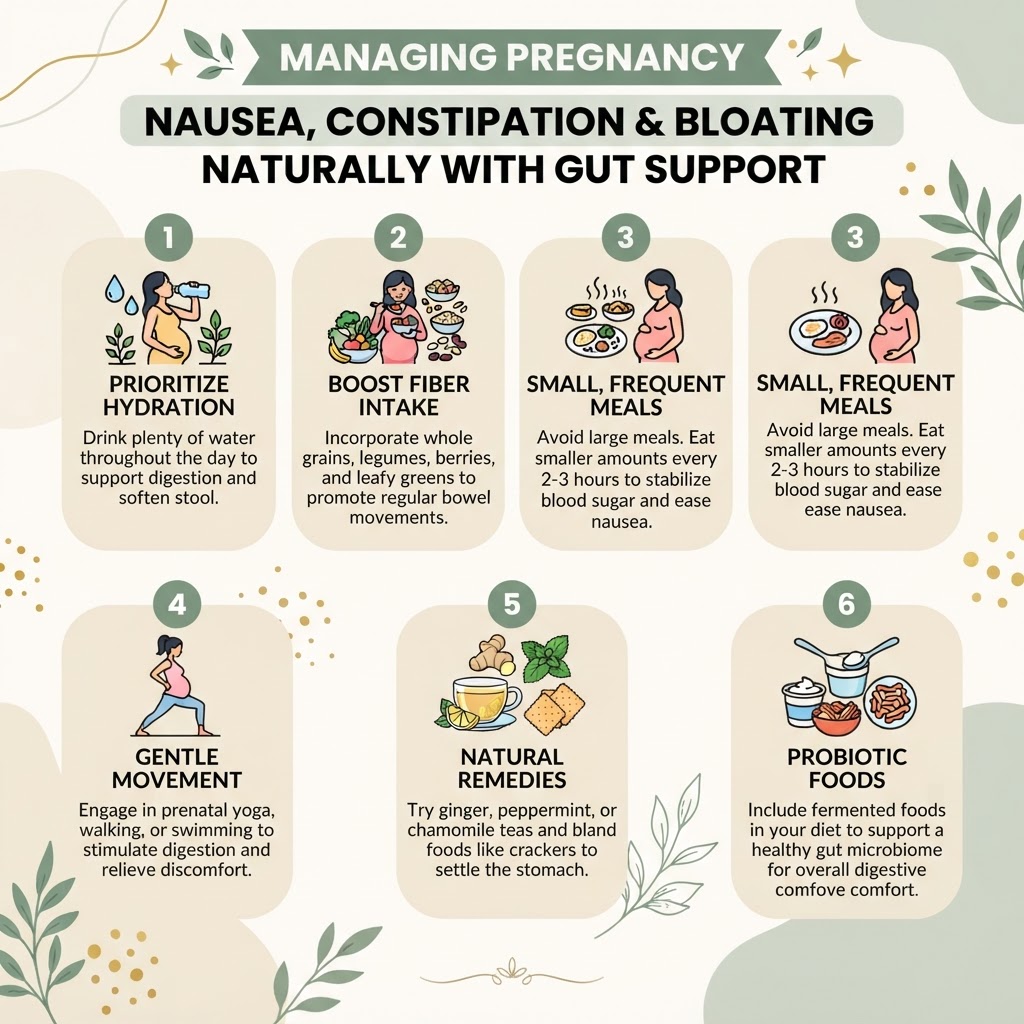
- Fibre: Aim for 25–30g of dietary fibre daily from a mix of soluble sources (oats, chia seeds, flaxseed, legumes) and insoluble sources (whole grains, vegetables). Soluble fibre feeds beneficial gut bacteria; insoluble fibre adds bulk to stools and eases transit
- Hydration: With progesterone pulling water from the gut, hydration becomes even more critical. Aim for at least 2–2.5 litres of water daily, and consider warm water with lemon in the morning to stimulate motility
- Small, frequent meals: Particularly helpful for pregnancy nausea gut management — an empty stomach worsens nausea, and overfull meals worsen bloating
- Ginger: Supported by WHO guidelines and multiple clinical trials as a safe, effective intervention for pregnancy nausea — add it to teas, smoothies, or warm water
- Fermented foods: Live yoghurt, kefir (if tolerated), and miso can gently support microbiome diversity
Targeted Probiotic and Prebiotic Support
This is where supplementation becomes particularly valuable — because during pregnancy, diet alone often cannot adequately support the microbiome shifts that are occurring. This is exactly why I developed PregBiotics Essentials.
Formulated specifically for the pregnant gut, PregBiotics Essentials combines clinically studied probiotic strains with prebiotic fibre and key micronutrients to address the core drivers of pregnancy digestive issues:
- Lactobacillus rhamnosus GG — one of the most extensively studied probiotic strains in pregnancy; supports gut barrier integrity and modulates the nausea-associated gut-brain axis
- Bifidobacterium longum — shown to reduce intestinal transit time, directly addressing constipation pregnancy probiotics needs; also supports immune regulation
- Lactobacillus acidophilus — helps restore microbiome balance, reduces gas-producing bacteria, and supports vaginal flora health
- Prebiotic inulin-FOS blend — selectively feeds beneficial bacteria, amplifying the effect of the probiotic strains and supporting regular bowel movements
- Magnesium citrate — a highly bioavailable form of magnesium that gently relaxes the bowel and is safe in recommended doses during pregnancy
- Vitamin B6 (Pyridoxine) — NHS guidance recognises B6 as a first-line treatment for pregnancy nausea, and it is included at the evidence-backed dose in our formula
- Ginger root extract (standardised) — included to provide consistent, measurable anti-nausea benefit alongside dietary ginger
For a deeper understanding of how your gut microbiome shifts through each trimester and what you can do at each stage, I'd encourage you to explore our Pregnancy Gut Guide, which maps these changes and offers personalised support strategies.
Expert Tips and Actionable Advice for Managing Pregnancy Digestive Symptoms
Here are my top evidence-informed strategies — practical, daily actions you can begin immediately:
-
Start your morning with warm water and lemon or ginger tea before eating. This gently stimulates the migrating motor complex — the gut's internal "housekeeping wave" — and can reduce morning nausea before food is introduced.
-
Eat every 2–3 hours, never on an empty stomach. Nausea is dramatically worsened when blood sugar dips and the stomach is empty. Keep plain crackers, rice cakes, or dry toast on your bedside table to eat before you even sit up in the morning.
-
Take your PregBiotics Essentials consistently, at the same time each day. Probiotic benefits are cumulative and depend on regular intake. I recommend taking them with a small amount of food to improve survival through the stomach acid environment.
-
Walk after meals. Even a gentle 10–15 minute walk post-meal significantly improves gut motility, reduces bloating, and can ease constipation. You don't need vigorous exercise — movement is the message.
-
Prioritise sleep position. Sleeping on your left side (particularly from the second trimester onward) uses gravity to support gut motility and can reduce acid reflux and bloating overnight.
-
Abdominal massage for constipation. Using gentle clockwise circular motions on your abdomen (following the direction of the colon) can stimulate bowel movement. Use a small amount of a pregnancy-safe oil such as coconut or almond oil.
-
Address stress actively. The gut-brain axis means anxiety amplifies every digestive symptom. Box breathing (inhale 4 counts, hold 4, exhale 4, hold 4) activates the vagus nerve and can reduce gut reactivity within minutes.
-
Avoid known bloating triggers where possible: carbonated drinks, cruciferous vegetables in large quantities (broccoli, cabbage, cauliflower), raw onions, and artificial sweeteners. Cook vegetables well to reduce their gas-producing potential.
-
Review your iron supplement. Ferrous sulphate — the most commonly prescribed iron supplement in pregnancy — is a well-known cause of constipation and nausea. Ask your healthcare provider about switching to a gentler form such as ferrous bisglycinate or iron bisglycinate.
-
Track your symptoms. Keeping a simple diary of what you eat, your symptoms, and your bowel habits can reveal patterns that allow you to make targeted changes and have more productive conversations with your midwife or OB.
When to Seek Medical Advice
While the digestive issues discussed in this article are common and manageable for most pregnant women, there are situations where symptoms require prompt medical evaluation. Please contact your midwife, obstetrician, or GP if you experience any of the following:
- Severe, persistent vomiting that prevents you from keeping down fluids or food for more than 24 hours — this may indicate hyperemesis gravidarum, which requires medical management
- Signs of dehydration including dark urine, dizziness, rapid heartbeat, or decreased urine output
- Blood in your stool or rectal bleeding
- Severe abdominal pain or cramping, particularly if one-sided or accompanied by fever
- Constipation lasting more than one week without relief despite dietary and lifestyle measures
- Sudden, significant worsening of any digestive symptom in the third trimester
- Nausea or vomiting that begins or returns in the second or third trimester (as this is less typical and warrants investigation)
This article is educational in nature and is not a substitute for individualised medical advice. Always discuss new supplements — including probiotics — with your healthcare provider before beginning, particularly if you have a high-risk pregnancy or underlying health conditions.
Conclusion
Your gut is not just along for the ride during pregnancy — it is one of the most dynamic, influential systems shaping your experience of these remarkable months. Nausea, constipation, and bloating are not simply unavoidable rites of passage. They are signals from a gut that is working incredibly hard, adapting to enormous hormonal and physiological demands, and in many cases, calling out for support.
The good news is that science now gives us genuinely effective tools: dietary strategies grounded in microbiome research, specific probiotic strains shown to reduce nausea and improve gut motility, and targeted nutrients like B6, magnesium, and ginger that have decades of safety data behind them in pregnancy.
When I founded PregBiotics, my mission was simple: to ensure that every pregnant woman had access to evidence-based gut support, formulated by someone who understands both the science and the lived experience of pregnancy. PregBiotics Essentials was built around that mission — to address the root causes of digestive issues in pregnancy, not just mask the symptoms.
You deserve to feel nourished, supported, and well during pregnancy. Your gut is where that journey begins.
For more expert insights on pregnancy gut health, microbiome science, and evidence-based maternal wellness, visit The PregBiotics Journal — where we publish new research, practical guides, and expert perspectives every week.
Dr. Chomba Chuma, MD, is the Founder of PregBiotics and a maternal health specialist with a focus on the gut microbiome in pregnancy and early life. All content in the PregBiotics Journal is reviewed for scientific accuracy and is intended for informational purposes only.
Get the PregBiotics Journal in your inbox
Gut-smart guidance for conception, pregnancy and breastfeeding — twice a week, plus member-only offers. Unsubscribe anytime.
You deserve to feel beautifully supported.
Join thousands of mothers on the PregBiotics journey. Receive your free Pregnancy Prep Guide and gentle, science-backed wisdom — tailored to where you are right now.