How Your Gut Microbiome Shapes Your Breast Milk — And Your Baby's Lifelong Health
Imagine handing your newborn baby a gift so powerful that its effects ripple through their immune system, digestive health, and even mental wellbeing for decades to come. You do this every single time you breastfeed.
Dr. Chomba Chuma, MD & Founder
MD & Founder, PregBiotics

How Your Gut Microbiome Shapes Your Breast Milk — And Your Baby's Lifelong Health
By Dr. Chomba Chuma, MD & Founder | PregBiotics Journal
Introduction
Imagine handing your newborn baby a gift so powerful that its effects ripple through their immune system, digestive health, and even mental wellbeing for decades to come. You do this every single time you breastfeed.
Most new mothers know that breast milk is nutritious — packed with antibodies, fats, and protein. But what many don't realise is that breast milk is also teeming with living bacteria. In fact, researchers have identified over 700 species of microorganisms in human breast milk, making it one of the most complex and biologically active substances known to science. This isn't contamination. It's by extraordinary design.
Here's the statistic that still astonishes me after years in maternal medicine: a breastfed baby ingests between 800,000 and 10 million bacterial cells every single day through breast milk alone. These microbes don't just pass through — they actively colonise your baby's gut, training their immune system and laying the foundations for lifelong health.
But here's what's even more remarkable: the composition of your breast milk microbiome is directly influenced by your own gut health. The bacteria living in your intestines communicate with your mammary glands in ways scientists are only beginning to fully understand. This means that what you eat, how you live, and how well you support your own gut microbiome during breastfeeding has a direct and measurable impact on what your baby receives at every feed.
In this article, I want to walk you through the science behind the breastfeeding microbiome, explain what it means for you and your baby in practical terms, and share how targeted nutrition and supplementation — including the support that PregBiotics Breastfeeding was specifically formulated to provide — can help you make the most of this extraordinary biological window.
The Science of Breast Milk as a Living Ecosystem
Breast Milk Is Not Sterile — And That's the Point
For decades, medical textbooks taught that breast milk was sterile. We now know this is fundamentally incorrect. The human milk microbiome is a rich and diverse ecosystem, dominated by bacteria such as Lactobacillus, Staphylococcus, Streptococcus, Bifidobacterium, and Propionibacterium species. These are not pathogens to be feared — they are pioneers, among the very first microbial colonisers of your newborn's gut.
The question that captivated researchers for years was: how do gut bacteria get into breast milk? The answer lies in a fascinating biological process called the entero-mammary pathway.
The Entero-Mammary Pathway: Your Gut Talking to Your Breast
The entero-mammary pathway describes how bacteria from your gut are selectively transported — via immune cells called dendritic cells and macrophages — through your lymphatic and circulatory systems to your mammary glands. This isn't a passive leak. It is an active, regulated process that appears to be specifically upregulated during late pregnancy and lactation, as though your body is deliberately seeding your milk with microbes for your baby's benefit.
Research published in Nutrients has confirmed that the bacterial profiles found in maternal gut and breast milk share significant overlap — meaning that a healthier, more diverse maternal gut microbiome is associated with richer, more beneficial breast milk microbial communities.
Human Milk Oligosaccharides: The Baby Gut Fertiliser
Beyond bacteria themselves, breast milk contains a class of complex sugars called Human Milk Oligosaccharides (HMOs). Here's the fascinating twist: HMOs are almost entirely indigestible by the baby. They pass through the small intestine completely intact — because they are not food for your baby at all. They are food for your baby's microbiome.
HMOs selectively feed beneficial bacteria, particularly Bifidobacterium infantis, helping these strains dominate the infant gut in the critical early weeks of life. The role of HMOs in baby gut colonisation is now considered so important that the World Health Organization highlights optimal breastfeeding as a cornerstone of infant gut development and immune protection globally.
Over 200 structurally distinct HMOs have been identified in human milk, and their composition varies between individual mothers. Crucially, maternal diet and gut health influence both the quantity and complexity of HMOs produced — yet another reason why your microbiome matters so profoundly during this phase.
Breast Milk Probiotics and Long-Term Infant Health
The bacteria transferred through breast milk — sometimes called breast milk probiotics — are not merely transient visitors. Studies have linked early gut colonisation patterns, shaped significantly by breastfeeding, to reduced risks of:
- Allergies and eczema
- Asthma
- Type 1 diabetes
- Inflammatory bowel disease
- Obesity
- Anxiety and depression (through the gut-brain axis)
The early weeks and months of life represent a narrow but profoundly important window for establishing the microbial architecture that will influence immune regulation and metabolic health for decades. As a breastfeeding mother, you are the primary architect of that ecosystem.
What This Means for You as a Breastfeeding Mother
Understanding the science is one thing — but I always want to bring this back to something real and actionable for the mothers I work with. So let me translate this biology into what it actually means for your daily experience of breastfeeding.
Your Gut Health Is Actively Influencing Your Baby
This is perhaps the most empowering — and occasionally overwhelming — realisation. Your microbiome is not just about your digestion. Right now, the bacterial community living in your gut is shaping the composition of your breast milk, which in turn is shaping your baby's gut colonisation, immune development, and lifelong health trajectory.
This does not mean you need to feel anxious or burdened. It means you have genuine agency. Choosing to prioritise your gut health during breastfeeding is one of the most evidence-based things you can do for your baby's long-term wellbeing.
Common Threats to the Breastfeeding Microbiome
Several factors that are unfortunately common in the postpartum period can compromise both your gut diversity and the microbial richness of your milk:
- Antibiotic use — necessary at times, but significantly disrupts the microbiome in both mother and baby
- Caesarean delivery — associated with altered maternal and infant microbiome profiles, though breastfeeding helps compensate meaningfully
- Postpartum stress and sleep deprivation — chronic stress elevates cortisol, which negatively shifts gut microbial balance
- A low-fibre, high-processed food diet — starves the beneficial bacteria that need prebiotic fibre to thrive
- Mastitis — inflammation and infection of the breast tissue, which alters the local breast microbiome and can impact milk bacterial profiles
Signs Your Gut May Need Support
You don't need a microbiome test to tune into your gut health. Watch for:
- Persistent bloating, gas, or irregular bowel movements postpartum
- Ongoing fatigue beyond typical new-parent tiredness
- Mood instability or low mood (the gut-brain axis is real — see our Pregnancy Gut Guide for more on this connection)
- Recurrent thrush or infections
- Your baby experiencing colic, gassiness, or skin reactions such as eczema
None of these are diagnostic on their own, but together they can signal a microbiome that would benefit from intentional support.
The Role of Nutrition and Supplementation During Breastfeeding
Breastfeeding is nutritionally demanding. Your body prioritises milk production, which means the nutrients in your diet are directed first toward your baby — sometimes at the expense of your own reserves. This is why postpartum nutritional depletion is real, common, and underrecognised.
But beyond macronutrients and vitamins, there's a category of nutritional support that is often overlooked entirely: targeted probiotic and prebiotic supplementation designed to actively support the breastfeeding microbiome.
Why Standard Postnatal Vitamins Aren't Enough
Most postnatal supplements focus on replenishing iron, calcium, vitamin D, and omega-3s — all important, certainly. But very few address the microbial ecosystem that is actively shaping your milk composition. This was the gap I set out to address when formulating PregBiotics Breastfeeding.
What PregBiotics Breastfeeding Contains — and Why It Matters
PregBiotics Breastfeeding was formulated specifically for the lactation phase, combining targeted probiotic strains with the prebiotic and nutritional co-factors that support a thriving breastfeeding microbiome. Key components include:
- Lactobacillus rhamnosus GG — one of the most extensively studied probiotic strains in maternal and infant health, associated with reduced risk of infant eczema and colic when supplemented in breastfeeding mothers
- Lactobacillus reuteri DSM 17938 — clinically studied for its role in reducing infant colic symptoms via breast milk transfer and its ability to colonise the infant gut
- Bifidobacterium longum — a dominant species in the healthy breastfed infant gut, supported by maternal supplementation
- Prebiotic FOS (fructooligosaccharides) — feeds beneficial bacteria in the maternal gut, supporting diversity and the entero-mammary pathway
- Vitamin D3 — critical for both maternal immune health and emerging evidence suggests an influence on breast milk immune factors
- Iodine — essential for infant brain development, transferred through breast milk
- Choline — supports infant neurological development and is frequently deficient in postpartum diets
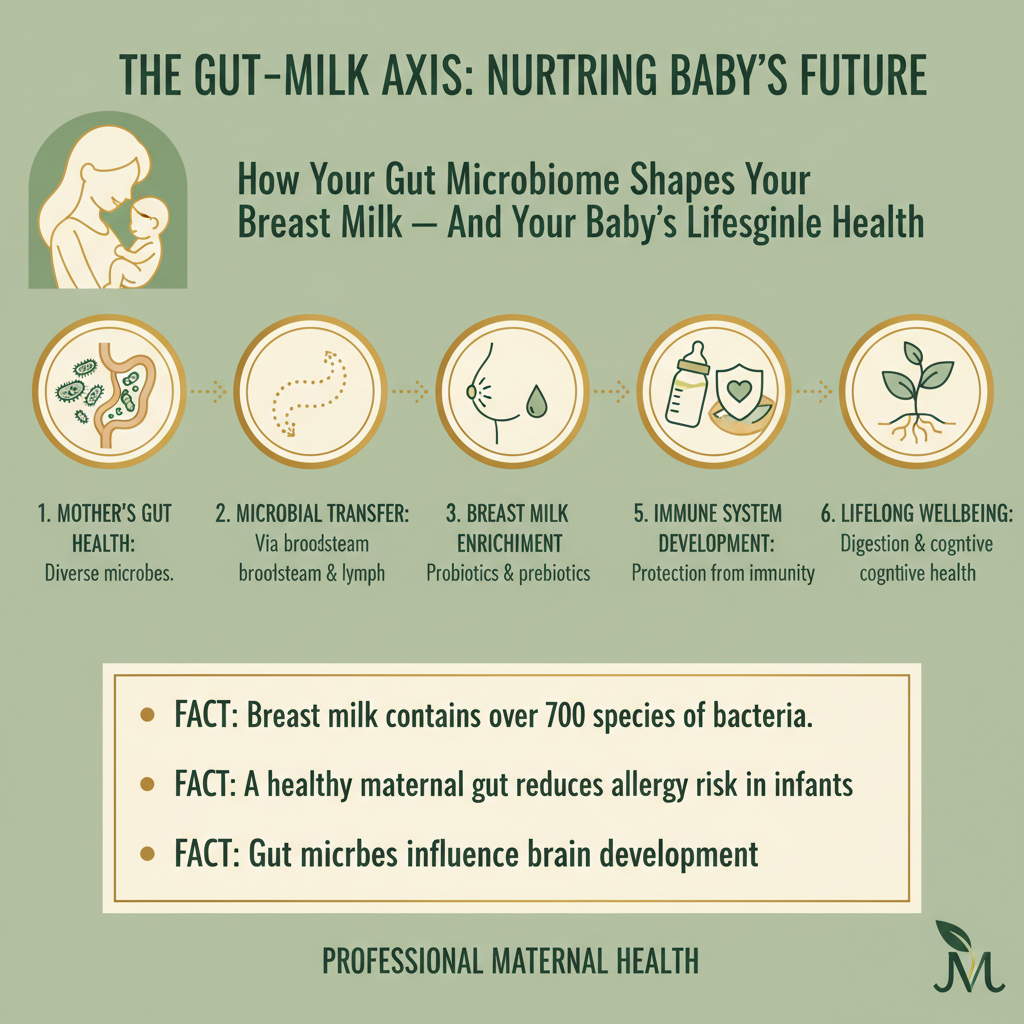
Suggested infographic: "The Journey from Your Gut to Your Baby's Gut" — illustrating the entero-mammary pathway, HMO function, and how PregBiotics Breastfeeding supports each step.
The evidence supporting probiotic supplementation during breastfeeding is growing rapidly. A systematic review published on NCBI found that maternal probiotic supplementation during lactation significantly altered breast milk microbial composition and was associated with measurable benefits in infant gut colonisation patterns.
Expert Tips and Actionable Advice for Breastfeeding Mothers
Here are my top evidence-based recommendations for nurturing your breastfeeding microbiome:
-
Start probiotic supplementation early. Ideally, begin supporting your gut microbiome in the third trimester and continue throughout breastfeeding. The earlier you establish a healthy microbial environment, the richer your milk's microbial profile.
-
Prioritise dietary fibre at every meal. Aim for 25–30g of fibre daily from a variety of sources — legumes, oats, root vegetables, leafy greens, and wholegrains. Fibre is the primary food source for your gut bacteria and directly supports the diversity that benefits your milk.
-
Include fermented foods regularly. Live yoghurt, kefir, sauerkraut, kimchi, and miso introduce beneficial bacteria to your gut. Even modest daily intake has been associated with increased gut microbial diversity.
-
Protect your microbiome when antibiotics are necessary. If you need antibiotics — for mastitis, for example — take a high-quality probiotic supplement at the same time (separated by two hours from each antibiotic dose) and for at least four weeks afterwards to support recovery.
-
Manage stress with intention. I know this is easier said than done with a newborn. But even ten minutes of deep breathing, a short walk outside, or asking for help with one task per day genuinely impacts your cortisol levels and gut health. Your microbiome responds to your nervous system.
-
Stay well hydrated. Breast milk is approximately 87% water. Dehydration concentrates and stresses the body in ways that impair normal gut function. Aim for at least 2–2.5 litres of water daily while breastfeeding.
-
Limit ultra-processed foods where possible. Emulsifiers, artificial sweeteners, and preservatives found in ultra-processed foods have been shown in multiple studies to negatively alter gut microbial diversity. This doesn't mean perfection — it means awareness.
-
Skin-to-skin contact continues to matter. Beyond feeding, skin-to-skin contact transfers microbes from your skin microbiome to your baby, contributing to microbial diversity from multiple routes. It also supports oxytocin release, which benefits both milk let-down and your own wellbeing.
When to Seek Medical Advice
While nurturing your gut health through diet and supplementation is safe and beneficial for the vast majority of breastfeeding mothers, there are situations where professional medical assessment is essential.
Please consult your midwife, GP, or healthcare provider if:
- You develop symptoms of mastitis (breast pain, redness, fever, flu-like symptoms) — this requires prompt medical evaluation and may need antibiotic treatment
- Your baby shows signs of a severe allergic reaction (hives, difficulty breathing, persistent vomiting)
- Your baby fails to gain weight adequately or shows signs of dehydration
- You experience significant postpartum mood changes, including persistent low mood, anxiety, or intrusive thoughts
- You have a known immune condition or are on immunosuppressant medication before starting any probiotic supplement
Probiotic and prebiotic supplements are generally well tolerated during lactation, but they are not a substitute for medical care. The PregBiotics Breastfeeding formula was designed to complement, not replace, the guidance of your healthcare team. Always discuss new supplements with your doctor or midwife if you have any underlying health conditions.
Conclusion
The relationship between your gut and your breast milk is one of the most extraordinary examples of biological wisdom I have encountered in my medical career. Your body has evolved not just to nourish your baby with nutrients, but to actively seed their gut with carefully selected microorganisms, and to fertilise those microbes with complex sugars designed specifically to help them thrive. Every feed is a transfer of living biology — a microbial inheritance that shapes immune systems, brains, and bodies for a lifetime.
The breastfeeding microbiome is not beyond your influence. By eating a diverse, fibre-rich diet, managing stress, protecting against unnecessary microbiome disruption, and supplementing intelligently with a product like PregBiotics Breastfeeding — formulated precisely for this phase of your journey — you can meaningfully enrich the microbial gift you give your baby at every feed.
You are not just feeding your baby. You are building them, from the inside out.
For more evidence-based guidance on maternal gut health at every stage — from preconception through to the postnatal period — explore the full range of articles at The PregBiotics Journal. Science, warmth, and practical wisdom — all in one place.
Dr. Chomba Chuma is a medical doctor and founder of PregBiotics, a science-led maternal gut health brand supporting women from conception through breastfeeding. The information in this article is intended for educational purposes and does not constitute medical advice. Always consult a qualified healthcare professional regarding your individual health needs.
Get the PregBiotics Journal in your inbox
Gut-smart guidance for conception, pregnancy and breastfeeding — twice a week, plus member-only offers. Unsubscribe anytime.
You deserve to feel beautifully supported.
Join thousands of mothers on the PregBiotics journey. Receive your free Pregnancy Prep Guide and gentle, science-backed wisdom — tailored to where you are right now.