How Your Gut Microbiome Affects Fertility and Your Ability to Conceive
Imagine you've been doing everything "right." You're tracking your cycle, eating well, taking your folic acid, and giving yourself the best possible chance of conceiving — yet month after month, it isn't happening. If this sounds familiar, you are not alone. According to the [World Health Organizati
Dr. Chomba Chuma, MD & Founder
MD & Founder, PregBiotics

How Your Gut Microbiome Affects Fertility and Your Ability to Conceive
By Dr. Chomba Chuma, MD & Founder | PregBiotics Journal
Introduction
Imagine you've been doing everything "right." You're tracking your cycle, eating well, taking your folic acid, and giving yourself the best possible chance of conceiving — yet month after month, it isn't happening. If this sounds familiar, you are not alone. According to the World Health Organization, approximately 1 in 6 people globally are affected by infertility. And while many factors contribute to this, one that is still largely overlooked in mainstream fertility conversations is the health of your gut microbiome.
Yes — the trillions of bacteria living in your digestive tract may have a profound influence on your ability to conceive.
Over the past decade, science has begun to unravel a remarkable connection between gut health and fertility. From regulating the hormones that govern your cycle, to influencing inflammation, immune tolerance, and even the environment of your uterus — your microbiome is far more involved in reproduction than most people realise.
In this article, I want to walk you through the science of the gut-fertility connection in a way that feels accessible and empowering. We'll explore what the research tells us, what it means for your conception journey, and — crucially — what you can do about it. Whether you've just started trying to conceive or have been on this road for some time, understanding your gut health could be the missing piece you haven't yet considered.
The Science Behind Your Gut and Fertility
Your Microbiome: A Quick Overview
Your gut microbiome is a vast, dynamic ecosystem of bacteria, fungi, viruses, and other microorganisms — estimated at over 38 trillion microbial cells — living primarily in your large intestine. Far from being passive passengers, these microorganisms are metabolically active partners in nearly every aspect of your health: digestion, immunity, mood, metabolism, and yes, reproduction.
When this ecosystem is diverse and balanced, we call it a state of eubiosis. When it becomes imbalanced — with harmful bacteria outnumbering beneficial ones — we call it dysbiosis. And it is dysbiosis that researchers are increasingly linking to fertility challenges.
The Gut-Hormone Axis
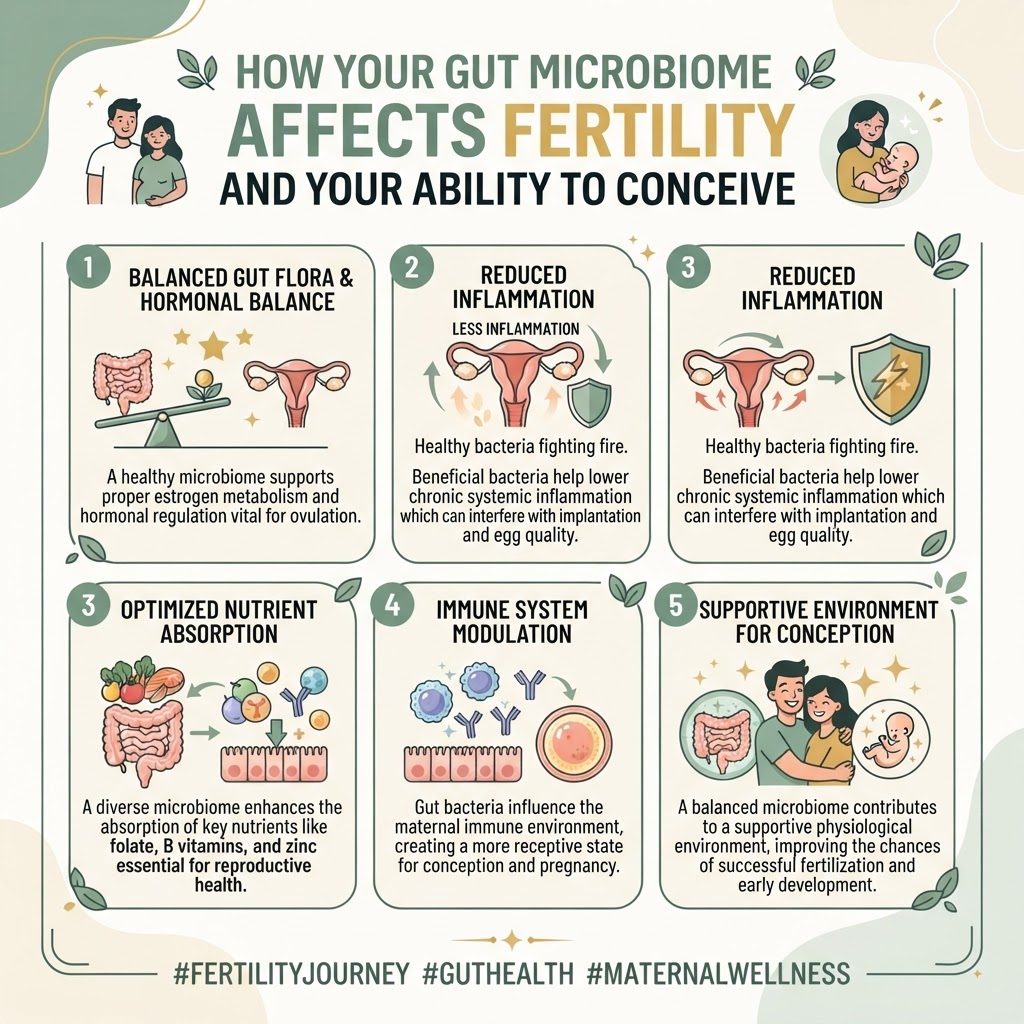
One of the most significant ways your gut influences fertility is through hormone regulation. Your gut bacteria play a central role in the metabolism of oestrogen — a hormone critical to ovulation, uterine lining development, and implantation.
A specific collection of gut bacteria known as the estrobolome produces an enzyme called β-glucuronidase, which reactivates oestrogen that has been marked for excretion by the liver. When the estrobolome is functioning well, oestrogen is properly recycled and circulated at the right levels. When gut dysbiosis is present, this process becomes dysregulated — leading to either oestrogen excess (which can contribute to conditions like endometriosis and PCOS) or oestrogen deficiency (which can disrupt ovulation).
A 2019 review published in the journal Maturitas highlighted the estrobolome's significant role in systemic oestrogen levels, with direct implications for reproductive health.
Inflammation, Immune Tolerance, and Implantation
Your immune system and microbiome are deeply intertwined. Approximately 70% of your immune system resides in the gut-associated lymphoid tissue (GALT). A disrupted gut microbiome drives systemic low-grade inflammation — and inflammation is one of the most well-recognised disruptors of fertility.
For a fertilised embryo to successfully implant, the uterus must achieve a state of controlled immune tolerance — essentially, the immune system must be calmed enough to accept the embryo without rejecting it. Research suggests that a healthy gut microbiome contributes to this immune modulation, producing short-chain fatty acids (SCFAs) like butyrate that help regulate inflammatory responses throughout the body.
The Vaginal and Uterine Microbiome
Here's something that often surprises people: your gut doesn't just affect your hormones and systemic inflammation — it also directly influences the microbial environment of your reproductive tract. Research has shown that the composition of vaginal and even uterine microbiomes is partially influenced by gut bacteria, particularly species of Lactobacillus.
A landmark study in the American Journal of Obstetrics and Gynecology found that a Lactobacillus-dominant uterine microbiome was significantly associated with higher rates of successful implantation in IVF patients — while a non-Lactobacillus-dominant uterine microbiome was linked to much lower live birth rates. The connection begins in the gut.
What This Means For You — Making the Science Personal
Understanding the microbiome-conception connection is exciting from a scientific standpoint, but what does it actually mean for someone who is trying to have a baby right now?
Here's the honest truth: gut health is rarely discussed at fertility consultations, yet the evidence increasingly suggests it should be. Whether you are in the early days of trying to conceive or navigating a more complex fertility journey, your gut health deserves attention.
Here are some of the most important practical implications:
-
Irregular cycles or anovulation may partly stem from oestrogen dysregulation linked to gut dysbiosis — particularly if you've noticed that standard cycle support hasn't been fully effective.
-
Conditions like PCOS and endometriosis are increasingly being linked to gut microbiome imbalances. Women with these conditions often show distinct patterns of dysbiosis. Supporting gut health may be a meaningful complementary strategy alongside medical treatment.
-
Recurrent implantation failure, whether natural or following IVF, has been associated in emerging research with non-optimal uterine and vaginal microbiomes — both of which are influenced by gut health.
-
A history of antibiotic use can significantly disrupt the microbiome and reduce Lactobacillus populations — not just in the gut, but throughout the reproductive tract. If you've taken antibiotics recently (which many of us have), actively restoring your microbiome is particularly important.
-
Stress and poor sleep — both common companions to the fertility journey — are themselves known to disrupt gut microbial diversity, creating a feedback loop that can compound the problem.
-
Diet-driven dysbiosis — high-sugar, low-fibre diets deplete the beneficial bacterial strains your reproductive system depends on.
The encouraging news is this: the microbiome is malleable. Unlike many fertility factors, it is something you can meaningfully influence through targeted nutrition and supplementation — often within weeks to months of consistent effort.
The Role of Nutrition and Supplementation in Supporting Gut Health for Fertility
Knowing that your gut microbiome affects fertility is one thing. Knowing what to do about it is another. This is where a proactive, science-guided approach can make a real difference.
What to Eat
A diverse, fibre-rich diet is the single most evidence-based way to nurture a healthy gut microbiome. This means:
- Plenty of colourful vegetables and fruits (especially those rich in prebiotic fibre: garlic, onions, leeks, asparagus, bananas)
- Whole grains over refined carbohydrates
- Fermented foods such as live yoghurt, kefir, kimchi, and sauerkraut to introduce beneficial bacterial strains
- Omega-3 fatty acids (found in oily fish, flaxseed, and walnuts) to help modulate inflammation
- Minimising ultra-processed foods, refined sugars, and excessive alcohol — all of which are associated with dysbiosis
The Role of Targeted Supplementation
While diet is foundational, targeted supplementation becomes particularly valuable when you are actively trying to conceive and want to give your body every advantage. This is precisely why I formulated PregBiotics Conception.
PregBiotics Conception is specifically designed for women in the pre-conception and early conception phase, combining clinically researched probiotic strains with key micronutrients to support gut health, hormonal balance, and reproductive readiness.
Here are the key components and why they matter:
- Lactobacillus rhamnosus — one of the most studied strains for women's health, supporting both gut and vaginal microbiome integrity, with research linking it to improved immune balance relevant to implantation
- Lactobacillus reuteri — shown to help regulate systemic inflammation and support oestrogen metabolism
- Lactobacillus crispatus — a dominant strain in healthy vaginal microbiomes, associated with reduced infection risk and a more favourable reproductive environment
- Bifidobacterium longum — supports gut barrier function, reducing the systemic inflammation that can compromise fertility
- Folate (5-MTHF, the bioavailable form) — critical for cell division and neural tube development from the very earliest moments of conception
- Vitamin D3 — emerging evidence links vitamin D status to both ovarian reserve and implantation success
- Inulin (prebiotic fibre) — feeds beneficial bacteria to ensure the probiotic strains actually thrive and colonise
When we talk about probiotics trying to conceive, it matters enormously which strains are used and at what evidence-backed doses. Not all probiotics are created equal — and generic supermarket products are rarely formulated with reproductive health in mind.
Expert Tips: Practical Steps to Support Your Gut Health for Conception
As both a doctor and someone deeply invested in maternal health research, here is the actionable guidance I offer to my patients and community who are trying to conceive:
-
Start gut support at least 3 months before actively trying to conceive. The gut microbiome takes time to shift meaningfully. Think of the 90-day preconception window as your opportunity to lay the foundation — this also aligns with the maturation cycle of eggs.
-
Introduce a targeted probiotic supplement. Choose one formulated specifically for women's reproductive health — like PregBiotics Conception — rather than a generic daily probiotic. Look for multiple Lactobacillus strains, adequate CFU counts (typically 10–30 billion), and a prebiotic component.
-
Audit your recent antibiotic use. If you've used antibiotics in the past 6–12 months, your microbiome may need more active restoration. This is the time to be particularly consistent with both dietary and supplemental support.
-
Address gut symptoms seriously. Bloating, irregular bowel habits, frequent infections, or food sensitivities are not things to push through — they are your gut signalling that something needs attention. These symptoms may also be quietly affecting your fertility.
-
Reduce unnecessary stressors. Chronic psychological stress is a significant driver of gut dysbiosis via the gut-brain axis. Practices like mindfulness, gentle yoga, and prioritising sleep are not "soft" strategies — they have measurable impacts on microbiome health.
-
Limit unnecessary use of NSAIDs and PPIs. Both classes of medication can significantly disrupt gut microbiome composition when used regularly. If you rely on these medications, discuss alternatives with your doctor.
-
Track your cycle alongside your gut health. Many women find that when their gut is in better balance, cycle regularity improves. You may be surprised at the connection when you begin to notice it.
-
Read more about gut health in pregnancy — if you're keen to understand what comes after conception, our Pregnancy Gut Guide is a wonderful next step.
When to Seek Medical Advice
While optimising your gut health is something most women can begin independently, there are important situations where professional medical guidance is essential.
Please consult your GP, gynaecologist, or fertility specialist if:
- You have been trying to conceive for 12 months or more without success (or 6 months if you are over 35)
- You have a known or suspected condition such as PCOS, endometriosis, premature ovarian insufficiency, or thyroid dysfunction
- You are experiencing significant gut symptoms such as blood in stools, unexplained weight loss, severe abdominal pain, or persistent diarrhoea — these require proper investigation
- You are currently undergoing fertility treatment such as IUI or IVF — while gut health support is still relevant, your treatment team should be aware of all supplements you are taking
- You have a history of pregnancy loss — your doctor can help identify potential contributing factors
Supplementation, including probiotics, is generally considered safe for most women trying to conceive, but it is always wise to discuss any new supplements with your healthcare provider — particularly if you have underlying health conditions or are taking prescription medications.
Conclusion: Your Gut Is Part of Your Fertility Story
The connection between gut health and fertility is one of the most exciting and rapidly evolving areas of reproductive science. What was once considered a peripheral or alternative idea is now being confirmed in peer-reviewed research across the world: the microbiome matters — not just for digestion, not just for immunity, but for your capacity to conceive and sustain a pregnancy.
The empowering truth is that your microbiome is not fixed. With the right nutrition, targeted probiotic support, and consistent lifestyle habits, you can meaningfully shift the microbial environment of your gut — and in doing so, create a more favourable hormonal, immune, and reproductive landscape for conception.
If you're on the journey to becoming a mother, I want you to know that the steps you take now — even the quiet, behind-the-scenes ones like nurturing your gut health — are deeply meaningful acts of care for yourself and for the baby you're hoping to welcome.
PregBiotics Conception was formulated with exactly this journey in mind: to fill the gap that exists between generic prenatal vitamins and the genuine, science-led microbiome support that women deserve in this pivotal season of life.
For more evidence-based guidance on gut health throughout your maternal journey, I invite you to explore The PregBiotics Journal — written by clinicians, for the women who trust us with their most important moments.
You've got this — and your gut has got you.
Dr. Chomba Chuma, MD Founder, PregBiotics
References:
Get the PregBiotics Journal in your inbox
Gut-smart guidance for conception, pregnancy and breastfeeding — twice a week, plus member-only offers. Unsubscribe anytime.
You deserve to feel beautifully supported.
Join thousands of mothers on the PregBiotics journey. Receive your free Pregnancy Prep Guide and gentle, science-backed wisdom — tailored to where you are right now.