Group B Streptococcus in Pregnancy: What Every Mother Needs to Know About GBS, Screening & Natural Prevention
Imagine receiving a phone call from your midwife at 36 weeks pregnant. She tells you that your routine swab has come back positive for something called Group B Streptococcus — or GBS. Your mind immediately races.
Dr. Chomba Chuma, MD & Founder
MD & Founder, PregBiotics

Group B Streptococcus in Pregnancy: What Every Mother Needs to Know About GBS, Screening & Natural Prevention
By Dr. Chomba Chuma, MD & Founder | PregBiotics Journal
Introduction
Imagine receiving a phone call from your midwife at 36 weeks pregnant. She tells you that your routine swab has come back positive for something called Group B Streptococcus — or GBS. Your mind immediately races. Is my baby at risk? What did I do wrong? What happens now?
If this scenario sounds familiar, you are far from alone. GBS pregnancy diagnoses affect approximately 1 in 4 pregnant women in the United States and United Kingdom, making it one of the most common — and most misunderstood — findings in routine prenatal care. And yet, despite its prevalence, many mothers tell me they leave their appointments with more questions than answers.
Here is what I want you to know from the outset: a GBS-positive result is not a failure on your part, and it is absolutely not a reason to panic. Group B Strep is a naturally occurring bacterium that lives harmlessly in the bodies of millions of adults. The challenge arises specifically during labour and delivery, when the bacterium can — in a small but significant number of cases — pass to a newborn with serious consequences.
In this article, I am going to walk you through everything you need to know about GBS in pregnancy: what it is, how GBS screening in pregnancy works, what the science says about risk and prevention, and — crucially — how optimising your gut and vaginal microbiome may offer a powerful, evidence-informed layer of protection. I will also introduce you to our GBS Shield protocol at PregBiotics, designed specifically to support mothers navigating this exact challenge.
Let us start with the science.
Understanding Group B Streptococcus: The Biology Behind the Bacteria
What Is GBS?
Group B Streptococcus (Streptococcus agalactiae) is a gram-positive bacterium that colonises the gastrointestinal and genitourinary tracts of healthy adults. It is not a sexually transmitted infection. It is not caused by poor hygiene. It is simply a commensal organism — one that coexists within our bodies without causing illness in most circumstances.
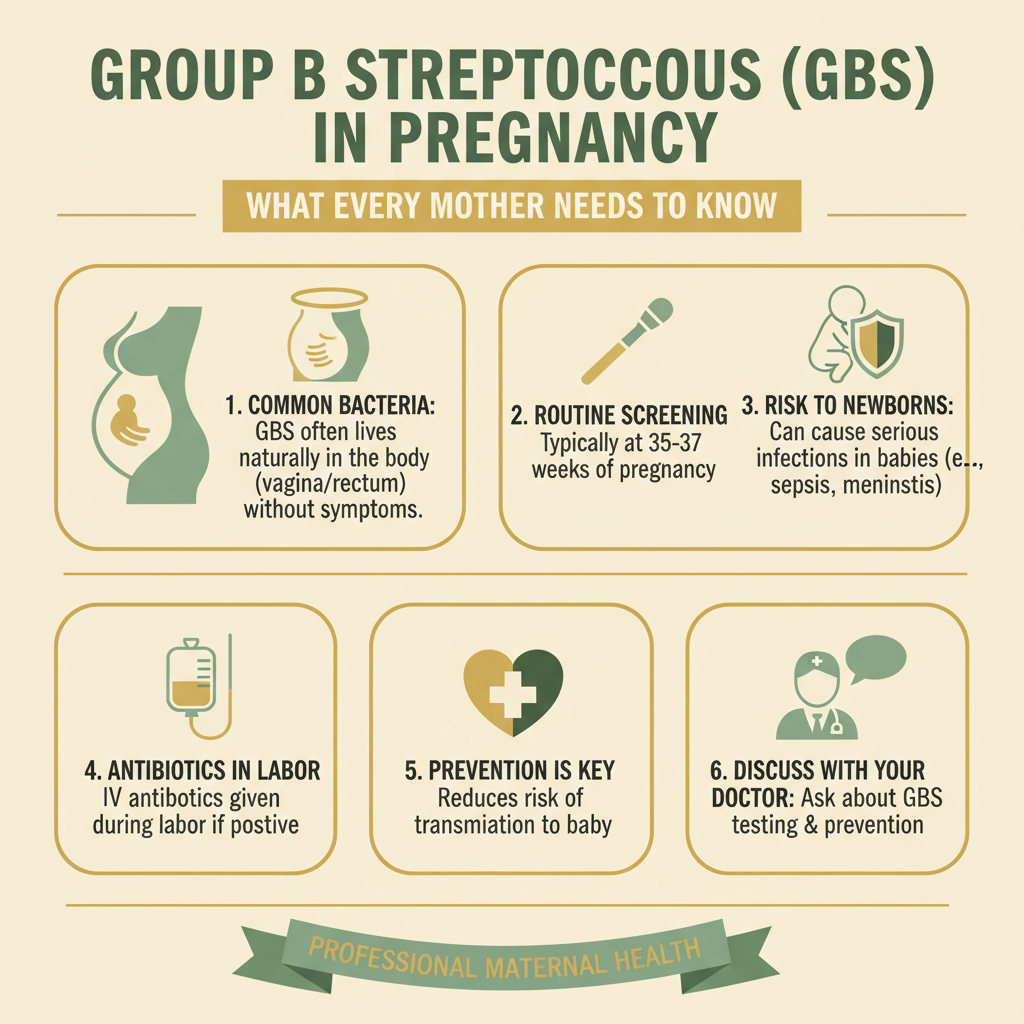
In pregnant women, GBS colonisation rates range from 10–40% depending on the population studied, making it one of the most commonly identified organisms in routine prenatal screening. The key distinction that every mother must understand is this: colonisation is not the same as infection. Being colonised simply means the bacterium is present; it does not mean you are ill, and in the vast majority of cases, it will not cause you any symptoms whatsoever.
Why Does GBS Matter During Pregnancy and Labour?
The clinical concern arises during labour. As your baby passes through the birth canal, they may be exposed to GBS. For most babies, this exposure is inconsequential. However, in approximately 1–2 per 1,000 births, GBS can cause early-onset neonatal disease — a serious condition that can present as sepsis, pneumonia, or meningitis within the first seven days of life. Late-onset GBS disease (occurring between 7 days and 3 months of age) is less common but equally serious.
Certain risk factors increase the likelihood of transmission and neonatal infection:
- Labour before 37 weeks gestation (preterm birth)
- Prolonged rupture of membranes (more than 18 hours before delivery)
- Fever during labour
- A previous baby affected by GBS disease
- High bacterial load on GBS screening
The Microbiome Connection
Here is where the science becomes particularly compelling, and where my work with PregBiotics begins. Research published in Frontiers in Microbiology and other peer-reviewed journals has demonstrated that vaginal microbiome composition plays a direct role in GBS colonisation rates. Women with a Lactobacillus-dominant vaginal microbiome — particularly Lactobacillus crispatus — show significantly lower rates of GBS colonisation compared to those with more diverse or dysbiotic vaginal flora.
This is not coincidental. Lactobacillus species produce lactic acid and hydrogen peroxide, creating an acidic vaginal environment that is actively hostile to GBS. A robust, healthy microbiome is, in effect, a biological shield. And that understanding forms the foundation of everything we do with the GBS Shield Protocol.
What GBS Means for You Practically: Navigating Screening, Results & Risk
How GBS Screening in Pregnancy Works
In most countries, GBS screening in pregnancy is offered between 35 and 37 weeks of gestation. The test involves a simple swab of the lower vagina and rectum, which is then sent to a laboratory for culture. Results are typically available within 24–48 hours.
It is important to know that GBS colonisation can change over time — a negative result earlier in pregnancy does not guarantee you will be negative at term, and a positive result does not mean you will still be colonised at delivery. This transient nature of colonisation is one reason why timing of screening matters so much.
In the United Kingdom, universal GBS screening is not currently part of the NHS antenatal programme, though the NHS provides guidance on risk-based approaches and private testing options. In the United States, the CDC and ACOG recommend universal culture-based screening at 35–37 weeks.
What Happens If You Test Positive?
A positive GBS result typically leads to the recommendation of intrapartum antibiotic prophylaxis (IAP) — intravenous penicillin (or an alternative if you have a penicillin allergy) administered during labour. IAP has been shown to reduce the risk of early-onset GBS disease in newborns by approximately 80%, making it a highly effective intervention.
Here is what this means for you in practice:
- You will need to go to the hospital promptly when labour begins or membranes rupture, to allow time for at least one dose of antibiotics before delivery
- Planned caesarean sections in women who are GBS-positive do not require antibiotic prophylaxis unless labour begins or membranes rupture beforehand
- Your birth plan may need to accommodate IV access during labour — discuss this with your midwife or obstetrician in advance
- Breastfeeding is still encouraged and safe — GBS is not transmitted through breast milk
- Your baby will be observed for at least 12 hours after birth for signs of infection
Emotional Wellbeing Matters Too
I want to acknowledge that receiving a positive GBS result can feel frightening, even with reassurance. It is completely understandable to feel anxious. Please do not hesitate to ask your healthcare provider to walk you through your specific risk profile and birth plan. Knowledge is genuinely empowering here — and the more informed you are, the more confident you will feel heading into labour.
The Role of Nutrition, Gut Health & Supplementation in GBS Prevention
This is the section I am most passionate about sharing with you — because it represents the frontier of maternal microbiome medicine, and it is where mothers have genuine agency.
The Gut–Vaginal Microbiome Axis
Your gut microbiome and your vaginal microbiome are in constant conversation. Research published in NCBI has demonstrated that gut bacterial communities significantly influence the composition of the vaginal flora — a pathway sometimes referred to as the gut–vaginal axis. This means that supporting your gut health during pregnancy is not just about digestion; it has direct implications for vaginal microbiome diversity and, by extension, GBS colonisation risk.
Probiotics and GBS: What Does the Evidence Say?
Multiple clinical studies have investigated the role of probiotic supplementation in reducing GBS colonisation rates in pregnant women. A landmark randomised controlled trial found that oral supplementation with Lactobacillus rhamnosus GR-1 and Lactobacillus reuteri RC-14 was associated with a statistically significant reduction in GBS vaginal colonisation in pregnant women by the third trimester. While research is ongoing and probiotics GBS prevention should not be positioned as a replacement for medical care, the evidence base is genuinely encouraging.
Introducing the GBS Shield Protocol
At PregBiotics, we developed the GBS Shield protocol specifically in response to the growing body of evidence linking microbiome health to GBS outcomes. It is a structured, trimester-aware supplementation programme designed to:
- Restore and reinforce Lactobacillus-dominant vaginal flora through evidence-based probiotic strains
- Support gut microbiome diversity to enhance the gut–vaginal axis
- Provide key micronutrients that support immune function and mucosal barrier integrity during pregnancy
The GBS Shield Protocol includes a curated combination of the following:
- Lactobacillus crispatus — the dominant protective species in a healthy vaginal microbiome
- Lactobacillus rhamnosus GR-1 — studied extensively for vaginal health and GBS colonisation reduction
- Lactobacillus reuteri RC-14 — clinically validated probiotic strain for urogenital health
- Lactobacillus acidophilus — supports gut lining integrity and immune modulation
- Vitamin D3 (2000 IU) — essential for immune regulation and antimicrobial peptide production
- Zinc — critical for mucosal immunity and microbiome balance
- Selenium — supports antioxidant defence and innate immune responses
- Prebiotic FOS (fructooligosaccharides) — feeds beneficial bacteria to ensure colonisation and persistence
For mothers already using our PregBiotics Essentials, the GBS Shield Protocol is designed to complement your existing supplement regime seamlessly, not replace it. Together, they offer comprehensive maternal microbiome support from the first trimester through to the postpartum period.
Expert Tips & Actionable Advice for GBS-Positive Mothers (and Those Who Want to Reduce Their Risk)
Having worked with hundreds of pregnant women navigating GBS, here are my most practical, evidence-informed recommendations:
-
Start probiotic support early. Ideally, begin a targeted probiotic protocol in the second trimester — not just when you receive a positive result. Microbiome shifts take time, and earlier intervention gives beneficial bacteria the opportunity to become established before your third-trimester screen.
-
Eat to support your microbiome. A fibre-rich, varied diet feeds the beneficial bacteria in your gut. Prioritise fermented foods (natural yoghurt, kefir, sauerkraut, kimchi), prebiotic-rich vegetables (garlic, onion, leeks, asparagus), and diverse plant sources. Reduce ultra-processed foods and excess sugar, which feed less desirable microbial communities.
-
Stay well hydrated. Adequate hydration supports mucosal barrier integrity throughout the gut and urogenital tract — a foundational layer of immune defence.
-
Avoid unnecessary antibiotic use before labour. While antibiotics are absolutely appropriate when medically indicated, unnecessary courses disrupt the vaginal and gut microbiome significantly. Always take antibiotics as prescribed — but discuss with your provider whether any non-urgent antibiotic treatment can be appropriately timed.
-
Know your GBS test timing. If you are in the UK and considering private GBS screening (via the Group B Strep Support charity), the enriched culture medium (ECM) test is considered more sensitive than standard NHS swabs. Timing the test between 35–37 weeks gives the most clinically relevant result.
-
Prepare your birth plan. If you are GBS-positive, discuss with your midwife or obstetrician exactly what happens at the onset of labour, when to go to hospital, and how IV antibiotics will be administered. Having a clear plan reduces anxiety significantly.
-
Consider a postpartum probiotic reset. Intrapartum antibiotics, while life-saving, will inevitably disrupt your microbiome. Supporting gut and vaginal flora restoration after delivery benefits both you and your breastfeeding baby. Ask us about our postpartum protocol.
-
Do not self-treat or delay medical care. Probiotics and nutrition are complementary strategies — they are part of a whole-person approach to maternal health, not a substitute for the medical management your clinical team recommends.
When to Seek Medical Advice Immediately
While the vast majority of GBS-positive pregnancies proceed without complication when appropriately managed, there are specific circumstances in which you must contact your healthcare provider without delay:
- Your membranes rupture (waters break) at any stage — contact your maternity unit immediately
- You go into labour before 37 weeks — preterm labour with GBS colonisation requires urgent assessment
- You develop a fever during labour — this is a significant risk factor for GBS transmission to your baby
- Your baby shows any signs of illness in the days following birth, including unusual breathing, poor feeding, high temperature, limpness, or inconsolable crying
- You have previously had a baby affected by GBS disease — ensure your entire care team is aware of this history from the very beginning of your pregnancy
The NHS GBS information page and your lead maternity carer are your first points of contact. Please never hesitate to reach out — there is no such thing as a question that is too small when it comes to your baby's wellbeing.
Conclusion: You Are Better Protected Than You Think
Group B Streptococcus is one of those topics that can feel enormous and frightening the first time you encounter it. But I hope that by the end of this article, it feels significantly more manageable — because the truth is, it is.
You now understand that GBS colonisation is common, that it is not your fault, and that effective medical management through intrapartum antibiotics dramatically reduces the risk to your newborn. You also understand something that far too few mothers are told: that your microbiome is not passive in this story. A Lactobacillus-dominant vaginal environment, supported by a healthy gut microbiome, is a genuine biological defence against GBS colonisation — and that is something you have meaningful influence over.
The GBS Shield Protocol was built on this science, and for the mothers I work with, it represents an empowering, proactive step they can take alongside the excellent medical care they receive from their clinical teams.
Your body is extraordinary. Your instinct to learn, prepare, and advocate for yourself and your baby is exactly the right one. Keep asking questions, keep seeking evidence, and know that at PregBiotics, we are always here to support you with science you can trust.
For more evidence-based guidance on maternal gut health throughout pregnancy and beyond, explore The PregBiotics Journal — our growing library of articles, expert Q&As, and research summaries written for mothers who want to understand the why behind their wellbeing.
Dr. Chomba Chuma, MD, is the Founder of PregBiotics and a specialist in maternal microbiome medicine. This article is intended for educational purposes and does not constitute personal medical advice. Always consult your healthcare provider regarding your individual pregnancy care.
Get the PregBiotics Journal in your inbox
Gut-smart guidance for conception, pregnancy and breastfeeding — twice a week, plus member-only offers. Unsubscribe anytime.
You deserve to feel beautifully supported.
Join thousands of mothers on the PregBiotics journey. Receive your free Pregnancy Prep Guide and gentle, science-backed wisdom — tailored to where you are right now.