Group B Streptococcus in Pregnancy: What Every Mother Needs to Know About GBS Screening, Prevention, and Gut Health
Imagine this: you are 36 weeks pregnant, glowing, exhausted, and counting down the days. Your midwife mentions a routine swab test — Group B Strep screening — and hands you a leaflet. You glance at it, tuck it into your hospital bag, and move on. Most mothers do. Yet Group B Streptococcus (GBS) is t
Dr. Chomba Chuma, MD & Founder
MD & Founder, PregBiotics

Group B Streptococcus in Pregnancy: What Every Mother Needs to Know About GBS Screening, Prevention, and Gut Health
By Dr. Chomba Chuma, MD & Founder | PregBiotics Journal
Introduction
Imagine this: you are 36 weeks pregnant, glowing, exhausted, and counting down the days. Your midwife mentions a routine swab test — Group B Strep screening — and hands you a leaflet. You glance at it, tuck it into your hospital bag, and move on. Most mothers do. Yet Group B Streptococcus (GBS) is the leading cause of life-threatening infection in newborns in the developed world, responsible for an estimated 1 in every 2,000 births resulting in a seriously ill baby in the UK alone.
Here is what makes this even more striking: approximately 20–30% of all pregnant women carry GBS naturally in their gut, rectum, or vagina — with no symptoms whatsoever. You may be one of them and have no idea.
That does not make you unwell. It does not mean something has gone wrong. But it does mean that understanding GBS in pregnancy, what GBS screening during pregnancy involves, and what you can actively do to support your body's defences is one of the most important things you can do in your third trimester.
In this article, I want to walk you through exactly what Group B Strep is, how it affects pregnancy, what the science says about gut health and GBS, and how our GBS Shield Protocol was designed to give mothers a science-backed, proactive tool to stand alongside medical care — not replace it.
Let us begin.
Understanding Group B Streptococcus: The Science Behind the Bacteria
What Is GBS?
Group B Streptococcus — formally known as Streptococcus agalactiae — is a gram-positive bacterium that lives harmlessly in the gastrointestinal tract of most people. It is part of what microbiologists call the "commensal" microbiome: bacteria that coexist with us without causing disease under normal circumstances.
During pregnancy, however, the stakes change. If a mother carries GBS in her vaginal or rectal flora at the time of labour, there is a real risk of transmission to the newborn as they pass through the birth canal. Neonatal GBS infection can lead to sepsis, pneumonia, and meningitis — conditions that are serious, fast-moving, and require urgent treatment.
Why Pregnancy Changes the Equation
The immune system undergoes a carefully orchestrated modulation during pregnancy. In order to tolerate a genetically foreign fetus, the body partially dials down certain inflammatory immune responses. While this is biologically brilliant, it also means that bacteria which would ordinarily be kept in check may have more opportunity to proliferate, migrate, or cause harm.
Hormonal shifts — particularly rising oestrogen and progesterone — also alter the vaginal microbiome significantly. Research published in Nature Medicine has shown that the vaginal microbiome during pregnancy becomes less diverse and increasingly dominated by Lactobacillus species, which is actually protective. However, this balance can tip if gut dysbiosis is present, allowing GBS to colonise more readily.
How GBS Colonisation Works
GBS colonisation is dynamic — meaning it can come and go. A woman may test negative at 28 weeks and positive at 36 weeks, or vice versa. The primary reservoir is the gut: GBS lives in the bowel and can migrate to the vagina via the perineum. This is precisely why gut health is not a peripheral concern in GBS management — it is central to it.
The Neonatal Risk
According to the World Health Organization, GBS is the leading infectious cause of neonatal mortality and morbidity globally. Early-onset GBS disease (within the first 7 days of life) is most directly linked to maternal colonisation at delivery. Late-onset disease (7–89 days) can also occur and is associated with postnatal transmission, sometimes through breast milk or caregiver contact.
It is important to state clearly: the vast majority of babies born to GBS-positive mothers do not become ill. But for the small percentage who do, the consequences can be severe. This is why understanding and addressing GBS pregnancy risk is so important — not to create fear, but to create informed, empowered action.
What GBS in Pregnancy Means For You: Making the Science Practical
Understanding the biology is one thing. Knowing what it actually means for your pregnancy, your birth plan, and your daily choices is another. Here is what the evidence translates to in practical terms.
GBS Screening in Pregnancy: Know Your Status
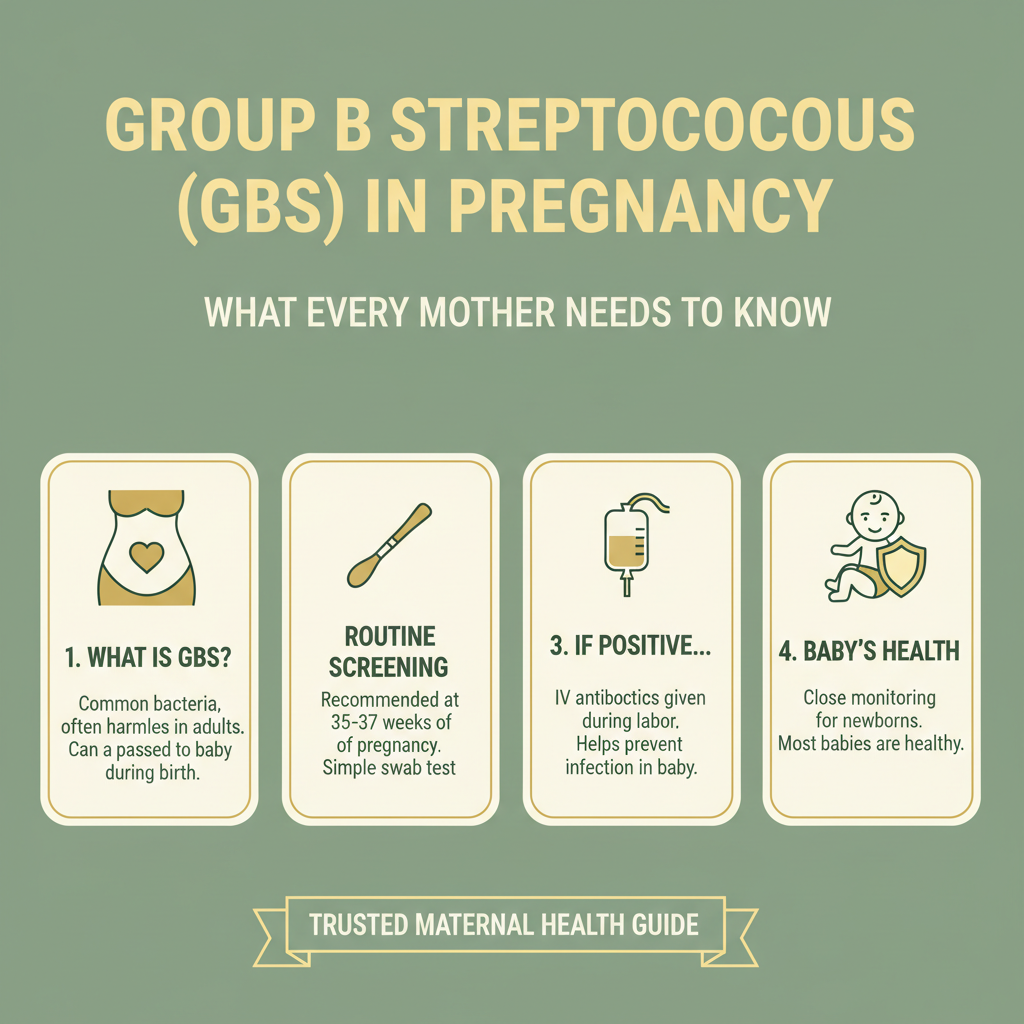
GBS screening in pregnancy is currently offered routinely in many countries, though policies vary:
- United States: Universal GBS screening is recommended at 36–37 weeks gestation, using a combined vaginal-rectal swab.
- United Kingdom: The NHS does not currently offer universal screening, though the Group B Strep Support charity advocates strongly for it. Private testing is available from around 35 weeks.
- Australia & Canada: Universal screening is offered in most regions.
If you are unsure whether you have been screened, ask your midwife or obstetrician directly. You have every right to know your status.
What a Positive GBS Result Means
A positive GBS result does not mean:
- You have an infection
- Your baby will definitely be affected
- You cannot have a natural birth
A positive GBS result does mean:
- You will likely be offered intravenous antibiotics (usually penicillin) during labour, which is highly effective at preventing early-onset neonatal GBS disease
- Your care team will monitor your baby more closely in the first hours after birth
- It is worth having an informed conversation about your birth preferences in the context of your result
Risk Factors That Increase GBS Concern
Certain factors elevate the risk of GBS-related complications beyond routine colonisation:
- Preterm labour (before 37 weeks): The baby's immune system is less developed
- Prolonged rupture of membranes: More than 18 hours before delivery increases exposure time
- Fever during labour: May indicate ascending infection
- Previous baby affected by GBS: Significantly raises risk for subsequent pregnancies
- GBS in the urine during this pregnancy: Indicates heavy colonisation and warrants treatment regardless of swab result
Understanding which category you fall into helps you have a genuinely informed conversation with your care team — not a reactive one.
The Role of Nutrition, Gut Health, and Supplementation in GBS Prevention
This is where I want to speak to you as both a physician and the founder of PregBiotics — because this is the area where so much is being learned, and where mothers have real, meaningful agency.
The Gut-Vaginal Microbiome Axis
One of the most exciting areas of maternal microbiome research is the connection between gut health and vaginal microbial composition. As I mentioned earlier, GBS originates in the gut and migrates to the vaginal and perineal environment. This means that a healthy, balanced gut flora — one where beneficial bacteria are thriving — may make it harder for GBS to take hold and flourish.
Probiotics for GBS are not a replacement for medical screening or intrapartum antibiotics. But the emerging evidence is compelling. A 2017 Cochrane-adjacent systematic review and subsequent research suggest that specific probiotic strains can reduce GBS colonisation rates in pregnant women, likely through competitive exclusion, lowering vaginal pH, and producing antimicrobial compounds like bacteriocins and hydrogen peroxide.
Key Strains and Nutrients That Matter
This is exactly why we formulated the GBS Shield Protocol — a targeted, trimester-appropriate supplement designed specifically to support the maternal microbiome during the critical window when GBS colonisation is most relevant. Here are the core ingredients and what the research says about them:
- Lactobacillus rhamnosus GR-1: One of the most studied probiotic strains for urogenital health; shown to colonise the vaginal tract and inhibit GBS adhesion
- Lactobacillus reuteri RC-14: Works synergistically with GR-1; produces reuterin, a potent antimicrobial compound
- Lactobacillus crispatus: A dominant species in healthy vaginal microbiomes during pregnancy; strongly associated with reduced pathogenic colonisation
- Vitamin D3 (2000 IU): Low vitamin D levels are independently associated with increased GBS colonisation; supports innate immune function
- Garlic extract (Allicin): Emerging evidence for antimicrobial activity against GBS strains in vitro; included at a safe, food-equivalent dose
- Prebiotic FOS (Fructooligosaccharides): Feeds the beneficial bacteria already in your gut, helping them outcompete pathogens
- Folate (Methylfolate form): Essential for cellular immune function and continued fetal neural development
The GBS Shield Protocol is formulated to be taken from 28 weeks of pregnancy through to delivery, and is designed to complement — never replace — standard obstetric care including GBS screening in pregnancy and, where indicated, intrapartum antibiotics.
You can learn more and access our full trimester-by-trimester gut health programme via the Pregnancy Gut Guide.
Expert Tips and Actionable Advice for Managing GBS During Pregnancy
After years in clinical practice and maternal health research, here is my practical, evidence-informed advice for mothers navigating GBS in pregnancy:
-
Get screened — and get screened at the right time. If you are in the UK, ask your midwife about private testing between 35–37 weeks. Timing matters because GBS colonisation is dynamic; a test at 20 weeks tells you little about your status at delivery.
-
Start supporting your gut microbiome early. Do not wait until 36 weeks to think about this. Begin probiotic and dietary support from the second trimester where possible. The gut-vaginal axis takes time to shift.
-
Prioritise a fibre-rich, plant-diverse diet. Aim for 30 different plant foods per week. A diverse gut microbiome is your first line of defence. Foods like garlic, onions, asparagus, oats, and legumes naturally feed beneficial bacteria.
-
Limit unnecessary antibiotic use during pregnancy. Every course of antibiotics during pregnancy disrupts gut flora. Discuss with your provider whether antibiotics are truly necessary when prescribed for non-GBS reasons, and always follow up with probiotics if antibiotics are unavoidable.
-
Do not douche or use vaginal washes. This disrupts the delicate vaginal microbiome, reduces protective Lactobacillus populations, and can paradoxically increase GBS risk. Clean water only.
-
Consider a targeted probiotic protocol. Strains matter enormously — generic supermarket probiotics may not contain the urogenital-specific strains that have shown benefit in GBS research. Look for products containing L. rhamnosus GR-1 and L. reuteri RC-14 specifically.
-
Know your risk factors and plan your birth accordingly. Have an open conversation with your midwife or obstetrician about your GBS status, your risk factors, and what your care pathway looks like. Ask what signs to look out for in your newborn's first 24 hours.
-
Do not let a positive result derail your birth preferences. A GBS-positive result with IV antibiotics in labour is compatible with hypnobirthing, water birth in many units, skin-to-skin immediately after delivery, and breastfeeding. Advocate for yourself with confidence and the right information.
-
Check your vitamin D levels. Vitamin D deficiency is extraordinarily common in pregnancy, particularly in northern latitudes. Supplementing appropriately is one of the simplest immune-supportive things you can do.
-
Trust the process — and your body. Being GBS positive is not a failing. Your body is not broken. With the right information and support, you can navigate this with confidence.
When to Seek Medical Advice
While this article is designed to inform and empower you, it is essential to state clearly: nothing in this article constitutes medical advice, and the GBS Shield Protocol is a nutritional supplement — not a treatment for GBS infection.
Please seek immediate medical attention if:
- You are GBS positive and go into labour before 37 weeks
- Your waters break and you are GBS positive or unscreened
- You develop a fever, chills, or unusual discharge during pregnancy
- You have had a previous baby affected by GBS disease
- GBS is detected in your urine at any point during pregnancy (this requires antibiotic treatment)
In the days following birth, watch your newborn closely for signs of early-onset GBS infection, including:
- Difficulty feeding or unusual lethargy
- High temperature or abnormally low temperature
- Grunting, breathing difficulties, or rapid breathing
- A high-pitched or unusual cry
If you are concerned, contact your midwife, health visitor, or go directly to your maternity triage unit. GBS in newborns is treatable — but speed is everything.
Always work with your healthcare provider to make decisions about GBS screening, treatment, and your birth plan.
Conclusion
Group B Streptococcus is one of those topics that too many mothers only encounter late in pregnancy — or sometimes, heartbreakingly, only after something has gone wrong. My mission with PregBiotics, and with this article, is to change that narrative.
You deserve to understand what is happening in your body during pregnancy. You deserve to know that your gut health and your GBS status are not separate conversations — they are deeply, scientifically connected. And you deserve practical, evidence-based tools to support your wellbeing, alongside the excellent medical care your pregnancy warrants.
The GBS Shield Protocol was not built as a miracle cure or a shortcut around medical screening. It was built because the science shows us that the maternal microbiome is a powerful, modifiable factor in pregnancy health — and mothers should have access to the best evidence-based support available during this window.
If you are in your third trimester right now, please speak with your care provider about GBS screening. Explore the gut health science. Nourish your microbiome. And know that being informed, proactive, and supported is one of the greatest gifts you can give your baby before they even arrive.
For more evidence-based guidance on maternal gut health throughout every stage of pregnancy, visit The PregBiotics Journal — your resource for science-backed maternal wellness.
Because informed mothers raise healthier babies. And you are already doing the work.
Dr. Chomba Chuma, MD, is a maternal health physician, microbiome researcher, and Founder of PregBiotics. The information in this article is for educational purposes only and does not replace the advice of your healthcare provider.
Get the PregBiotics Journal in your inbox
Gut-smart guidance for conception, pregnancy and breastfeeding — twice a week, plus member-only offers. Unsubscribe anytime.
You deserve to feel beautifully supported.
Join thousands of mothers on the PregBiotics journey. Receive your free Pregnancy Prep Guide and gentle, science-backed wisdom — tailored to where you are right now.