Group B Streptococcus in Pregnancy: What Every Mother Needs to Know About GBS, Screening & Natural Prevention
Imagine reaching the final weeks of your pregnancy — you've navigated morning sickness, back pain, endless baby name debates — and then your midwife mentions a routine test for something called Group B Streptococcus. Suddenly, you're Googling at midnight, reading alarming statistics, and wondering w
Dr. Chomba Chuma, MD & Founder
MD & Founder, PregBiotics

Group B Streptococcus in Pregnancy: What Every Mother Needs to Know About GBS, Screening & Natural Prevention
By Dr. Chomba Chuma, MD & Founder | PregBiotics Journal
Introduction
Imagine reaching the final weeks of your pregnancy — you've navigated morning sickness, back pain, endless baby name debates — and then your midwife mentions a routine test for something called Group B Streptococcus. Suddenly, you're Googling at midnight, reading alarming statistics, and wondering why nobody told you about this sooner.
You are not alone. Every year, approximately 1 in 4 pregnant women in the UK and US carry Group B Streptococcus (GBS) — a common bacterium that lives harmlessly in the gut and vagina of many adults, yet poses a potentially serious risk to newborns during birth. In fact, GBS is the leading cause of life-threatening infection in newborns in high-income countries, responsible for conditions including neonatal sepsis, meningitis, and pneumonia.
The good news? When detected early and managed appropriately, the risks to your baby can be significantly reduced. And emerging science now points to something even more exciting: the state of your maternal gut microbiome may play a meaningful role in GBS colonisation — opening the door to proactive, evidence-informed strategies that go beyond antibiotics alone.
In this article, I'm going to walk you through everything you need to know about GBS in pregnancy — from the biology and screening process, to what it means practically for your birth plan, to the role that targeted nutrition and supplementation can play in supporting your microbiome health during this critical window. Knowledge is empowerment, and my goal is to leave you feeling informed, confident, and prepared.
Understanding Group B Streptococcus: The Science Behind the Bacteria
What Exactly Is GBS?
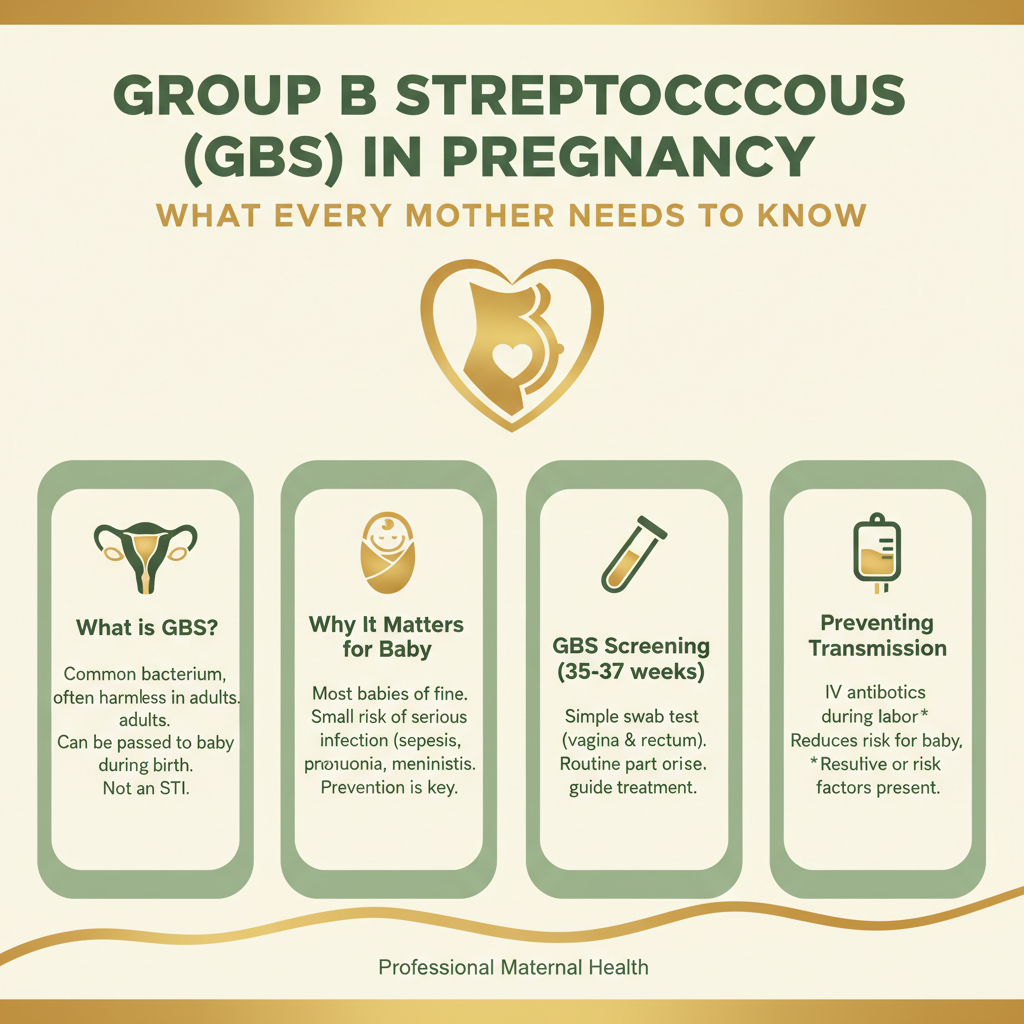
Group B Streptococcus (Streptococcus agalactiae) is a gram-positive bacterium that naturally colonises the gastrointestinal and genitourinary tracts of healthy adults. In most women, it causes absolutely no symptoms whatsoever — no odour, no discharge, no discomfort. This is precisely what makes it both common and clinically challenging: you cannot feel it, and you cannot see it without a dedicated test.
GBS colonisation is not a sexually transmitted infection, nor is it a sign of poor hygiene or compromised health. It simply reflects the natural diversity of the human microbiome. The bacterium comes and goes — colonisation status can change from week to week, which is one reason why the timing of screening matters.
How Does GBS Affect Newborns?
The primary concern with GBS in pregnancy is vertical transmission — the passing of the bacterium from mother to baby. This most commonly occurs during labour and delivery, as the baby passes through the birth canal and is exposed to vaginal secretions. Transmission can also occur, more rarely, in utero through ascending infection when membranes rupture prematurely.
GBS infections in newborns are categorised as:
- Early-onset GBS disease (EOGBS): Occurs within the first 7 days of life (most commonly within 24 hours). Symptoms include sepsis, respiratory distress, and pneumonia.
- Late-onset GBS disease (LOGBS): Occurs between 7 days and 3 months of age, and is more commonly associated with meningitis. This form is less directly linked to maternal colonisation.
According to Group B Strep Support UK, approximately 340 babies in the UK develop GBS infection each year, with around 19 deaths and 37 survivors left with long-term disabilities. These numbers, while relatively small in absolute terms, carry enormous weight for the families affected.
What Determines Colonisation?
Research published on PubMed/NCBI suggests that maternal microbiome composition is closely linked to GBS colonisation status. Women with lower microbial diversity in the vaginal and gut microbiome — particularly those with reduced populations of Lactobacillus species — appear to have higher rates of GBS colonisation. This makes intuitive biological sense: a healthy, diverse microbiome creates a competitive environment that makes it harder for opportunistic bacteria like GBS to establish a foothold.
Hormonal shifts during pregnancy alter vaginal pH and microbial composition, creating conditions that can favour or inhibit colonisation. This is an active and evolving area of research, but the signals are increasingly clear: the microbiome matters enormously in the GBS equation.
GBS Screening in Pregnancy: What This Means For You
How and When Is GBS Testing Done?
GBS screening in pregnancy involves a simple swab — typically a low vaginal and rectal swab — that is sent to a laboratory for culture. In the United States, routine universal screening is recommended at 35–37 weeks of gestation by the Centers for Disease Control and Prevention (CDC). In the UK, universal screening is not currently standard NHS practice; instead, a risk-factor-based approach is used, though this is an active area of debate and policy review.
If you're in the UK and wish to be tested proactively, you can request a private GBS test or ask your midwife or GP about your risk factors.
Understanding Your Results
- GBS negative: GBS was not detected in the sample at the time of testing. Note that this does not guarantee GBS-free status at delivery, as colonisation can change.
- GBS positive: GBS was detected. This does not mean your baby will be infected — it means appropriate precautions should be discussed with your care team.
- Unknown status: If you go into labour without a known GBS result, your healthcare provider will use clinical risk factors to guide management.
Key Risk Factors for GBS Transmission to Baby
Your healthcare team will consider the following risk factors when making decisions about intrapartum antibiotic prophylaxis (IAP):
- GBS-positive swab in the current pregnancy
- Previous baby affected by GBS infection
- Preterm labour (before 37 weeks)
- Prolonged rupture of membranes (more than 18 hours before delivery)
- Fever during labour (above 38°C)
- GBS detected in urine during this pregnancy (a sign of heavier colonisation)
If you have one or more of these risk factors, intravenous antibiotics (typically penicillin) are usually recommended during labour. This has been shown to significantly reduce the risk of EOGBS disease.
What About Your Birth Plan?
A positive GBS result does not automatically mean you cannot have your preferred birth experience. Many GBS-positive women deliver vaginally, have water births, and achieve the experiences they hoped for. The key is early, open communication with your midwifery team and consultant. If you've been considering a home birth, this will require a specific conversation about the logistics of antibiotic administration. Don't be afraid to ask questions — this is your birth, and your care team is there to support you.
The Role of Nutrition & Supplementation in Supporting GBS Health
This is where science meets proactive self-care, and where I believe we can offer mothers something genuinely empowering.
The relationship between the gut microbiome and GBS colonisation is no longer speculative — it is supported by a growing body of peer-reviewed evidence. A systematic review published in the journal Frontiers in Cellular and Infection Microbiology found that Lactobacillus-dominant vaginal microbiomes were associated with significantly lower rates of GBS colonisation. Given that the gut and vaginal microbiomes are closely connected — sharing bacterial populations through the gut-vaginal axis — nurturing gut health during pregnancy may contribute meaningfully to reducing colonisation risk.
This is the foundation on which we built the GBS Shield Protocol at PregBiotics.
Introducing the GBS Shield Protocol
The GBS Shield is a targeted, trimester-specific supplementation and dietary protocol designed to support a healthy maternal microbiome during pregnancy — with particular attention to the bacterial balance relevant to GBS colonisation. It is not a replacement for medical screening or intrapartum antibiotics where indicated. Rather, it is a science-led complement to conventional care that empowers mothers to take an active role in their microbiome health.
The protocol includes:
- Lactobacillus rhamnosus GR-1: One of the most clinically studied strains for vaginal microbiome health. Research demonstrates its ability to colonise the vaginal tract following oral supplementation and to reduce GBS colonisation in some studies.
- Lactobacillus reuteri RC-14: Frequently paired with GR-1 in vaginal microbiome research; supports a healthy vaginal pH and competes with pathogenic bacteria.
- Lactobacillus acidophilus NCFM: A robust gut microbiome strain that supports the gut-vaginal axis and immune function.
- Vitamin D3 (2000 IU): Immune regulation and antimicrobial peptide production are both influenced by vitamin D status; deficiency has been linked to higher GBS colonisation rates.
- Zinc: Supports immune surveillance and epithelial barrier integrity.
- Prebiotic FOS (Fructooligosaccharides): Feeds and sustains the beneficial bacterial strains above, improving their colonisation efficiency.
Dietary Foundations That Support the Protocol
No supplement works in isolation. The GBS Shield Protocol works best alongside:
- A diet rich in fermented foods (live yoghurt, kefir, sauerkraut, kimchi)
- High fibre intake from vegetables, legumes, and wholegrains
- Reduced refined sugar consumption (sugar promotes dysbiosis and may facilitate GBS overgrowth)
- Adequate hydration to support mucosal immunity
Expert Tips & Actionable Advice for Every Pregnant Mother
Whether you've just received a positive GBS result, are preparing for your third-trimester screening, or simply want to be proactive, here are my most important evidence-informed recommendations:
-
Ask for GBS screening proactively. If you're in the UK, don't assume routine screening will be offered. Speak to your midwife or GP about your individual risk factors and, if appropriate, consider private testing between 35–37 weeks.
-
Start microbiome support early. The gut microbiome doesn't change overnight. If you want to optimise your microbial environment ahead of delivery, begin a targeted probiotic protocol in the second trimester — ideally by 20 weeks — to allow time for meaningful colonisation.
-
Review your antibiotic history. Previous courses of antibiotics, including for dental work or UTIs, can deplete beneficial bacteria and increase dysbiosis risk. Discuss this history with your healthcare provider and consider additional microbiome support.
-
Don't skip the diet piece. Probiotics in supplement form are meaningfully more effective when you're also consuming prebiotic-rich foods. Think of the beneficial bacteria as seeds — your diet is the soil.
-
Have the GBS conversation with your birth team before 36 weeks. Whether you're planning a hospital birth, birth centre, or home birth, discuss what a positive result would mean for your specific birth plan. Knowing the protocol in advance reduces anxiety enormously.
-
Avoid unnecessary use of antiseptic vaginal washes. These products disrupt the natural vaginal microbiome and can actually worsen dysbiosis, potentially increasing susceptibility to GBS colonisation.
-
Manage stress actively. Chronic stress alters gut permeability and microbiome composition through the gut-brain axis. Prioritise sleep, gentle movement, and evidence-based stress reduction such as mindfulness or prenatal yoga.
-
If prescribed IAP (intrapartum antibiotics), plan your postnatal microbiome recovery. Antibiotics save lives in this context — take them if indicated. But do discuss postnatal probiotic supplementation for both yourself and your baby, as IAP will affect both microbiomes. Our Pregnancy Gut Guide includes a full postnatal microbiome reset protocol.
-
Check your vitamin D levels. Ask your GP or midwife to include vitamin D in your routine bloods. Supplementing to optimal levels (75–150 nmol/L) supports immune function throughout pregnancy and into the postnatal period.
-
Trust your instincts and advocate for yourself. If something doesn't feel right, or if you feel your concerns aren't being heard, seek a second opinion. You are your baby's first advocate.
When to Seek Urgent Medical Advice
While this article is designed to inform and empower, I want to be absolutely clear: Group B Streptococcus is a medical condition that requires proper clinical management. No supplement, dietary change, or natural protocol replaces the guidance of a qualified healthcare professional.
Please contact your midwife, GP, or maternity unit immediately if:
- You go into labour before 37 weeks and do not know your GBS status
- Your waters break and labour has not started within a few hours
- You develop a fever, chills, or feel generally unwell during labour
- Your newborn shows signs of illness within the first few days of life — including poor feeding, unusual breathing, high or low temperature, or marked irritability
- You have concerns about GBS and your care team has not discussed screening or management with you
The NHS GBS guidance provides clear information on when to seek urgent care, and I encourage every mother to familiarise herself with the warning signs in both herself and her newborn.
Supplementation and microbiome support are valuable tools in your maternal health toolkit — but they work alongside medical care, never instead of it.
Conclusion: Informed, Empowered, and Prepared
Group B Streptococcus is one of those topics that tends to arrive late in pregnancy conversations, often when women are already navigating an overwhelming amount of information. My hope is that this article has changed that experience for you — that you now feel genuinely informed about what GBS is, why screening matters, and what proactive steps you can take to support your body's natural defences.
The science is clear that the maternal microbiome plays a meaningful role in GBS colonisation — and that means you have more agency in this picture than you might have thought. Through targeted probiotic support, dietary optimisation, and early, open conversations with your care team, you can approach your third trimester with confidence rather than anxiety.
The GBS Shield Protocol was created because I believe that every mother deserves access to evidence-led tools that complement the best of conventional medicine. It is not a miracle cure. It is a carefully formulated, science-backed protocol designed to do one thing well: support your microbiome so that your body is in the best possible position as you approach birth.
If you found this article helpful, I'd encourage you to explore more evidence-based maternal health content at The PregBiotics Journal, where we cover everything from gut health in the first trimester to postnatal microbiome recovery.
You are growing a life. Your health matters just as much as your baby's — and the two are more connected than you may realise.
With warmth and science, Dr. Chomba Chuma, MD Founder, PregBiotics
Disclaimer: This article is for informational purposes only and does not constitute medical advice. Always consult your healthcare provider regarding any aspect of your pregnancy, health, or supplementation.
Get the PregBiotics Journal in your inbox
Gut-smart guidance for conception, pregnancy and breastfeeding — twice a week, plus member-only offers. Unsubscribe anytime.
You deserve to feel beautifully supported.
Join thousands of mothers on the PregBiotics journey. Receive your free Pregnancy Prep Guide and gentle, science-backed wisdom — tailored to where you are right now.