Group B Streptococcus in Pregnancy: What Every Mother Needs to Know About GBS, Screening & Prevention
Imagine reaching 36 weeks of pregnancy — your nursery is ready, your hospital bag is packed, and you feel closer than ever to meeting your baby. Then, at a routine prenatal appointment, your midwife mentions a swab test for something called Group B Streptococcus. You nod, but quietly wonder:
Dr. Chomba Chuma, MD & Founder
MD & Founder, PregBiotics

Group B Streptococcus in Pregnancy: What Every Mother Needs to Know About GBS, Screening & Prevention
By Dr. Chomba Chuma, MD & Founder | PregBiotics Journal
Introduction
Imagine reaching 36 weeks of pregnancy — your nursery is ready, your hospital bag is packed, and you feel closer than ever to meeting your baby. Then, at a routine prenatal appointment, your midwife mentions a swab test for something called Group B Streptococcus. You nod, but quietly wonder: What exactly is GBS? Should I be worried? And is there anything I can do?
If that scenario resonates with you, you are not alone. Group B Streptococcus — or GBS — is one of the most common yet least-discussed concerns in pregnancy care. Here is the statistic that tends to stop people in their tracks: approximately 1 in 4 pregnant women carry GBS bacteria in their gut or vaginal tract at any given time, often without a single symptom. In the UK, around 700 babies per year develop GBS infection — a figure that, while relatively small, carries enormous consequences for the families involved.
The good news? Knowledge is power. Understanding what GBS is, how GBS screening in pregnancy works, what your results mean, and what practical steps you can take — including the emerging role of probiotics and gut health — puts you firmly in the driver's seat of your own prenatal care.
In this article, I want to walk you through the science of GBS in pregnancy in a way that is clear, honest, and empowering. We will cover the biology behind GBS colonisation, what routine screening involves, how your gut microbiome plays a surprisingly central role, and how targeted nutrition and supplementation — including our GBS Shield Protocol — can form part of a proactive approach to maternal and newborn health.
Let us start at the beginning.
Understanding Group B Streptococcus: The Science Behind the Bacteria
What Is GBS?
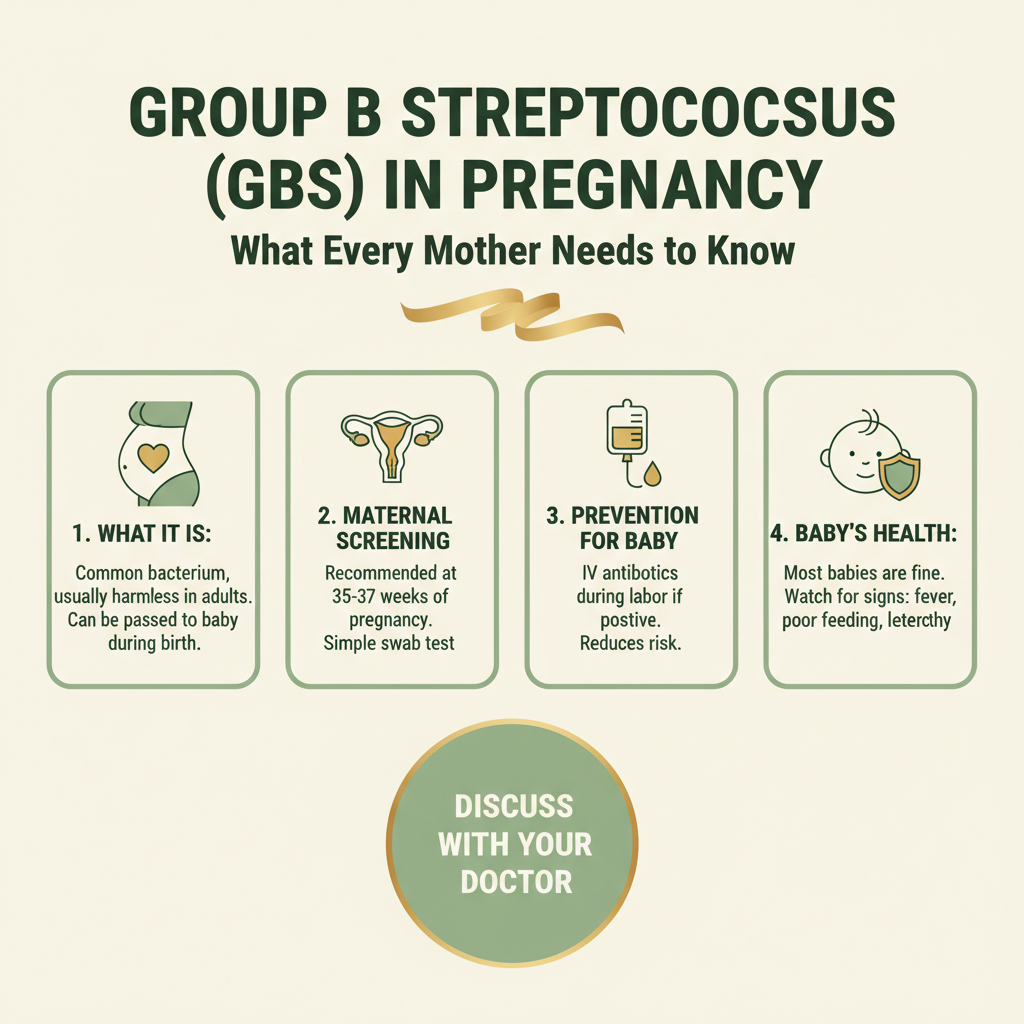
Group B Streptococcus (Streptococcus agalactiae) is a gram-positive bacterium that lives naturally and harmlessly in the gastrointestinal and genitourinary tracts of many healthy adults. It is not a sexually transmitted infection, it is not caused by poor hygiene, and carrying it does not mean something has gone wrong in your body. It is simply part of the complex bacterial landscape that inhabits all of us.
However, during pregnancy and labour, the picture changes. As a baby passes through the birth canal, they can be exposed to GBS bacteria. In most cases, nothing harmful happens. But in a small and unpredictable number of newborns — particularly those born prematurely, or where labour is prolonged — GBS can cause serious early-onset infections including sepsis, pneumonia, and meningitis, conditions that require urgent treatment and can have lifelong consequences.
How Does GBS Colonisation Work?
GBS colonisation is dynamic. This means a woman may test positive at one point in pregnancy and negative at another — or vice versa. The bacteria reside most commonly in the lower gastrointestinal tract, and from there can colonise the vaginal and rectal areas. This is precisely why the relationship between your gut microbiome and GBS status is more important than most people realise.
Research published in Frontiers in Microbiology has demonstrated that the composition of the maternal vaginal and gut microbiome significantly influences GBS colonisation patterns. Women with a Lactobacillus-dominant vaginal microbiome — particularly species such as Lactobacillus crispatus — show markedly lower rates of GBS colonisation. This is thought to be due to the production of lactic acid and hydrogen peroxide, which create an inhospitable environment for pathogenic organisms like GBS.
Risk Factors for GBS Colonisation
Several factors are associated with higher rates of GBS carriage and increased risk of transmission:
- Previous baby affected by GBS infection
- GBS detected in urine during current pregnancy (bacteriuria)
- Premature labour (before 37 weeks)
- Prolonged rupture of membranes (waters breaking more than 18 hours before delivery)
- Fever during labour
- Multiple pregnancy
- Reduced gut microbial diversity — an emerging and increasingly important factor
Understanding your personal risk profile is the first step in having an informed conversation with your care team.
What GBS Means For You: Screening, Results & Next Steps
GBS Screening in Pregnancy: What to Expect
In the United Kingdom, routine GBS screening is not currently offered universally on the NHS, although this remains a topic of active debate and research. In the United States, universal screening is standard practice between 36 and 37 weeks of gestation, using a combined vaginal-rectal swab. Privately funded GBS testing is available in the UK through organisations such as Group B Strep Support (GBSS), and many mothers choose to self-fund this at around 35–37 weeks.
If you are unsure whether you will be screened or whether to request a test, here is what I recommend:
- Ask your midwife or obstetrician explicitly about GBS testing at your 28-week appointment
- Consider private testing if you have any of the risk factors listed above
- Understand that a negative result at 35–37 weeks gives the best predictive value for your GBS status at delivery — earlier tests are less reliable
What Do Your Results Mean?
- GBS negative: Reassuring, but colonisation can still occur before delivery. Continue with standard care and remain alert to any signs of early labour or membrane rupture.
- GBS positive: This does not mean your baby will be harmed. It means your care team will offer Intrapartum Antibiotic Prophylaxis (IAP) — intravenous antibiotics (typically penicillin) given during labour — which reduces the risk of early-onset GBS disease in newborns by approximately 80%.
The Antibiotic Dilemma
While IAP is highly effective and I absolutely support its use as a clinical tool, it is worth acknowledging the broader picture. Broad-spectrum antibiotic use during labour affects not only GBS bacteria, but the entire developing microbiome of the newborn. Research from the NCBI highlights that intrapartum antibiotics are associated with reduced gut microbial diversity in infants, with potential downstream implications for immune development and allergy risk.
This is not an argument against IAP — the protection it offers against GBS disease far outweighs these concerns in GBS-positive mothers. But it is a powerful argument for doing everything we can before and after labour to support both maternal and infant microbiome health. And this is where nutrition, probiotics, and targeted supplementation become genuinely important.
The Role of Nutrition, Gut Health & Supplementation in GBS Prevention
This is the section I feel most passionate about sharing with you, because it represents the intersection of cutting-edge microbiome science and practical, actionable maternal health care.
The gut microbiome is not a passive bystander in GBS pregnancy outcomes. It is an active participant. A diverse, Lactobacillus-rich microbiome creates a protective biological environment that actively resists colonisation by pathogenic bacteria. Think of it as your body's first line of natural defence.
What the Research Tells Us About Probiotics and GBS
Several studies have now investigated the role of specific probiotic strains in reducing GBS colonisation. A landmark study published in Infectious Diseases in Obstetrics and Gynecology demonstrated that Lactobacillus rhamnosus and Lactobacillus reuteri strains were capable of significantly reducing GBS carriage in pregnant women when administered vaginally and orally. While the evidence base continues to develop, the mechanistic rationale is strong — Lactobacillus species produce bacteriocins and organic acids that directly inhibit GBS growth.
The approach I have built into our GBS Shield Protocol at PregBiotics is designed around this exact science — providing targeted probiotic strains alongside key micronutrients shown to support the maternal immune system and microbial balance during the third trimester.
Key Components of a GBS-Supportive Nutritional Protocol
Our GBS Shield Protocol incorporates the following evidence-informed elements:
- Lactobacillus rhamnosus GR-1 — one of the most studied strains for urogenital health, shown to colonise and protect the vaginal microbiome
- Lactobacillus reuteri RC-14 — works synergistically with GR-1 to create a competitive exclusion environment for GBS
- Lactobacillus crispatus — a dominant species in women with naturally low GBS colonisation rates
- Prebiotic fibres (FOS & inulin) — fuel the growth of beneficial Lactobacillus species in the gut
- Vitamin D3 (2000 IU) — low vitamin D levels are associated with both increased GBS colonisation and impaired immune response during pregnancy
- Zinc — essential for maternal immune function and epithelial barrier integrity
- Garlic extract (Allicin standardised) — emerging evidence supports antimicrobial properties against streptococcal species
- Folate (methylated L-5-MTHF) — supports immune competence and foetal neural development simultaneously
Alongside our GBS Shield Protocol, I also recommend exploring our broader PregBiotics Essentials formulation, which provides a comprehensive prenatal micronutrient foundation throughout all stages of pregnancy.
Expert Tips & Actionable Advice: Building Your GBS Prevention Strategy
As a physician and someone who thinks deeply about maternal health every day, I want to leave you with practical steps you can genuinely act on — regardless of whether you are in the early weeks of pregnancy or approaching your third trimester right now.
-
Start gut health optimisation early. The microbiome changes you make in the first and second trimester create the foundation for your third trimester colonisation status. Do not wait until 35 weeks to think about this.
-
Ask for GBS testing explicitly. If you are in the UK, discuss private GBS screening with your midwife. The test is simple, affordable (typically £35–£50), and gives you invaluable information. Visit Group B Strep Support (GBSS) for testing options near you.
-
Eat a fibre-rich, diverse diet. A diet rich in fermented foods (live yoghurt, kefir, sauerkraut), colourful vegetables, legumes, and whole grains actively nurtures the Lactobacillus species that protect against GBS colonisation.
-
Take a targeted probiotic supplement from the second trimester. Not all probiotics are equal. Choose formulations that specifically include the strains Lactobacillus rhamnosus GR-1 and Lactobacillus reuteri RC-14, which have the strongest evidence base for urogenital and GBS-related benefits.
-
Optimise your vitamin D levels. Ask your GP or midwife to check your vitamin D levels at booking. Supplement appropriately — the standard 400 IU recommendation in the UK is widely considered insufficient by maternal health specialists; many of my patients benefit from 1000–2000 IU daily.
-
Know your risk factors. Review the list above. If you have a history of a previous GBS-affected baby, or GBS in urine during this pregnancy, advocate loudly and clearly for IAP during labour.
-
Create a birth plan that addresses GBS. If you test positive, ensure your labour ward team knows you need IV antibiotics as early as possible — ideally at least 4 hours before delivery for maximum protection.
-
Support your newborn's microbiome post-birth. If you received antibiotics during labour, consider infant-specific probiotic drops containing Lactobacillus reuteri or Bifidobacterium longum to support your baby's gut colonisation in the early weeks. I cover this in depth in the Pregnancy Gut Guide.
-
Do not catastrophise a positive result. A GBS-positive result is not a diagnosis of illness — it is information. With appropriate care, the vast majority of GBS-positive mothers deliver healthy, thriving babies.
-
Stay informed and stay connected. Follow emerging research. The microbiome science in this area is moving quickly, and what we know today is only the beginning of a much richer understanding.
When to Seek Medical Advice
While proactive gut health strategies and nutritional supplementation form a meaningful part of a GBS prevention approach, I want to be completely clear: they are complementary to, not a replacement for, standard obstetric care.
Please contact your midwife, obstetrician, or GP urgently if you experience:
- Signs of preterm labour before 37 weeks — including regular tightening, pelvic pressure, or low back pain
- Rupture of membranes at any gestation (your waters breaking or leaking)
- Fever during pregnancy or labour — this can be a sign of infection, including GBS
- Any reduction in foetal movement — always worth a same-day assessment
- Burning or pain when urinating — GBS can cause urinary tract infections in pregnancy that require antibiotic treatment
If you have already tested positive for GBS in a previous pregnancy, have had GBS bacteriuria confirmed, or have a prior history of a GBS-affected newborn, please ensure this is clearly documented in your maternity notes and discussed proactively with your care team at every appointment. Early preparation is everything.
Conclusion: Knowledge, Advocacy & Proactive Care
Group B Streptococcus is one of those topics that, once you understand it, you realise should be spoken about far more openly in prenatal care. It is common, it is manageable, and with the right information, you are far better equipped to navigate it.
Here is what I want you to take away from this article:
GBS is common — approximately 1 in 4 pregnant women carry it. It is often symptomless. GBS screening in pregnancy, whether routine or privately arranged, gives you critical information. Intrapartum antibiotics are highly effective when needed. And your gut microbiome matters enormously — both for your own GBS colonisation status and for the microbial legacy you pass to your newborn.
At PregBiotics, we believe that evidence-based gut health support during pregnancy should be accessible, practical, and deeply personalised. Our GBS Shield Protocol was designed with exactly this philosophy — not to replace medical care, but to work alongside it, empowering your body's own defences during one of the most important biological journeys you will ever take.
You are not a passive recipient of pregnancy care. You are an active, informed participant in it — and that makes all the difference.
For more science-led guidance on maternal gut health, probiotics in pregnancy, and newborn microbiome care, explore the full PregBiotics Journal — where we publish research-backed articles designed to inform and empower mothers at every stage.
With care and science, Dr. Chomba Chuma, MD Founder, PregBiotics
This article is for informational purposes only and does not constitute medical advice. Always consult your registered healthcare provider before starting any new supplement, particularly during pregnancy.
Get the PregBiotics Journal in your inbox
Gut-smart guidance for conception, pregnancy and breastfeeding — twice a week, plus member-only offers. Unsubscribe anytime.
You deserve to feel beautifully supported.
Join thousands of mothers on the PregBiotics journey. Receive your free Pregnancy Prep Guide and gentle, science-backed wisdom — tailored to where you are right now.